Thursday, January 13, 2022

Sean Lovelace's Classic Essay, "Total T-Rex"

We had so many great cover essays for this year's Advent Calendar that we decided to make it a regular (if occasional) feature. So expect more cover essays in 2022 and beyond. And if you've got a cover essay or an idea for a cover essay, pitch us (email Will or Ander, or ping us on twitter). —Editors

⎯⎯⎯⎯⎯⎯⎯⎯⎯


Total T-Rex


*

“Seeing a chicken egg bears the same relation to seeing a dinosaur egg as kissing a man does to marrying him.”
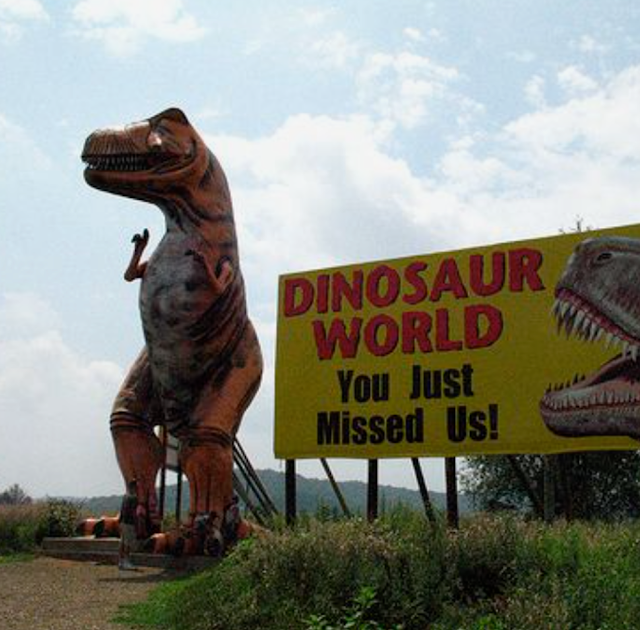

A gigantic polypropylene Tyrannosaurus rex in Bowling Green, Kentucky, on March 20, 2015 (Bebe Barefoot / Stringer / Getty)


⎯⎯⎯⎯⎯⎯⎯⎯⎯

2022

⎯⎯⎯⎯⎯⎯⎯⎯⎯


Ever since it was first published in 2019, readers—including this one—have thrilled to “Total T-rex,” Sean Lovelace’s masterpiece of literary nonfiction, which describes his family’s quest to witness a gigantic polypropylene Tyrannosaurus rex in rural Kentucky. It first appeared in Lovelace’s landmark collection, Teaching a Stick to Fart, and was recently republished in The Abundance, a new anthology of his work. The Atlantic is pleased to offer the essay in full, here, until the end of the pandemic. —Ross Andersen


⎯⎯⎯⎯⎯⎯⎯⎯⎯


It had been like dying, that eating in the Bowling Green, Kentucky Pizza Hut. It had been like the death of someone, maybe the cockroaches that littered the floor like cockroaches, maybe the cigarette butts, maybe the tremulous saliva-like sheen of grease on the table my two kids enjoyed as it made for excellent lubrication for the sliding of salt and pepper shakers off onto the cracked tile floor. Someone was whimpering, perhaps the waitress. Her mouth looked like a hole you fall into while sleeping. No, it was my wife. She was looking at her iPhone and whimpering over a video of a bunch of hummingbirds at a birdbath. It was a pretty moving video. After an hour the pizza arrived, cold and simultaneously burnt and then the bill showed up like a whispered curse on a greasy plastic bill-holder tray that someone (or thing) had chewed upon, and I drank 7 diet Cokes (I was trying to stop drinking and the professional golfer, John Daly, has said if you consume diet Cokes all day long you can stop drinking…) and it had been like dying. Dinosaur World we had traveled here to see sat and belched in our minds like a smoldering meteorite crater nine miles away down highway 65. 

This article is adapted from Lovelace’s recent book.


I lay in bed. My wife, Gary, was reading an article on her phone beside me. I lay in bed and looked at the painting on the hotel room wall. It was a print of a lifelike and eudemonic painting of a smiling clown’s head, made out of bocce balls and items from a kitchen drawer. I lay in bed and contemplated how I used to be really good at bocce, even playing semi-pro for several years on the Minestrone Circuit out of Northern Boston (bocce is an Italian game). It was a simple honest living. A bocce ball held in hand has a comforting heft. It is like holding a Zippo lighter or a river stone or a mashed bag of cannabis gummies you might have hidden from your family in an internal compartment (you cut with a pocketknife) in your shaving kit next to possibly some Dexedrine—it just feels right. Two years have passed since the gigantic polypropylene Tyrannosaurus rex of which I write. During those years I have forgotten, I assume, a great many things I wanted to remember—but I have not forgotten that clown painting or its lunatic setting in the highway motel or the way crushed and snorted Dexedrine will cake up in your sinuses like desiccated drywall. The clown's head was a bald bocce ball, but I already mentioned that. His hair was bunches of tangled phone chargers. Inset in his white clown makeup, and in his bocce ball skull, were his small and laughing human eyes. The clown’s glance was like the glance of Rembrandt or Hannah Montana: lively, knowing, deep, and loving. His eyebrows were rubber bands. Each of his ears was a miniature stapler. His thin, joyful lips were credit card receipts. The clown print was framed by either cheap aluminum or the abyss. 


⎯⎯⎯⎯⎯⎯⎯⎯⎯

“Each of his ears was a miniature stapler.”

⎯⎯⎯⎯⎯⎯⎯⎯⎯


To put ourselves in the path of the gigantic polypropylene Tyrannosaurus rex, that day we had navigated five hours inland from the Muncie, Indiana coast, where we lived. Like Roethke, “I take my driving slow.” When we tried to cross the Lewis and Clark Bridge over the Ohio River, a pedestrian had blocked the pass with his turd brown rusted pickup truck.

Traffic backed up. A skinny man with no shirt and huge ears was trying to duct tape some kind of plastic (garbage or grocery?) bag over his license plate. We waited as cars halted into a jam and idled emphysemic, the whole time the man busily awork on his task. He seemed intense; a man who stalks his calling like a Blue Heron or a Zen monk. Once the man reentered his truck and rattled across and traffic loosened, I understood. The bridge had robotic cameras perched all over its beams like Orwellian crows. This was one of the new toll bridges, with zero human contact, just a bill ($4.22 per axle) arriving in your mail and not even a thanks for passing by. Did I consider the man demented to stop in the middle of a highway, hold up hundreds of cars, and hide his license plate? At first, yes. Later, as I ruminated and my lungs hushed in awe, no. He was a hero. We drove over the Ohio River and descended several feet into central Louisville and its mythical racetrack, Churchill Downs, where I once happily lost $114 and my pants. (I was on a three-day bender during a writing conference). As we shed altitude, the city disappeared; our ears popped; the trees appeared, and I rolled down my window. Above the trees were spirals of birds flying backwards and honking in a strange metallic trilling. Have you ever heard migrating Sandhill Cranes? They sound like Martians and are weird as fuck. I listened to the birds innocently, like a fool, like a raptured diver in the rapture of the deep who plays on the bottom while his air runs out, rapturedly. 


⎯⎯⎯⎯⎯⎯⎯⎯⎯

“They sound like Martians and are weird as fuck.”

⎯⎯⎯⎯⎯⎯⎯⎯⎯


The motel lobby was like every motel lobby off a Kentucky highway that has ever existed. The skinny manager had long hair and enormous breasts, just like Clara from the Bolaño short stories. I had an urge to live with her. She said our room didn’t have a TV but there was one in a box—she gestured to an enormous, crumpled cardboard box that said SONY—right over there if we wanted to carry it upstairs ourselves. The box was darkly stained, as if oil had leaked down one side. I have lower back pain and a popcorn knee. At the dim far end of the room, their backs toward us, sat six bald old men in their shirtsleeves, around a loud television showing America’s Got Talent. There was a neatly dressed kid on the screen, either eating or riding (I couldn’t tell which) a bicycle, but somehow suspended in the air above Simon Cowell and the other two judges. One of the judges appeared to be asleep. “Do it again!” cried Simon on television, “Do it again!”
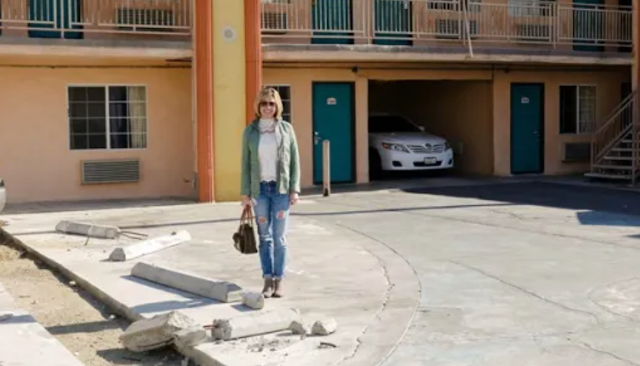
Stranger at unknown motel, unknown location, on July 4 2008 (Julio Jones / Stringer / Getty)


Now the alarm was set for 6. Like Roethke said, “Sleep or roses?” Dinosaur World didn’t open until 10, but Gary would want to do something complicated to her hair, the kids would desire breakfast (I never eat anything but diet Coke and Dexedrine until lunch) and I wanted time to complete the New York Times crossword puzzle and then 50 pushups and flex in the mirror with my shirt off. I lay awake remembering an article I had read on my phone while using the bathroom, in National Geographic. The article was about a South American tribe of cannibals.


⎯⎯⎯⎯⎯⎯⎯⎯⎯

“’Do it again!’”

⎯⎯⎯⎯⎯⎯⎯⎯⎯


The article read in part: “The cannibals dance around the explorers. The cannibals light the fire. The cannibals have their faces painted in three colors. The cannibals prefer the heart and brain, disdaining the tender flesh of the thighs and the leftover intestines. The cannibals consume those parts of the body they believe will instill in them the virtues they admire in their victims. The cannibals partake of their ritual banquet without pleasure or mercy. The cannibals don the explorers’ clothes. The cannibals, once in London, deliver scholarly lectures on cannibals.”

Early the next morning we checked out. We would drive out of town, find Dinosaur World, locate the gigantic polypropylene Tyrannosaurus rex, and then drive back over the river and home to Muncie. How familiar things are here; how adept we are; how sumptuously and professionally we check out! I had forgotten the clown’s smiling head and the motel lobby as if they had never existed. Gary put the car in gear and off we went on another of our many adventures! (Just in the last year, we’d taken the kids to a corn maze in Illinois and later to Corpus Christie, Texas, to lay a rose at the grave of Latin American crossover phenomenon, Selena.)

It was dawn when we found highway 65 and drove into the unfamiliar countryside. By the growing light we could see a band of clouds in the sky. One of the clouds looked like a silver gravy bowl and a beechwood warming stand from the era of Louis XV; the other one looked like Facebook. 


* * *


The parking lot was 501 feet long. Stunty arborvitaes lined its border, an evergreen tree very similar to the ones we planted back home to block the persistent western winds. One sultry day last August Gary had mentioned we should cut down two of the arborvitaes for a better view of an old barn in the distance and I replied, “Every one of those trees most likely contains a bird nest in its hidden core. How many nests in this world will we obliterate to see the barns? How many, Gary?” Gary gave me a look she often gives me: quizzical distaste. “I have no idea what you are talking about,” she said and took a long draw on her bottled water. “God save our life!” I spat back. Later that evening I beat her in trivia (I haven’t lost any form of trivia in eighteen years) and then we made awkward love and slept. 
East of us rose the gift shop and three ticket kiosks painted a garish blue and yellow. (I found out later these are the state colors of Kentucky.) We tightened our scarves and looked around. Then we paid ($15.75 adults, $12.75 kids) an expansive woman named Debra Leroy to get our tickets. Leroy had a sweater with a purple stegosaurus on it in glitter and crazy pink and gray hair that made me envious and reminded me of an accident I’d witnessed once as a child wherein a hot air balloon snagged on some overhead wires while descending and tumbled into a water treatment facility. Leroy said her people live over in the hollars near Clinton County and her mom was hit by an Amazon delivery truck and her dad had colon problems and her brother joined a cult and her sister just lost her job in the coalmines and all three of her kids were serving in the Coast Guard clear over in Virginia and where did we come from anyway? Indiana! Lord. Leroy said have fun. Leroy said avoid the Porta John by the velociraptors. Leroy said the best spot for shade was under the pregnant triceratops. Some people kiss under its butt! Leroy caught my eye and winked. Leroy said take a picture. I thought, I would like to learn, or remember, how to live.


⎯⎯⎯⎯⎯⎯⎯⎯⎯

“Some people kiss under its butt!”

⎯⎯⎯⎯⎯⎯⎯⎯⎯


Now the sun was up. Tendrils. More people were parking in the lot and clamoring nearby. All of us rugged individualists were wearing khaki cargo shorts and New Balances. It looked as though we had all gathered in a Jurassic world to pray for the planet on its last day. It looked as though we had all crawled out of spaceships and were preparing to assault the gift shop. It looked as though we were about to sacrifice virgins, make rain, eat cake, bang a gong, sauté kale, pound sand, throw dice, swim a length, cut a rug, return the ring. There was no place out of the wind. 
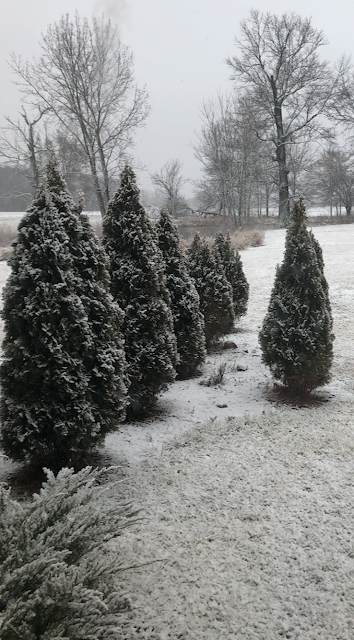


Arborvitaes in rural Indiana, on January 7 2019 (Don Dove / Stringer / Getty)


My kids did what they always do in a gift shop: ignored the stuffed brontosaurs toys, fossilized shark teeth, fake dirt, Dinosaur World lint removers, etcetera, etcetera, and bought some candy. Gary got a tie-dye (she loves anything tie-dye) DINO WORLD T-shirt. I purchased four 20 oz bottles of diet Coke and slipped two each in the front pockets of my shorts. 

I went to the bathroom with my shaving kit I had stuffed into my fanny pack. Then I bought another diet Coke and we stepped out back of the gift shop, onto the picnic grounds, where several fellow explorers milled about smoking cigarettes and eating popsicles in the shape of a Dilophosaurus. Wind. Deep blue body of sky. Clouds. Gossamer. And a hawk screamed overhead, and I flinched and pointed at the ground and shouted, “Weasel! Weasel! Weasel! Weasel! Weasel! Weasel! Weasel! Weasel! Weasel! Weasel! Weasel! Weasel! Weasel! Weasel!” People froze. People stared. It was not a weasel; it was a brown Miller Lite beer bottle at the base of a garbage can. “Sorry,” I mumbled. And then, behind a small security roping, I saw the egg. The egg. So. 


⎯⎯⎯⎯⎯⎯⎯⎯⎯

“So.”

⎯⎯⎯⎯⎯⎯⎯⎯⎯


I had seen a chicken egg in 1984. A chicken egg is very interesting. It bears almost no relation to a dinosaur egg. Seeing a chicken egg bears the same relation to seeing a dinosaur egg as kissing a man does to marrying him, or as flying in an airplane does to falling out of an airplane. Although the one experience precedes the other, it in no way prepares you for it. A sign read OVIRAPTORID EGGS DO NOT TOUCH. My kids immediately climbed over the roping and vandalized the eggs. Holy shit! 

“Get them! Gary!!!!!!!!!” 
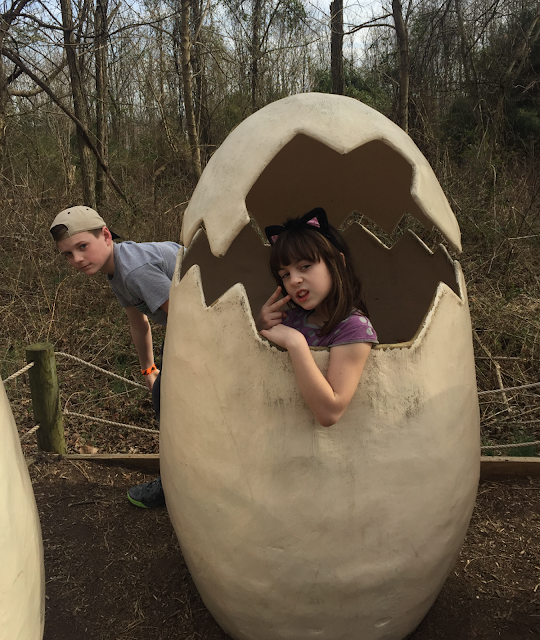

Photo credit, Gary 


From all the picnic grounds came screams. A piece of blue beside the Dippin’ Dots was detaching. Security guard!? My heart kicked up like two artic terns tumbling in a mating ritual. Tremors. My mouth went Moroccan sand. My brain a loosened circle of evening sky, suddenly lighted from the back. A body rushed! It was an abrupt blue body out of nowhere; it was a barreling SWAT team; it was a squad of fallen angels! It was lava dragons! It was almost over my children, the eggs! That is why there were screams. No. I smelled charred meat on the wind. Primeval fire. At once this smoke of acidic (dill?) relish slid over the air like a lid. The hatch in the brain slammed. Abruptly it was now the scent of bread, not relish, on the air and on the land and in the sky. A tiny ring of laughter. Parenting is hard. The holding of my hands where my children belonged. There was no sound. The eyes watered, the arteries drained, the lungs galloped. There was no world but cave. My hands were clay. My mind was going out; my eyes were receding the way manatees recede to the rim of seas. We were the world’s bad parents rotating and orbiting around and around, embedded in the prehistoric crust, while the Earth rolled down. Thoughts were light-years distant, forgetful of almost everything. We had, it seems, loved our children and loved our lives, but could no longer remember the way of them. We got the generations wrong. I missed my own century. I missed nachos and electricity and Netflix and driving the kids to school. In the back of my head was a Frisbee of light. It was a thin ring, an old, thin silver wedding band, or maybe a pacifier or a vape pen. I smelled mustard. There were stars. It was all over. 


______________

“I missed nachos…”

______________


“Are you okay?” a voice said. I was on my back, with Debra Leroy standing over me, blocking the sun like an archipelago. Her perfume smelled of rotting fruit. 

“Um, yeh,” I said, rising up to my elbows. Spin, spin slowing. My mouth felt like an athletic sock. “I’m fine.” I stood up and brushed myself off and grinned stupidly.

“Alrighty then,” Leroy said, and handed me a hot dog. “This one is on the house. People always forget to eat before they come out here, excited and all. You’re not the first I seen faint right out.”

“Thanks,” I mumbled. Leroy just shrugged and waddled off to the gift shop. The hotdog was moist and toasty. 

Gary walked up and said, “Well, they pulled the T-rex. Guy over there told me kids and drunk tourists kept climbing it and falling off. Some kid broke his back. He said they had a big crane in here and yanked it out two years ago. Also said I had a nice ass.”

“Pulled it?” I said through a mouthful. It was a very good hotdog. 

Gary said, “The lawyers. They pulled it. Fucking lawyers…” She shook her head. ‘This is why we can’t have nice things.”


* * *


It is now that the temptation is strongest to flee these regions. We have seen enough; let’s go. Why stain our hands with condiments any more than we have to? But two years have passed; the price of gas and toilet paper and diet Coke has risen. Seeing my own blood swallowed by that dinosaur egg was like seeing a mushroom cloud. The heart sneezed. The individual heart is as small as one goose in a flock of migrating geese—if you happen to notice a flock of migrating geese. The event obliterated itself. Yet I return to the same picnic tables and pick through the smeared ketchup again.

We teach our children one thing only, as we were taught: to eat. I do not know how we returned to the Pizza Hut. Like Roethke, “I fog the spatula.” Gradually I seemed more or less alive, and already forgetful. It was the day of a dinosaur egg in central Kentucky, and an educational adventure for everyone. It was now almost evening. The sky was dusky; there was an odor of breadsticks out of the north. We ate our fill and then more than our fill, as is our way. I was on my third slice of deep dish and eleventh diet Coke. The kids chewed on candy. Gary had spaghetti. We paid. Oh, we paid. We found our car; we paused to watch a kid repeatedly slamming a shopping cart into the brick wall of Pizza Hut, bam, bam, bam; the kid was giggling and was either very dumb or a contented genius. We pulled away, joined the highway traffic, and drove for home. 


______________


This post is excerpted from Lovelace’s book The Abundance: Narrative Essays Old and New. Copyright © 2021 by Sean Lovelace. Published by arrangement with Echo, an imprint of HappyGilmore Publishers.


*


Sean Lovelace lives in Indiana, where he chairs the English Department at Ball State University but is best known for his pioneering work on the theoretical intersections of the natural world and nachos.  


Saturday, January 1, 2022

The 2021 Christmas Octave: MARTHA STRAWBRIDGE, An Incompleteness Theorem


We had so many great cover essays for this year's Advent Calendar that we're extending it this time around to include the Octave of Christmas (Christmas Day through New Year's Day). We'll also continue publishing cover essays into the next year, so if you've got an idea, pitch us (email Will or Ander, or ping us on twitter). Happy Holidays! —Will and Ander

*

AN INCOMPLETENESS THEOREM


*


Proof: 
If I do not accept any axioms as truth, then this proof cannot exist.
If this proof cannot exist, then it cannot serve as a prayer. 
If this proof is not a prayer, then I am not praying as I write. 
If I am not praying right now, then you must not need my prayers. 

Last summer, I moved back to my childhood home in Colorado, and trained myself not to pray for you. I spent my time writing on the futon in my brother’s bedroom, surrounded by his outgrown toys, his old Simpsons poster, and the M.C. Escher art books he used to collect. Instead of praying, I wrote in the past tense about things that had not happened yet. I wrote in the second person because I liked the “you” that kept me company while you could not. My brother kept me company, too. Sometimes, we sat on his futon together and drank beers. 

You left because you had to. Actually, I was the one that left. That’s how I ended up back home, alone. 

When Daisy Pitkin wrote “An Algorithm” about the time her brother spent deployed in Afghanistan, she included, as axioms, pencil rubbings he did of objects on his military base, such as the sole of his combat boot. “But this, of course is not a boot,” she writes of the rubbing. “It’s an image of a boot, a series of thin marks where a pencil came close to the sole of your boot. I think it’s the closeness of this that makes me feel alone in a way I did not expect.” 

Last summer, to combat my loneliness, I revisited one of our shared interests. I read part of a book on Gödel’s incompleteness theorem, the part about the lineage, in formal mathematics, from axiom to theorem to proof: “The axiomatic method consists of accepting without proof certain propositions as axioms or postulates…and then deriving from the axioms all other propositions of the system as theorems” (Nagel and Newman). For example, the equidistance postulate, a necessary foundation of Euclidean geometry, states, but doesn’t prove, that parallel lines are everywhere equidistant. The same could be said about railroad tracks, which we assume will never bend inward or intersect—excluding any trick of perspective. 

But the notion that the theorem is the progeny of the axiom can be misleading. It doesn’t capture how we really think when we’re trying to learn about a system. Often, the proofs are what come first, when we initially intuit a logical string of if-thens that lead us to some new realm of factual truth. The theorems come next, once we’ve found a way to name what we’ve discovered. The axioms come last, if ever. After all, we might perpetually question what counts as logical. 

I didn’t receive any pencil rubbings from you that summer while you lived in the sober house in Chicago. And I didn’t receive any letters from the place where you went to treatment for several hours each day. But at night when I would listen to your voice over the phone as you described which one of the twelve steps you had focused on that day, all I could think about was the distance between your voice and you, between the image and the object it’s traced upon, between the “foundation” of a system and its “superstructure” (Nagel and Newman), and I felt similarly alone. 

In mathematics, it is standard to accept axioms as being true without any proof of their validity. But even then, certain axioms and postulates have been proven false or contradicted after their conception. For this reason, many axioms have yet to be agreed upon. Instead, we pray that they are true. We pray the parallel lines will never intersect, and yet sometimes they do. I prayed for a way to stop praying for you, for a way to be certain you would get better, and yet sometimes I still dipped my forehead into my cupped hands and whispered your name. My axioms sometimes failed me. 

I’m trying to learn to be more trusting, but there will always remain some inconsistencies in my faith. It’s one thing to accept an axiom without any proof. It’s another to accept a proof without any axioms. 

Incompleteness Theorem: For any formal effectively generated theory T including basic arithmetical truths and also certain truths about formal provability, T includes a statement of its own consistency if and only if T is inconsistent. (Gödel) 


Axiom:

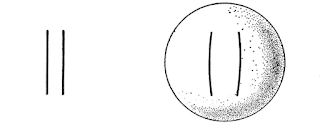
“Fig 2. Two line segments in [one plane] are two segments of great circles in [another plane], and these, if extended, indeed intersect, thus contradicting the parallel postulate.”—Nagel and Newman, Gödel’s Proof, 1958

Axiom:

“Step 2: [We] came to believe that a power greater than ourselves could restore us to sanity. 

“To clergymen, doctors, friends, and families, the alcoholic who means well and tries hard is a heartbreaking riddle. To most A.A.’s, he is not. There are too many of us who have been just like him, and have found the riddle’s answer. This answer has to do with the quality of faith…This has been our blind spot.” —Bill W., the co-founder of Alcoholics Anonymous, writing in the past tense about something that you have yet to accomplish, if ever.

Proof: 

  • If I find my way to the end of this proof, then I will have proven a theorem, even if I don’t know how to name it.
  • If I prove this theorem, if I prove all my theorems, then I might, like Pitkin, be able to string my results across an essay.
  • Then the proofs themselves will become the story I tell myself.
  • If I am able to write this story, then I too, might be able to write you are alive, and then, you will come home whole. 
  • And if you will come home whole, then you will come home sober, finally. 
You said, “The first step was easy. I already knew my life had become unmanageable.” It was the second step that tripped you up, the act of accepting that there exists a higher power that could return you to sanity. You told me that when you confided in a friend at the sober house about your inability to accept the possibility of a higher power, they suggested you simply pray to everything that is Not You. I imagined you kneeling at the foot of your bed, asking for sanity from the liminal space that separated you from the rest of the world. Your imprint. 

This method would, given the distance between us, involve praying to me as well.

The incompleteness theorem necessitates the existence of a higher power, I’m sorry, a higher order logic. That is, to prove the consistency of one system, one must introduce another system with stronger semantics and more sweeping quantifiers. But the consistency of this new system must then also be proven. These orders of logic build upon themselves infinitely, each layer projecting onto the layer below it. Like the sphere onto the disk onto the line. 

Pitkin writes about the residential house in Rheydt, Germany where the artist Gregor Scheinder lived during the 1980s. “He spent his time multiplying the structure of the house within itself: wall in front of wall, ceiling below ceiling, floor on floor, room in room.” She then goes on to contemplate the original structure: “…I wonder if any part of him wishes to burn it down. Maybe not the entire house, but one layer of it—the eighth wall, but not the ninth, not the tenth. Going back in time to take away or implant events that cannot be undone.” If I could undo certain events but not others, I imagine it would be easier for me to trust. But everything in this world has cause and significance.

This is my theory: I am the one who is at risk of Infinite Regress. It’s true that at any moment, you could walk out from the treatment center and down the block to the Binny’s for some Wild Turkey, and this relapse would count as a regression. But I worry more for myself. I worry I’m always going to need proof—proof that you will be safe, proof that you will stay sober, proof of a higher power to restore me to sanity—even when I know that some true facts are necessarily unprovable.

There exists a family video of me traversing the depths of our home before we added the foundation. I remember the hole that was dug into the earth, then filled with layer upon layer of concrete and bright wiring and copper pipes and more concrete. I was crudely digging up clods of dirt with a shovel taller than me. Trying to reach the bottom of something bottomless. 

Infinite Regress: One of three parts to a theory that purports the impossibility to prove any truth logically or mathematically. An Infinite Regress arises if the truth of proposition P1 requires the support of proposition P2, the truth of proposition P2 requires the support of proposition P3,…, and the truth of proposition Pn-1 requires the support of proposition Pn and n approaches infinity. (Albert)


Axiom:

[Screenshot of Pete Edward’s 3D Model of M.C. Escher's 1945 “Three Spheres I” woodcut]

“‘Three Spheres’ is a working drawing in which [Escher] meticulously experiments how to convey a sphere on flat paper. Of course, it is still a piece of paper, but all those meticulously drawn lines make us believe that we are in fact looking at three spheres. While the top one is easy to see, the second, middle sphere is a disk which in Escher’s words is:

“‘folded in two halves: a vertical piece and a horizontal piece, on top of which the top sphere rests. But the disk can also be depicted like a round table top, at the bottom of the print, without a fold.’” —Micky Piller, former curator at Escher in Het Paleis, “The Illusion of a Dragon”


Axiom:

“The Hungarian mathematician Johann Bolyai (1802-1860)… spent much of a lifetime in a futile attempt to prove [the equidistance postulate]. [His father], however, knew all too well the difficulties…and wrote this strong warning to his son: 

“‘You must not attempt to approach the parallels. I know this way to its very end. I have traversed this bottomless night, which extinguished all light and joy in my life… leave the science of parallels alone.’” —William Dunham, Journey through Genius, 1990


Proof
  • If I approach the parallels in this proof, then I will learn it is impossible to prove that parallel lines are everywhere equidistant.
  • If I accept this impossibility, then I will have reached the limits of my logic, where I must choose between contradicting myself or accepting a new axiom. 
  • If I am forced to choose between inconsistency and incompleteness, I will have to accept the latter; that is, I will have to accept that I can’t know everything. 
  • If I accept that I can’t know everything, I will have to operate on a degree of faith.

Traveling east between Pitkin and her brother involves traversing seven countries, an ocean, and a sea…There are more than twelve thousand miles. The summer I spent alone, the distance between us was considerably smaller. Traveling west towards Colorado from downtown Chicago where I said goodbye to you, I passed through two Midwest states on i-80 and over one major river (Mississippi), but through no oceans, seas, or mountain ranges. I used to make this trip by train.

What else can be proven about this distance? What else can be proven about the distance between parallel lines, except that they eventually meet at the horizon?

When you came to stay with me in my childhood home at the end of the summer, I was careful not to ask you too much. Excusing myself of the fear of having to know by telling myself that you wouldn’t want to say. I didn’t want to know if or when you had faltered in your belief that you would get better. And I didn’t want to reveal how little I wanted to know. We laid in bed together and stared at each other in silence. I made invisible maps of the distance between you and me, between you and Not You. 

I had been warned that there were risks entailed in remaining in a romantic relationship with someone who had recently become sober. There was a chance, I was told, that the person in recovery (you) would outgrow the people of their past. 

Which would, given the time that’s elapsed between us, involve outgrowing me as well. 

But there was also a chance, I hoped, of us recognizing our mirror images in each other, of growing even closer than we used to be. We were both at turning points, after all, both learning to fight off the temptation to regress. The law of excluded middle ensures that one and only one of these two possibilities will occur, lest we reach a contradiction.


Law of Excluded Middle: Of two contradictory propositions, one must be true, the other false: P ∨ ¬ P. (Aristotle)


Axiom:

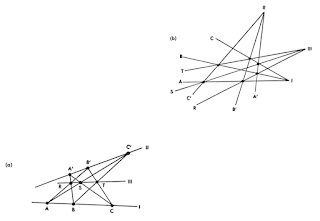
Fig 3. The two figures have the same abstract structure though in appearance they are markedly different. (a) is so related to (b) that points of the former correspond to lines of the latter, while lines of the former correspond to points of the latter. In effect (b) is a map…(or is the “mirror image” of)…(a).—Nagel and Newman

Axiom: 

“What makes the images impressive is the use of movement and perspective, the possibility of sky charts. The point where two railroad tracks come together is the point where they vanish, one new thought that leaves our sight.” —T. Fleischmann, Syzygy, Beauty: An Essay, 2012

Proof:
  • If I am enamored by the tools of mathematical proof, then I am beholden to the extremes of logical quantifiers. 
  • If I am bound to these quantifiers, then I am inescapably aware of each “for every” and “there exists” statement that could undo the foundations of our mutual trust. 
  • (As in, for every year that we remain together after this summer, there exist 356 days on which you might relapse, on which I’ll stop trusting you, on which you’ll stop trusting me to trust you.)
  • And if I am aware that our foundations are in a perpetual state of potentially going to ruins, then I could imagine myself refusing to build any lasting theorems upon them. 
  • If there are no more theorems, then there are no more proofs, and no prayers. 

or (proof as prayer)
  • If I am enamored by the tools of mathematical proof, then I am enamored enough to believe that these tools are capable of withstanding my bastardization of them. 
  • If I can trust myself to bastardize the proof, then I am willing to trust my bastardization of the axiom, too. 
  • (As in, I can call the symbols meaningless and the truth will persist, I can destroy the image but not the object, I can distrust the blueprint but the foundation will remain intact.)
  • And if I can accept my incomplete trust in the axioms, then I can accept that each proof is proof as prayer. 
“An Algorithm” ends with two divergent proofs. Either Pitkin can find no way back to her brother, who is enamored by the tools of war, or else his body is still somehow separate…from the war itself, thus furnishing a promise of his eventual return. The law of excluded middle ensures that one and only one of these two possibilities will occur, but it offers no prediction one way or the other. It is up to whoever creates the system to assert these truths that are not provable. 

I never fully understood Gödel’s incompleteness theorem, nor is it something, I am realizing, I ever really want to fully understand. The original proof is infamously challenging to decipher, riddled with arcane logical symbols that render it incoherent to amateurs. If I plan to keep my understanding this limited, I can continue to extravagantly misuse the incompleteness theorem whenever I reach an impasse in my faith. 

But I know this much: that after he proved the incompleteness theorem in 1931, Kurt Gödel became intoxicated with, or tortured by, the idea that there existed truths beyond the scope of his life. He quaked at the possibility that the intricate network of human minds and relationships were extinguished after death. “That would be approximately as if someone laid the foundation for a house with much effort and expenditure of money, then let everything go to ruin again,” he wrote in a letter to his mother in 1961. 

After that summer, we moved back in together. Our foundations haven’t gone to ruins, but I do write about them sometimes, and therein find that I do not truly know what counts as logical. I’ve started to think that maybe every essay, at least every essay of mine, is an incomplete theorem, every story dependent on a string of proofs—the proof by the second person, the proof of the past tense—that are built upon loose earth.

Predicate Calculus: An axiomatic form of predicate logic in which formulas contain variables which can be quantified. Two common quantifiers are the existential ∃ (“there exists”) and universal ∀ (“for all”) quantifiers. (Boole)

Axiom: 

“[Gödel] also makes the interesting observation that “it was to be expected” that his incompleteness proof “would be made useful for religion sooner or later, for that is doubtlessly supportable in a certain sense”—suggesting that Gödel himself was more open to embracing philosophical ramifications of his theorem than have been his fellow logicians and philosophers, who are almost uniformly critical of such endeavors (though admittedly often with good reason, given the extravagant misuse of Gödel’s proof in popular culture in recent years.)

“In one sense, to be sure, his religious and philosophical views are marked by [Gödel’s] paranoid, or at least naïve, reasoning…in which he applies rigorously logical inference to a dubious premise, namely that everything that happens in the world has cause and significance.” —Stephen Budiansky, Ever Your Kurt: The Intimate Family Letters of Kurt Gödel, Translated by Marilya Veteto Reese, 2021

Axiom:

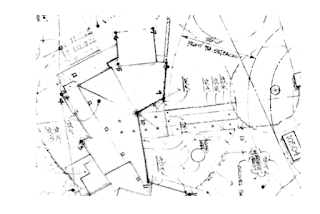
[blueprint of my childhood home]

It is not a guarantee that there exists a higher power who will proofread all my unprovable proofs. But if I mean well and try hard, does it matter that I am occasionally inconsistent? This is, at times, a heartbreaking riddle. 


*


Martha Strawbridge is a writer living in Iowa City, where she is a rhetoric instructor and MFA candidate in the Nonfiction Writing Program at the University of Iowa. [twitter]

Friday, December 31, 2021

The 2021 Christmas Octave: LOGAN NAYLOR, My Stolen Property


We had so many great cover essays for this year's Advent Calendar that we're extending it this time around to include the Octave of Christmas (Christmas Day through New Year's Day). We'll also continue publishing cover essays into the next year, so if you've got an idea, pitch us (email Will or Ander, or ping us on twitter). Happy Holidays! —Will and Ander

*

MY STOLEN PROPERTY

After “My Private Property” by Mary Ruefle


*


The lucky rabbit’s foot was the first thing I stole. It’s severed you know, like actually cut from the body of a dead rabbit. I know you know this, and that I should too, but it only really occurred to me now, occurred to me in the way one might start to think harder about process. Something you might realize when confronted with the image of a shrunken head being filled with hot sand, and simmered down to the size of an orange. A real, human head, made empty rubber glove, with only the hair kept exactly the same. You cannot shrink hair, cannot empty its shaft, its natural shape, but you can preserve it. And what I mean about my epiphany concerning dismemberment is that it's obvious. What I mean is there’s a real morbidity to the object that did not scare me when I was nine. What I mean, I guess, what I must mean, is that it is sad, is it not, that no one’s thinking about rabbits' feet. I was once, every day for years. It started on one of my nine-year-old-days, in a gift shop. I dug my fist into a wooden bucket full of severed rabbit limbs, and how morbid really, I know, you know, but I was intoxicated with the thought of slipping the one that felt the most alive into my pocket. That felt important. That toe gnarls were to be expected, something crooked that wasn’t there in life, but there remained a desire to find one with even toes, cured rigor mortis that felt non arthritic. I was on a fifth-grade field trip, a war reenactment. I didn’t feel too bad or afraid of death. War and death felt far in our imitation. I was hung up on a boy, who would later be a girl, once I was a boy, but right then we were all mixed up, and in line, waiting to be handed a long stick to be slung over our shoulders like a gun. Let someone preserve me as I was then, that first day, ignorant, innocent, at my most beautiful, and overcome by another. Let me never know the jagged bone that lay beneath a keychain cap. My boyfriend and I were stuck five people apart right then, so we pulled up the grass and sank into our heads. The five people between us passed me a moonstone: From boy, with love. A however -many-weeks-of-nine-year-old-dating sort of gift, a stone tumbled smooth and oval, a divot for my thumb. I clutched it in my hand while we charged the other kids with stick-guns and hid behind rocks. I held my thumb to that shallow, worry stone place. The part that made room for me, was cold and ungiving once but warmed under my skin, seemed to have pressed away and held hands with me. Afterwards, we got rations. Cornbread and apples and beef jerky. The food tasted something like the sweat against the stone in my hand. And I was still holding it in the gift shop, of course. Palm sweating on the moon rock was vital to stealing the rabbit foot. It gave me purpose and confidence. I carried both the stone and the foot with me for a long time after. And still, after all of its time in the shoe box, it hadn’t sunk in until now that a lucky rabbit’s foot was in fact severed. I was lured to the small thing that could shapeshift and that was all. I stole Littlest Pet Shop characters from my cousin's house. There was an elaborate scheme involving a small Yoda figurine. I harbored glass elephants from my grandmother. Stole small, clay bumblebees once, but it began to shift beyond plastic. Maybe it started with the seed pods of our mulberry tree. They were soft and green. They had guts. I’d cup them in my hands, tell anyone that would listen that I’d caught a caterpillar. I’d lie. I guess you could put it that way if you want. Lying. You could also say these things required me to lie. That I was fixated on things that asked me to fight for the way they might live on. They were so real already that immediately they became a portal to a world of fabricated, shallow breathing, even if I felt like I could force that feeling into anything at all. The rabbit’s foot was an especially private instance. Something I allowed myself to take out of my shoe box, and fawn over in secret. It was too alive to fool with. It was a token I needed to clutch close to me as I moved through the world, searching for new trinkets to breathe life into, all while parting the long tufts of fur to find the real nails still beneath. I would sometimes press it to my cheek and lie there, dreaming of the rabbit. Thinking about its origin in a guarded way that hid parts of itself from me. Like, how do you make a rabbit’s foot anyway? There are procedural necessities to make it the lucky kind. The left, hind foot. Killed in a cemetery, during an intentional day. A friday. A rainstorm. A holiday. At midnight. This is what makes it lucky. It seems self explanatory that the foot just comes off. Garden shears should do the trick. Nothing more intensive. Just the way fingers can be snapped with teeth, the force it takes to bite a baby carrot and nothing more. If anything, it’s the curing process that’s complicated. Soaking it in a jar of isopropyl alcohol. Rinse and repeat. Add borax. Shampooing it. Drying it in the sun. Clipping the jagged end into a keychain, hiding fragments of bones and blood stain. Making death smooth and tidy. And still: mostly simple. I was close to this transition once, from life to death. I was eleven, and my infatuation with rabbits growing. I caught a baby rabbit, mid air in the backyard. It was young and slow and away from the nest too soon. Something that needed its mother and had a different kind of trust, timid but still growing into fear. I held it in my lap on our couch, feeling its heart beat beneath my palms, until it spasmed a few times, and I said, calm down, calm down, I got you. All at once it was too still, as if I had commanded it. I wanted to take it back as soon as I’d spoken. It felt wrong that I could touch the fur without resistance. It wouldn’t quiver, couldn’t jump like horse skin. I couldn’t feel its heart but knew it was inside. I was left with shame, staring into glassy eyes that watched me feel for its beating heart. It took only seconds for small bugs to leave its skin. They all came up at once, fleas or mites, searching for new warmth, understanding the end, finding the next planet to inhabit. Sweaty fear ate at my own skin. I knew what the bugs knew. We knew it together and started a desperate search to exit and continue. I took it to the yard still trying to confuse lifelessness with sleep. Coyotes carried it away within the hour, tossing it back into their jaws, feeding it to their own pups, holding bugs close inside their coats, bugs that still fed on their lasting warmth. I’m thinking about whether fur is really the same the whole time. If the fur, when it cools, loses something more than just bugs. I’m looking for something to remain. Fur as memory. Make believe. I’m waiting for anything to breathe. Lying about what can and can’t. Cupping small, fur pelts in my hands and trying to make wonder appear. Holding a stolen rabbit’s foot tight in my fist and getting too attached to an afterlife that looks like that. A segment kept perfect. Even toes, even toes. Something miniaturized and kept going. A shrunken head given to a widow, and still, someday, eaten by a mouse like jerky. Passive and still, chewable, yet a kind of life carrying on. I want to preserve the rabbit I scared to death, but I am also glad that the coyotes left me with nothing. I want to preserve the first pet rabbit I lost, whose body I watched drop from the jaws of the neighbor's dog, but I am squeamish and unable. I’m thinking about what can’t be kept if it isn’t easy. How I didn’t keep his foot when he died, but the ritual was there. The dog made a graveyard of our home. It was on a cold Friday, late into the night. The dog ran up to me, licked ketchup from my laces and left my rabbit dying in the grass, and I could have done it. But I never would have been able to soak the life away in a jar, or use the garden shears, or patch it up with a keychain bandaid. A month later, a raccoon dug up his body. He did a half-assed job moving the headstone, making the flies swarm from their holes under the plywood. He left without finishing the grave robbing. Just disturbed everything enough to force me to confront it. I had to move him. He was still in my T-shirt where I had left him. He smelled. I don’t know if I expected clean bones or what. I thought even then that I wanted a memento. His teeth. His skull. But his body was heavier than I expected it to be. I knew under the cotton I had wrapped him in there would be maggots and leftovers. That no matter how much I wanted a piece to hold, I couldn’t stomach the truth of death. That I had once held his body until it went cold, and then stiff, and only then did I forget to feel kind through my crying. I was disquieted by the stiffness that took over. I wanted to let go. Somehow a dismembered fragment felt like a way to surpass this fear, as if I could distill softness by keeping a paw to hold, as if that would work to soothe the loss better than the awkward stiffness of the thing I could not keep. The morning after he was killed, I traced the yard for clues of his path. How many laps had he run before the dog caught him? All I found to calculate it were a few wisps of fur, looped around blades of grass. I picked them up and stuffed them into a mason jar where they have stayed since. But I could never reach into the shirt and look for something more. Something I would have to dissect and make clean. When the raccoon forced me to resurface the body, I patched it up with a deeper grave. I put the headstone back. I left that part of my brain there in the yard. Forgetting still, choosing to forget, that memento involves killing and skinning. I like to be left with neatness. I want to preserve without process. I want to never let them mold or rot. I would not let the mice near them, their fate would be to remain exactly as they were in life, exactly as they are, albeit dismembered and portable, and from time to time I would take them out and look at them and be startled, and I think of the widow who fainted at the sight of her husband’s head, and I think if I could hold the soft paws of my beloved in my hand I would indeed feel faint, but I think also I would get used to it, I would grow calm and be moved in the tenderest of ways, at just the sight of them there in my hand. I’d take that feeling as far as I go. Give me rabbit’s feet to hold. Promise me there is nothing beneath the keychain cap. Tell me there are some things that always live like this. Just like this. 


*


Logan Naylor writes and teaches at the University of Iowa. They live in Iowa City with their partner, two cats, one gecko, three rats, and twenty-nine houseplants. They are, unfortunately, running out of space for new pets.

Thursday, December 30, 2021

The 2021 Christmas Octave: AARON PANG, Code


We had so many great cover essays for this year's Advent Calendar that we're extending it this time around to include the Octave of Christmas (Christmas Day through New Year's Day). We'll also continue publishing cover essays into the next year, so if you've got an idea, pitch us (email Will or Ander, or ping us on twitter). Happy Holidays! —Will and Ander

*

CODE


*


If (plastic === ‘motion’) { code = ‘thought’; }

Code is meaningless. At least the name is. Ask any non-practitioner of code to describe it and odds are you will get a description closer to that of magic than that of science. Ask a practitioner of code and odds are their answer will start with the phrase…”well actually…”.
     Yet even with no clear definition, the modulated, hyphenated, coloned, parenthesized, functional, bracketed, camelCased, variable, compiled, classed, factored, and refactored strings of text that makeup code means something. We coders, the writers of code, like us writers, the writers of word, all know that to be true. That the meaning made through its writing is significant, even if the meaning is not explicitly defined.
     That undefined possibility is what lends this material, code, its power. We didn’t need our computer science professors to tell us that the script we wrote to build the child’s game of tic-tac-toe was important. Its power was realized when upon the code’s execution, where on our screen there were none, tics, tacs, and toes appeared. 
     If plastic is the physical embodiment of motion, then code is the digital embodiment of thought. Code is the dissection of reasoning, of logic, of cause and effect. It breaks down a thought into ideas, and those ideas into conditions, processes, and cases. This digestion of thought continues until the comprehensible becomes incomprehensible. And it is on these motes of incomprehensibility, code, that we have built our entire digital world.
     Software engineers sit at supercomputers the size of spiral bound notebooks, writing line after line of code in integrated development environments. Line after line are compiled into applications running on operating systems, executing commands that have been converted into machine language readable only by the hardware. Line after line after line exist only as 1’s and 0’s.
     There is an endless conversion happening, an unceasing program to codify. It is done by us, all of us companies, coders, non-coders, your distant aunt on Facebook. We don’t know why, perhaps it is for progress, or efficiency, or just curiosity. Some of the conversions are easy. Quantifiable representations: a nation’s population, a bank account balance, barrels of oil imported, reams of paper produced, COVID cases, Tinder right swipes, the weight of a newborn baby. Other conversions are harder, like capturing who we are as people. Yet, we still try. Databases fill with approximations of who we are. The articles we half-read, the songs we played, the people we’ve stalked, the porn we’ve watched. It is an incomplete facsimile.
     But this digital facsimile is becoming less and less a facsimile. Instead it has become a truth in and of itself. Take the historical transmutation of code. There are little remnants of its original form. The evolutionary path between the IBM punch cards and the Java IDE is not obvious. Vacuum tubes no longer fit inside our smartphones. The physical space taken by the original computers have now given way to an infinite digital one. 
     The physical is no longer the determinant of the digital. There is now a bidirectional relationship between the physical and the digital. The two realms now dictate each other. If your account balance reads zero on the screen, there is no physical way to correct it. You can stuff wrinkled bills into an envelope and throw it at a teller, but until those pixels change, until the code is executed, you still have zero.
     How the zero becomes anything else no one really knows. Some can make an educated guess. This is the incomprehensibility that exists with code. The lay person has no real ability to interact with it. At least with plastic you can break it with a hammer. No physical force can stop code in its modern day manifestation. It executes with no regard. It is an untouchable material. There will always be a gap between the finger and the button it presses. 
     The gap between the finger and the button is the gap between the intent of the click and the code executed. Anything can be written within a button’s function. When clicked, the code in the function runs. The function is an infinite space within another infinite space. A footnote in a book that is a book within itself. The button is not limited to one action regardless of intent. With the right code you can launch nuclear weapons while ordering a pizza. All that functionality with just one-click. 
     Yet we continue to push every button we have access to. Thousands of times a day. We press, click and push these little gateways into the digital world. Each press with an expressed intention. We click play to watch the TV Show (The Americans on FX on Amazon Prime Video). We click search to find the name of the lead actress: Keri Russell. We click buy because Keri Russell was holding a can of Coke in Season 3 Episode 6 (I don’t know if that’s true, I’m not there yet). Each button is a trigger. Each press executing code. 
     But every button's function always starts empty. An empty button does nothing. There is no code to run, no materials to use. Only the promise of possibility. When I was a practitioner of code, we would build these buttons. I would sit and watch test subjects click and click again. The experiment would always go on longer than expected. They would continue to click. Their actions, illogical and instinctual. Each subject never knew why they clicked when we asked. Perhaps they hoped that on the next click some code would run. 


let code;
let nonPractitioner = "magic";
let practitioner = "well actually...";
let describeCode = code ? nonPractitioner : practitioner;


if(typeof code === 'undefined') {
  code = 'something';  
} else {
  code = 'something';
}

if(typeof code ==='undefined' && !isFinite(code)) {
  let ticTacToe = null;
  ticTacToe = true;
}

if(plastic === 'motion') {
  code = 'thought';
}

let reasoning, logic, causeAndEffect;

code = reasoning + logic + causeAndEffect;

let idea = {
  conditions:'if this then that',
  processes:'xyz.exe',
  cases:this.conditions,
}

let thought = [idea, idea, idea];

let converting = true;
let physical = [
  'a nation’s population', 
  'a bank account balance', 
  'barrels of oil imported', 
  'reams of paper produced', 
  'COVID cases', 
  'Tinder right swipes', 
  'the weight of a newborn baby',
  'articles half-read',
  'songs played',
  'people stalked',
  'porn watched',
];
let digital = {};
while(converting){
  physical.forEach((thing)=>{
    switch(thing) {
      case 'a nation’s population':
        digital[thing] = 329500000;
        break;
      case 'a bank account balance':
        digital[thing] = 5533;
        break; 
      case 'barrels of oil imported':
        digital[thing] = 7860000;
        break;
      case 'reams of paper produced':
        digital[thing] = 68000000;
        break;
      case 'COVID cases':
        digital[thing] = 49500000;
        break;
      case 'Tinder right swipes':
        digital[thing] = 454;
        break; 
      case 'the weight of a newborn baby':
        digital[thing] = 8;
        break;
      case 'articles half-read':
        digital[thing] = [
          'The White Album',
          'Why I write',
          'Death of a Moth',
          'Domanju',
          'The Fourth State of Matter',
          'Plastics',
        ]
      case 'songs played':
        digital[thing] = [
          "PYT",
          "Best Part",
          "Ain't no sunshine",
          "Eleanor Rigby"
        ]
      case 'people stalked':
        digital[thing] = [
          "Megan",
          "Marissa",
          "Henry",
          "Brenda",
          "Katie",
          "Ashton",
        ]
      case 'porn watched': 
        digital[thing] = [
          "Asa Akira anal bukkake",
          "Babysitter caught by stealing by father",
          "Sissy boy punished",
          "Asian girls fingered",
        ]
    }
  });
}

physical = digital;
digital = physical;

if(digital['a bank account balance'] === 0) {
  physical['a bank account balance'] = 0;
}


code.canTouch = false;

const button = <Button/>;

button.canTouch = false;

let willPressButton = true;

let buttons = [
  play,
  search,
  buy,
]

while (willPressButton) {
  buttons.forEach((b)=>{
    b.press();
  })
};

button.onClick = () => {}


*


Aaron Pang is a writer based out of Oakland, CA telling stories to anyone who will listen. He’s currently getting his MFA in Creative Nonfiction at the University of Iowa. Aaron’s work can be found on The Moth Radio Hour and America’s Test Kitchen. Twitter: @AaronZengPang

Wednesday, December 29, 2021

The 2021 Christmas Octave: SARAH KHATRY, The Shadow World


We had so many great cover essays for this year's Advent Calendar that we're extending it this time around to include the Octave of Christmas (Christmas Day through New Year's Day). We'll also continue publishing cover essays into the next year, so if you've got an idea, pitch us (email Will or Ander, or ping us on twitter). Happy Holidays! —Will and Ander

*

THE SHADOW WORLD 

After “Domanju,” by Brandon Shimoda


*


I was six years old when the twin towers fell. On the west coast, New York was more concept than living city, rendered in grainy footage on our living room TV during the morning news hour while I was supposed to be preparing for school. My mother tells me she entered the room to find me before the TV’s screen, rapt and frozen. My expression was her first indication something unusual was going on.
     When we filed in for class, our tender, grandmotherly teacher addressed the events with a baldness I think I now would find startling. On the whiteboard, in a few simple lines, she drew the towers: two long and open-ended rectangles, blue marker in my memory. She drew a single plane: a narrow oval, tapered into points at each longitudinal end for nose and tail, with a pair of triangular wings shooting out of the middle. And then she drew an arrow. Plane to towers. 
     A flourish persists that I’m not sure was real. Past the arrow’s tip, I remember her eraser sweeping down over the towers, wiping them into blankness. White oblivion. 
     She narrated over the images, but it’s only the whiteboard I remember, and the story it told. In the weeks that followed, as my small hand set forward to practice shaping the letters of the alphabet, it would not stop shaking.
     Twenty years later, our reactions in real time unspool below in nested comment threads, ongoing livestreams, and feeds of tragedy. But what happens after? How do the functions of cultural memory and memorialization operate now? 
     In Brandon Shimoda’s “Domanju,” the most effective tribute to Hiroshima is the simplest: a great mound housing the ashes of 70,000, of whom all but 815 reside unnamed. But where Hiroshima and its horrors marked the end of a war, September 11 spurred multiple conflicts, and the decades since have seen the rise of other forms of publicized violence—mass shootings, the documented brutality of police on Black and brown people, and now literal plague—all aswirl in our cultural consciousness. The last twenty years are so much bigger than me. I want to write only as myself, with the grounding specificity that makes Shimoda’s essay so effective—so follow me home, follow me into my body. 

My body as record, while all others erode and corrupt. The body remembers:
     In a small town where I used to live, a pair of high school seniors died in a car crash, their collision with a tree rending the car into separate pieces, front and back. Overnight, a memorial sprouted near the site. Something like flowers and a teddy bear and handwritten testimonials of love, fragile and delicate in permanent marker. All given over immediately to the decay of October rain. As a child, the realization that even the memorial was melting, and would be dirtied and muddied and eventually blown away by wind, struck me. Like all that love didn’t even matter. 
     Nine years later, coincidence brought me to Paris the night orchestrated attacks created and sustained an atmosphere of terror. The morning after, I stood before a reminiscent memorial, candles and signs and objects of love overflowing the metal barriers erected near the Bataclan theater. Every now and again a body (still living or dead, impossible to tell) wheeled out of the theater and through the double doors of a white van. There was a soft drizzle. The candle flames wobbled. Grief flowed through the crowd tangibly, flowed through the confusion of my body: a joint fugue in which the self could disappear, be swallowed in a wave, dissolved into the rain. What was the point in this shared witnessing? I don’t know, except we all felt the need to come and stand.
     The same year, as a sophomore in college, I assisted my professor in reporting a story about a man shot and killed by the LAPD. I did remote research. I made phone calls. I requested documentation. I made myself look second-by-second, frame-by-frame, through the short video of the killing (an execution, a murder, we would learn, muzzle pressed to his chest) caught by a bystander. I thought I should look if I was going to do this work. I let each pixelated, obscured shot, tangles of bodies and movement, become etched in my mind. I took notes with timestamps. I was somehow violating him. But this video was the only thing at the time that had any power to make things ‘right.’ Its existence had nudged open the door of public consciousness.
     The horror of the act (the horror that here we are again) is compounded by the horror that we’re all watching it—for the whole of a life to be defined by its terminating and unjust brutalization, a name and memory overridden in full not by what you’ve done but what’s been done to you. 

As he circumambulates the mound in “Domanju,” Shimoda surprises himself by perceiving, after multiple prior visits, a door. Shimoda writes: “The door, opaque yet severe, startled me. It bestowed an aspect of fantasy. It suggested a clandestine, unending world. An underground network, a labyrinth. Shadow Hiroshima. That behind the door stood either a single, self-contained object, like an inexplicable idol or letter, or a replication of the universe.” 
     The real purpose of the door he doesn’t surmise. It may well be utility, maintenance: a portal, not to alternate histories or lost worlds of the dead, but to anonymous HVAC units or an array of old clanking pipes. Still, I find Shimoda’s description irresistible, and wonder if it may suggest a wider truth: that within grief, and within the memory of tragedy, there may always be an unexpected door.
     Today, we all have entrance to the digital simulacra of memorial grounds after a major tragedy. Charnel houses of Instagram posts, excruciating explanations of horror beyond words, evocations of prayer that seem vacuous in sans serif font. These digital grounds are not stately and peaceful, but riotous, roiling, tossing like the ocean. Unlike physical grounds, they are always peppered with doors. Brilliantly advertised doors and windows (hyperlinked text, video thumbnails cropping up in the corner, responses recursed into responses on responses), but also trap doors and hidden doors (as in behind the right book tugged off the shelf, as in the twist of a particular tile in a wall causes you to hear a deep, mechanical click).
     Some of these doors lead to the illusion of proximity: gory photographs the media would never publish, or heart-wrenching accounts of bystanders, survivors, intimate relations, strangers suddenly known to you, Digital Wanderer, right there in a username or social media handle. Many of the doors offer a false sense of agency. They request either a token gesture or that you become a new prophet. Sometimes they even result in convictions. Sometimes they threaten to overthrow governments. Often, they are a placebo to still the pounding drum in your chest.
     You may also discover doors within doors within doors, which will require a lockpick, a clue, a secret password whispered to the dark eye of a keyhole. For those who follow the trail, the accumulation of doors has a persuasive effect. Radicalized standard-bearers can perceive further secrets, and secondary, or even tertiary meanings, to every act of speech papering the Internet. This is the blooming of conspiracy at work, the weaponization of its capability to deform any object it encounters to fit into its mosaic. (Reality is inverted. Grief alchemically transformed. Tragedy into farce. Pain or shame warp into hate. Even apathy can become something sharp and directed.)
     Perhaps I’m the one who’s tripped and fallen through a trap door into a shadow world. I’m exhausted. I feel like I’ve been in a cell these past two years, sucked into the glow of a screen, navigating the rhizomes of digital mourning.

I lost my grandmother in February, not to COVID but still locked far away from her family in her final weeks by quarantine. 
     In the days after her death, I listened over and over to her voicemails, still encoded within my phone’s physical memory. There was a certain intimacy in holding the phone close to my ear, hearing the familiar crackle of her voice. (Wishing me a belated birthday. Coaching me to leave the dough in a warm corner of my kitchen for it to rise properly. Asking what toppings I’d like on a pizza.) I cried and I listened to them, thinking: At least, I will never forget the sound of her voice. But someday those files will be lost in the cloud, or I’ll fry the device’s storage. And someday, I will forget. Of course, the body is the most temporary thing. What is archived and logged in its twists of gray matter will regularly betray me, until the day there is no me. 
     This is why lovers carve their initials under bridges. This is why teenagers tag overpasses and alleyways. This is, maybe, part of why any of us write and publish. But access to the person, to the vivid universe of their subjectivity, closes forever, as solidly as the far majority of those housed in Domanju’s mound are nameless, their lovers, their friends, their children potentially nameless alongside them, together all unreachable across time or history even as their ashes (or their images, their words, their voicemails) remain right there. Looming out of the earth.


*


Sarah Khatry is a writer, editor, and journalist living in Iowa City, where she is an Iowa Arts Fellow in the Nonfiction Writing Program. Her work has appeared in Virginia Quarterly Review, Himal Southasian, and 40 Towns, among others. Twitter: @khatrysarah

Tuesday, December 28, 2021

The 2021 Christmas Octave: REBECCA FLOWERS, The Death of the Beetle


We had so many great cover essays for this year's Advent Calendar that we're extending it this time around to include the Octave of Christmas (Christmas Day through New Year's Day). We'll also continue publishing cover essays into the next year, so if you've got an idea, pitch us (email Will or Ander, or ping us on twitter). Happy Holidays! —Will and Ander

*

THE DEATH OF THE BEETLE 

After “The Death of the Moth” from Holy the Firm by Annie Dillard


*


I am looking at Annie Dillard looking at Virginia Woolf looking at a dying moth: “O yes, he seemed to say, death is stronger than I am.”
     I am looking at the pictures of dead bugs on my phone that I took after deciding to become a writer. On my way to the gym there is a desiccated thing about the size of two thick blades of grass. It’s upside down, brown legs curled in and exposed, a stripe of inky black down its middle. The eyes are turned up, meaning they’re looking at the sidewalk instead of the sky. The wings look like the glass in old houses. 
     I am looking at beetles pinned to a board in a museum that looks like a painter’s palette. Instead of a hole for my thumb there is a beetle shining green with apples of red on its thorax, one painted like a chestnut with a horned projection emerging from its face, a periwinkle blue that reminds me of a chip of sea glass, a long, black string of a beetle that ends in a crossbow, a zebra-striped beetle with long antennae that curve like a sad face, one that is more pin than beetle, and a little brown one that looks like a caterpillar-eaten leaf suspended from a pin with a few strings. These beetles have no labels, scientific or otherwise. They are all positioned away from me, facing the top of the display case, looking at a strip of wood. 

Five years earlier, in my freshman year of college, I joined a lab to study mercury bioaccumulation in the ephemeral pools that formed all around our local forests in Vermont. As part of my job, I spent hours in a “clean room”—clean of metals, clean of rodents, often clean of people—identifying little brown bodies beneath a microscope. The beetles I studied were already dead—I was not witness to that process—but it was my job to look at their backs, and their wings, and the protrusion of their eyes, and the number of tarsi—the little segments that make up a beetle “foot.” The beetles underneath my microscope were for the most part Dytiscus beetles (Greek for “little diver”) that were about an inch long with fat torsos. They fit easily on the two fingers of my blue-gloved hand. In life, they dove in ponds and ate smaller creatures. In death, I pulled them out of frozen plastic bags and warmed them beneath the lights of the microscope. 
     I spent hours with them as I listened to the Hamilton soundtrack on repeat—turning them over, making notes on the species, distinguishing males from females by the males’ sucker-filled pads for gripping mates. Over many hours alone with them, I learned to adore their feathery legs, the little triangle that separated wings from head, the dull shiny brown of their hard shells, where in life they stored air to allow them to breathe underwater. Each beetle became an individual for me, as real as the click my gloved nails made on the back of their shells. 

I am looking and I wonder if one of these is a scarab beetle. The hieroglyphic for scarabs roughly translates to “transform.” They were sacred in ancient Egypt because they represented Kheri, the god of the rising sun, as he wheeled the ball of flame across the sky. The Egyptians believed only male scarab beetles existed, creating dung balls out of semen, and in doing so they represented Kheri’s daily creation of the sun. Self-creation, renewal, regeneration. The serpent eating its tail. The beetle creating itself in a new ball each day. One story cannibalizes another, until the sun passes over the horizon and never returns.

In my sophomore year, I took a trip to Cerro de la Muerte, also known as the hill of death. This was Cuericí Biological Field Station, in the cloud forests of Costa Rica. Still studying biology, I arrived with a group of fellow students to conduct field studies for a week. On the night of our arrival, I slept in my traveling clothes under three blankets, in the bottom bunk on the top floor of the wooden house. I woke up three times from the cold, my exposed nose plastic and chalky. The room was dark and the beds creaked with the bodies of my sleeping classmates. I curled my fingers into the blankets and brought them up to my face. 
     The morning brought heat back into our toes, and we hiked up through vast hanging vines, listening to the birds calling each other in the trees. When we returned to the house, cold and sweaty, our professors called on us to propose research ideas. I picked my group not for their topic so much as the students who I liked. They wanted to stay close to the station. They’d noticed beetles on the flowers in the garden. We took our orange field notebooks and sat around the flowers. We watched little beetles unfold wings from under shells and make little jumps between yellow flower spring boards. We developed our hypothesis—that the beetles landed more on some flowers than on others, and that the reason was heat.

I am looking at the palette in the basement of the University of Iowa Museum of Natural History, and I see that someone has labeled it “Variation in Beetles.” On the side is a sign: “Physical Variation. Through the evolutionary process, insects have developed extraordinary variations in size, shape, and color. This is demonstrated by an array of beetles, in which each shows the physical characteristics which have enabled it to succeed within its own ecological niche.” In a big glass display, this is all it says, and these are the only beetles I can find in a building filled with articulated skeletons and glass eyes.

When I had finished identifying each diving beetle, when I had filled all my little boxes, my job in the clean room was done. The beetle was warm now, as warm as it had been when alive. And I knew what I had to do next. I took my thawed beetles out of the clean room and deposited them in a machine. A machine I knew I would have to turn away from when I brought it to life, because the purpose of this machine was to grind the beetles into a powder, so that they were no longer identifiable as anything that had ever been alive. I was the last one to see the beetles as they had been, as nature had made them, as they had grown from birth, before they were captured and frozen. I was the last one to stroke their heads, and feel the grooves down their backs, and press the pads that would never press another beetle. When I slotted them into the machine for grinding, to be broken down into their principal parts so that they could be weighed and so that we could put them through another machine that would sort through their component parts and pop out a reading on milligrams of mercury they had absorbed, it was a private little funeral between us. Between the beetles and the person who had known them only in death—when they were past anything that made them real, anything resembling cares or worries, mating and eating and survival. A mossy, earthy dust filled my nostrils as the machine rumbled and buzzed—bits of the bugs that once were. I collected the remains and returned to the clean room. 

I am looking at these beetles in this room in this basement, far the places I have studied them. I have seen many beetles on many boards. And I realize now that, in placing them on a board, they no longer exist in the world—not to live or die, not even to decompose. They are mounted and coated and placed. They are divided up into satisfying categories, but nothing about the marks we assign them makes us understand what they are. They are designated for the consumption of human eyes alone.

After a week on the hill of death identifying native and nonnative flowers, setting out temperature sensors around the house and in the centers of flowers, I brought our professor one of the beetles in a petri dish along with the dog-eared identification manual. 
     “In order to identify it,” he said, looking down at me, “I’m going to have to kill it.” He said this with a look that showed me he knew me—the girl who had stayed vegan for the last month in Costa Rica, even when I had very little to eat. 
     I handed him the beetle reluctantly. He took the dish between two big fingers and placed it under the microscope. He lifted a small bottle of alcohol solution and, as I looked on, poured it over the beetle. It squirmed on its back, I think, or it tried to swim away, or it made to climb up the walls. Again, I was not really witness to its moments of death. Again, I turned away. Soon the liquid covered its body, and the wings stopped fluttering. My professor shifted in his seat and looked into the eye piece. I looked at the beetle now. I had picked it up myself, unassuming, from the center of a yellow flower. I had given it to my professor. It was dead because of me. 
     My professor looked up from the microscope and told us the beetle was in the family Chrysomelidae, subfamily Hispinae—leaf-mining beetles. In identifying the beetle, we had to kill it—as if to know it was to strike it through the heart. Categorized, collected. No longer a beacon of life now that it had a name, now that it could fit into an identification manual, its details diagnosed and digested. In his essay “Butterflies,” Nabokov wrote about how the smell of ether opened his memories, how he liked the sound of the pin crunching through the thorax, sticking into the cork board behind.
     The next day, I returned to the lab alone and found the petri dish beneath the microscope empty, the alcohol evaporated. A little brown beetle was crawling beside it. Had it suffered all night, half-drowned? I scooped it up and returned it to a flower in the garden, not sure whether to feel better or worse.

As I walk home from the museum, I am looking at Annie Dillard looking at her students and telling them “You must go at your life with a broadax.” And I think perhaps my broadax is a beetle, and perhaps my life is an essay—or maybe my broadax is an essay, and my life is a beetle—or maybe my life is my broadax, and a beetle is an essay. Maybe we are all pinned to boards in a way, or at least our work is. And I wonder what will happen when someone tries to know our names. Goliath, Hercules, Harlequin, Rhinoceros, Bombardier, Great Diving Beetle. They were not named on the palette I left behind me. But I want to know them anyway. 

And now I am thinking. I am thinking about how my thesis advisor once told me I would never write anything original, so I shouldn’t even try. I had by that point abandoned biology for writing, but the beetles stayed with me, like mosquitos on a hot night, or moths around a candle. From the beetles I knew that we are all inheritances on the backs of inheritances, like hard shells over delicate wings, all of which began in a single cell. Repetition, repetition, but with variation. The same, but slightly different. 
     I am thinking about the only piece of classical music I ever loved—Mozart’s “The Sparrow Mass,” which he wrote in 1775 or 1776, and which I sang as a choir girl in 2015. A song which only became magical to me once I was involved in bringing it to life, and, in bringing it to life, I took part in breaking it down. I knew it wholly within me—I could name it and label it and pick it out of a book and tell you all the words, and I knew only the soprano notes. 
     I am thinking about Measure for Measure, which I only started to appreciate as a true work of art when, in the same year I ground up beetles, I wrote an essay about Shakespeare. And now I only remember it for my own analysis, instead of the for the problematic beauty that it is. 

The beetle sits in the middle of a flower, absorbing heat, having escaped death in a plastic petri dish. The energy that flows through the universe, from the sun to this insect is much like stories passed down from one to another. Repetition, variation. I am wondering: if we pin down a story, an essay, a piece of art—do we kill it? If we try to know a work and identify its parts, does it die? If I run these writings through a machine, and disintegrate them into such little pieces that are dust on the wind—if I put them in a box and observe their actions for a week, will I know what they mean? 
     I will never truly know what a beetle means. I will never truly know what it is to be a beetle, to die as a beetle. All I can do is try for the next one, the next beetle, the next work—to get closer to some understanding—as a writer, as a biologist, as a human. Whether I die or live, whether I am successful or not, I am just another part of the cycle, transforming energies. And that makes writing, and beetles, and death, both more and less knowable, both more and less terrifying. All I can do is keep striving for something more. To go at my life with a broadax, and carve myself into a beetle. To fold my wings on my back like origami beneath a hard shell, or sun myself in the center of a dahlia on a cold day in the cloud forest, or wheel my proud heap of dung across the horizon. To be down in the muck, jostling between detritus and leaves. To dive and mate and eat until I die. And then maybe, finally, I will know. But it will be too late to tell you.


*


Rebecca Flowers is an MFA student in the Nonfiction Writing Program at the University of Iowa, where she also teaches Rhetoric. Her previous work has been published in VICE and Guernica. 

Monday, December 27, 2021

The 2021 Christmas Octave: HANNAH BONNER, Being Alive Twice: a New Moon Report


We had so many great cover essays for this year's Advent Calendar that we're extending it this time around to include the Octave of Christmas (Christmas Day through New Year's Day). We'll also continue publishing cover essays into the next year, so if you've got an idea, pitch us (email Will or Ander, or ping us on twitter). Happy Holidays! —Will and Ander

*

BEING ALIVE TWICE: A NEW MOON REPORT

After Ariana Reines’ “New Moon Report


*


Light me on fire / gently —Benny Blanco from Dave 
 

The second winter of the virus brought consternation, but then again so did the heartache. I didn’t turn back too soon. Neither did I linger. If Orpheus and Eurydice were a game, I was 0 for 1.  

I scrolled Instagram as an exercise in existentialism and ate so intermittently that some might call this health. I screenshot the meme, Self-alienation has reached such a degree that we can experience our own destruction as an aesthetic pleasure, then texted a nude of my tits to my ex. 

A full moon eclipse crept our way, and the advice in the ether was to stay inside for three days, if you could. Everyone was extra sensitive. Everyone was reinventing themselves. Everyone’s pronoun was the collective “we.” Except we weren’t connected or interchangeable or even equal, just closer apart. 
 
In hot yoga, the instructor invited us to place one hand on our belly, one hand on our heart. This is called nurture, she intoned. I cried in shavasana during the pop country song and stole all the free shampoo. Fuck the breath, I thought, then exhaled. 
 
To paraphrase the astrologer Diana Rose, at least there’s liberation in the Saturnian importance of saying no. 

The ground gave way under me, but the Midwest sky still hardened, cold and black as onyx. I wasn’t writing and I wasn’t happy, but I existed, all the same. I stopped drinking for a short while and forewent cheese. When my grandfather called, I didn’t answer. When the musician with the girlfriend called I did. 
 
I became conceptual. I became absorbative. An objective subject readymade. A Thousand Plateaus told me a body was not defined by form nor by substance, but by affects and local movements, differential speeds. Which is to say, we can only ever perceive our own becoming as it occurs in the present moment. The past tense fans out like Duchamp’s “Nude Descending a Staircase,” a whirring diverish of being always already at work.  
 
In the Year of the Rat, we lit firecrackers in an abandoned van just to see what would happen. We took tabs of acid just to walk in rain. We talked about trading partners based on rising signs and stayed up all night, almost every night, but, I’ll admit, we didn’t watch any sunrises. When the police blockaded the station, we knelt before them. When our chants rattled the windows, their weapons of war blotted out stars. We walked the perimeter of the city, down onto the interstate, but somehow we knew the coracle to Cerberus would only get us so far. 

I walked through another mourning field, my skirt haloed around my thighs. I wore lipstick and cried on many couches. Staying up, sucking wine - all the hands felt so good no matter where they went. 

The numbers declined in hospitals and the protests muted on TV. We concealed vaccination cards like fake IDs in our bra cups and tongued jello shots in bars. 

The masks fell. The masks fell like supplication in a basilica. For once the red states and millennials were one in the same.  

In the beginning, we dropped a stone in a well for a bushel of grain. When the well filled with sediment we emptied it again until we could lean into the dark hollow and sing. 

This practice was called commerce. We had no need for ledgers. To barter was a visual endeavor, like pornography or shadow play. 

We placed hands on shoulders in greeting and spit over our shoulders to ward off plagues. We cut flowers for our salads, but never for our hair. The river lathed us in its honey of forgetting, and the petals puckered in the brine. 

Love was something we craved like fire or like food, but if we stared at it, square on, we would immolate to ash. My Venus was in Aries hence the aggressive tenderness. Hence the ardent impatience. Hence the abstract knowledge of the word care. Basically the unspoken understanding was that I never was ok. 

In astrology, your life purpose is encoded in your lunar nodes. My north node is in Pisces and my south node is in Virgo. This configuration speaks to health and to healing, to addiction and to doubt. The crux of conflict is already within me. What matters most is the torment is transient, even when it recurs. 

A predecessor with a north node in Pisces is Joan of Arc. If the next vessel for God is a woman who will scorch the earth, He’ll be waiting a long time. 

It was like being alive twice. / I’ll try to tell you better when I am stronger, wrote Linda Gregg in “The Defeated.” 

In the beginning, there was the flesh, which manifested within us. The affects, that came later, the heart’s differential speeds. Language initially spoke of myths, not of men. The eclipse reached its zenith. The violence of desire crossed at the rings of longitude and latitude in certain lands. 

Listen. Everything follows. With forgiveness, and with time. 

So I sayeth, I am the word in the Red Sea. I am the word in the Red Sea. I am the one parting water which lives in the mouth of the lion. 


*


Hannah Bonner’s poems have appeared, or are forthcoming, in Asheville Poetry Review, Pigeon Pages, Rattle, Schlag, So to Speak, The LaHave Review, The North Carolina Literary Review, The Pinch Journal, The Vassar Review, Tinderbox Poetry Journal, and Two Peach. Her essays have been featured in Bright Wall/Dark Room, Bustle, The Little Patuxent Review, and VIDA. She’s the poetry editor for Brink and a creative nonfiction MFA at the University of Iowa. You can follow her on Twitter @HannahB40843697 or on Instagram @hannah__bonner