
Horse(s) at Dusk
or
“What is in the room is ours” :
A Diary about Amina Cain’s A Horse At Night: On Writing
by Jay Ponteri
*
"Without planning it, I began a diary of sorts. Lightly. A diary of fiction.”
Those are the opening sentences of Amina Cain’s new prose book A Horse At Night: On Writing, just published by Dorothy Project. As soon as I read these sentences, I understood immediately that my writing about Cain’s book would also be “...a diary of sorts. Lightly. A diary of…” nonfiction about Cain’s “diary of fiction.”
I have given myself this parameter, too: as I read and write a diary about Cain’s A Horse At Night, I shall also reread her last two books of fiction—Indelicacy and Creature—and I’ve just discovered she published a book of stories before Creature titled, I Go to Some Hollow, which I have ordered and added to my list.
Third parameter: I shall read some (maybe all?) of the books she mentions, the first being Marguerite Duras’s Ravishing of Lol Stein.
*
Now is an appropriate time to say that I only write about BOOKS THAT I LOVE, and in this way, the brand of criticism I write might be called Lovicality. I know that I love Cain’s new book before I have read past the title. Often my favorite book is the book I have yet to read. Often my favorite book is the book yet to be written. You can stop reading today’s entry at any point to order your copy (preferably, directly from the Dorothy Project website) of A Horse At Night.
*
The space between what happens on the page and what lies beyond is, for many writers, softly porous, a dynamic web with many curvilinear, intersecting pathways passing through material and immaterial realms blending—holding us and revealing us at once. Walk these pathways within / through / around / beyond language into what language represents, attempts to represent, slips off. Feel the soundscape to which you’ve been listening shaping the page’s visual field extending 0ff the page into your heart and the hearts of many others. Let’s call this softly porous membrane a condition cultivated from a committed, lifelong reading practice in which books expand already-existing interior scapes that cannot help but pour into the exterior ones. At once meta-spatial and metaphysical, this condition in which the text becomes a 3D space one can literally step into and with and one in which whatever’s happening on the page rises up as its own body—bodies making new textual bodies. Reading embodies the reader by allowing the body to commingle with other bodies. Cain meditates on and enacts this embodied condition again and again. In the opening section, Cain refers to it as the “double immersion” of “fiction and life.” Here’s an example from that entry:
The little shop, I have gone to it a couple of times a week every week for many years. Can you picture me driving there, all that I was thinking, all that I was feeling? Picture it one hundred times. On this day this person was important to me, on this day another. Often it was the same person, the same people. There was something I needed from the shop, or I wanted to leave my desk. I don’t think it’s bad to leave your desk, especially when you are going to a place that reminds you of the shop Laura discovers in Sylvia Townsend Warner’s Lolly Willowes, the one that is half florist, half green grocer. And so I have also always been thinking of Lolly.
The flowers that look like bright yellow balls, with soft pinetree-like leaves, are standing in their bucket of water, not far from a large bowl of tangerines. Fresh flowers and surrounded by darkness in that corner. How could I not think of Lolly, especially in the blustery seasons? I was glad I left my commonplace desk. I went back to it with those images in mind. (10-11)
For Cain, Lolly (a.k.a. Laura) is not simply a character in a book but an intimate, a woman whose inner life and experience Cain has not just simply witnessed but felt so deeply as to transmit then illumine, through her own reflection, Lolly’s inner life. To communicate the experience of feeling seen while witnessing another. One of the most dynamic qualities—there are so many of course—of reading is how we can be so close to another human being’s thinking, how we can feel the distinct texture of their consciousness, feel within our bodies another way of being in the world while feeling our own. And at what seems like the same instance, but is the next instance, our own memories and thoughts and analogous experiences—nesting there the entire time—reveal themselves. (This thought nesting within Cain’s consideration.)
*
This softly porous condition is also one of vulnerability and fragility. Things so easily loosen, break off, attach to other things—and one discovers they’ve been connected all along—or float off on their own, alone. What seems disparate is linked and what appears connected reveals its thousand fissures. My favorite passages in both Indelicacy and A Horse At Night—which seem like sibling books—occur when Cain writes ekphrastically, dreaming within and beyond paintings. Paintings are 2D, yes, and yet Cain’s prose extends painting into the realms of installation and performance. She makes a hybrid art of painting. A sentence from Indelicacy, page 51:
It rains in a drawing, and if the drawing is good, you feel wet.
Another example from Indelicacy, pages 54-55:
A woman stands in a room facing away from the viewer. Her dress is black, with either a white apron or cord tied around her waist. We can’t tell which, but it affects how we see her all the same. It gives her shape; it separates her from her surroundings, which is not always so. At the bottom of the painting, for instance, her dress blends into shadows on the floor.
We see also her white neck, her brown hair pulled back from it; she is looking down, but not completely. Maybe she is reading a letter.
The room is almost bare, except for a chair she’s standing next to, in front of her a table, and beyond the table a furnace. Two white doors, closed, lead to other rooms, other feelings, or else a continuation of this one.
I am always fooled by these suggestions of other rooms we might go into, but never can, never will. Another space, but it is closed to us, even if it feels open. Thought of in a different way, if it is all suggestion, what is in the rooms is ours.
Things closed feel open. The narrator sees, beyond the frame, a letter the figure looking down might be reading. The narrator sees beyond shut doors too. What is in the room is ours.
This dreaming into and around the paintings’ figures extends into her consideration of literature. Now I offer an example from A Horse At Night in which Cain—she’s meditating on the idea of projection—adds, through her imagination, to a landscape she first encounters in Deborah Levy’s Hot Milk:
…I’ve been imagining the sea in Southern Spain where the narrator Sofia is stung twice by several jellyfish. The medusas in the water in Almeria are transparent and have long tentacles. The land beyond that sea: a scorched desert with white plastic greenhouses scattered across the hills. I like to imagine the medusas and the greenhouses are communicating with each other, projecting themselves to each other across the beach.
What emerges through Cain’s imaginative act: a connection—between beings (medusas) and non-being beings (greenhouses) filled with beings (flora). It’s hard to say if we are in Levy’s landscape or in Cain’s, which reminds me of Anne Carson’s short talk on reading in which the narrator recalls being so immersed in her reading during summer vacations, nestled in the backseat of the family car, that she sees in a rockface Madame Bovary’s neck and, conversely, when she thinks about the hair on Madame Bovary’s “female flesh,” she asks “Deciduous”? In a sense, Cain has kept intact the child’s imagination, so active, so fluid and tendrillar, that it never sees the partitions adults throw up between various realms and modes of existence. Here the narrator in Indelicacy enacts this idea as she considers writing about painting:
And maybe more important, I began to feel that I could see my writing—not the words or the paintings—somehow in between. That I had made a new thing. (27)
Cain’s prose is somehow in between. Reminded of Celia Paul’s—in Letters to Gwen John—view of image-making as “unvoiced language.” Although it could also be an observation Etel Adnan makes in Journey to Mount Tamalpais. This is now reminding me of Brandon Shimoda’s vision, as expressed in his essay “The Process of a Drawing Being Made” in which Shimoda describes the act of drawing and looking at his drawings as 3D instances:
There was a destruction site, a pit of dirt with workers, surrounded by buildings and trees, so that’s what the drawings were: workers, buildings, trees… Looking at the drawings now, I’m most attracted to the workers. The buildings have aged, the trees are overgrown, but the workers are fresh, because they look like they are still waiting. For what? For the work to end? For the work to begin? To be returned to their families, tranquility, music? It is clear they love each other. For one among them to move closer? To be honest?
*
Try this (I did yesterday):
From Indelicacy:
I thought if I spent time in the country every day I would be able to write. Walk in the morning, write in the afternoon, walk again in the evening, then write again. Late at night, read. Then write again. Sleep. (29)
*
I have been thinking for years about how writers write about writing. During and after graduate school (late 90s), I studied fastidiously “the writing craft,” in particular, the tools fiction writers and poets use and the language we use to describe said tools, e.g., point of view, characterization, structure, metaphor, image, syntax, lineation, etc…, and when I found the genre I was meant to work in—Essay, the space (for me) in between and beyond fiction and poetry—I eventually began to question all of this naming and analysis, which felt to me too far removed from what I was doing when I wrote. These words and definitions I encountered were somebody else’s words and definitions, mostly white cis- men’s. I knew I wanted to think more impressionistically about writing or not even separate the two, ie., here is writing and here is writing about writing, which is to say, it’s all essay to me.
The giant beating heart of Cain’s book (of Indelicacy, too) is her close, dynamic interactions with pictures, objects, and their figures and aspects of their visual compositions. She’s showing the reader-writer the idiosyncratic ways she defines elements of story. She models the writer’s need to investigate their own sense of story along with the origins of that sense, to look for methodology in their own particular narrative instincts—and to stave off trying to impose methods that work well for other writers. I often see this in Creative Nonfiction courses when students, under the spell of exceptional lyric essay and collage work, impose nonlinear structuring and its methodology of juxtaposition/blank space/soundscape on content that perhaps wants more straightforward story or essay. Of course writers benefit from mimicking what other writers do—as I am mimicking Cain’s form here—but equally important we must listen closely to (and for) our own way of being in the world, on and beyond the page. Cain articulates her own sense of her journey of writing about writing on page 110 of A Horse at Night:
While thinking and writing about novels and short stories, I’ve mostly been paying attention to things we could say are “accessories” to them, not what we would say is crucial. I haven’t been paying attention to plot, character, dialogue, or conflict, those formal elements of fiction. If I get to these elements at all, it is through one of these accessories, like animals, relaxation, friendship, or the self. Animals appear in novels just as characters do, even if not all of the time. Plants appear in fiction too. I’ve begun to think that when they appear, they can guide us in understanding what we are reading, and where we are when we read.
Cain chooses her own word—“accessories”—for what she’s thinking through. She does not refuse the formal elements—she works with them in her own ways that rise through her way of being in the world. And of course there are so many other writers working critically in more idiosyncratic or, perhaps, somatic ways, thinking of Lyn Hejinian’s The Language of Inquiry, Audre Lorde’s “Poetry is not a luxury,” or Carl Phillips Art of Daring: Risk, Restlessness, Imagination and Douglas Kearney’s forthcoming Subwoof Optic. Mary Ruefle, in Madness, Rack, and Honey: Collected Lectures, says this in her “Short Lecture about Craft” (bracketed text, mine):
A craft is a boat, ship, or airplane; the most primitive craft is a raft, whose very word is embedded in the word craft.
Great skill is involved in building a craft, for it is far from easy to make things that float or fly.
Those unknown men and women [referring to the Phoenicians] who with the labor of their minds devised a raft and with the labor of their hands tied the logs together and tested the seaworthiness of their raft…
Who taught them their craft?
*
Cain grapples with what preoccupies her—the feelings, struggles, sensorium, ideas, and conditions drawing her attention and that her fiction engages through story. Winter/snow. Female friendship. Animals. Authenticity. This is essay—the mind using the materials of language and blank space on the page to realize instances knowing and unknowing, often in the same beat, and Cain refers to this essay space as “a pasture of thought.” She might consider the works of others—novels, paintings, creative nonfiction—or she might remain in consideration of her own experience, which is to say, one way, perhaps the best way, to write about writing is not to write about writing. This reminds me of a sentence from Jenny Boully’s Between-and-Betwixt: Essays on the Writing Life:
What I have learned about great writers: they were always obsessed with something, but they were very seldom obsessed with writing. (117)
One of Cain’s preoccupations is solitude. The prose explores the various contradictions that any solitary experience engages. On page 32, Cain explores the importance of witnessing the world autonomously:
When another person is accompanying you, they fill the space between you and certain kinds of experience. It is important that that not always happen. A person should be like Ralph Waldo Emerson’s transparent eyeball, absorbing everything around them. We can’t see quite this way with someone else by our side.
Later on page 34:
To be in favor of solitude is not to be against community or friendship or love. It’s not that being alone is better, just that without the experience of it we block ourselves from discovering something enormously beneficial, perhaps even vital, to selfhood. Who are you when you are not a friend, a partner, a lover, a sibling, a parent, a child? When no one is with you, what do you do, and do you do it differently than if someone was there? It’s hard to see someone fully when another person is always attached to them. More importantly, it’s hard for us to see our own selves if we’re not ever alone.
I have just culminated a two-year period of not being in a relationship amid the pandemic era. During this period, I grieved over lost loves and my 18-year-old son’s near exodus, now less than 12 months away, and our planet’s collective decline and denial of the violence surrounding us, within us. I was in reflection of my own behaviors, my own complicity. I understood I wanted and needed to spend time alone, although I didn’t intend it to be for two years. Certainly, at any moment, I could have created an account on a dating app and attempted to meet someone (or even just hook up). I simply didn’t want to encounter myself in that virtual space. I didn’t want to begin a relationship in what seemed to me a space of severance, removed from bodies, disembodied, a space of representations of personaes trying out and being tried out, nothing unfolding, just judgment and everything mediated through a screen. I didn’t want to have a relationship with a device. I realize dating apps work for others, but I couldn’t, still can’t see myself in that space.
During those two years, also totally sober, I identified all the destructive behaviors—across a 15-year marriage and two post-divorce relationships spanning four years—in which I engaged and reflected on them again and again. Much of that reflection occurred either in my writing, still in draft form, or on long nightly walks around my SE Portland neighborhood. Eventually—maybe it was the motion my body made through space-time along with the new body I was creating on the page—I learned to identify then allow shameful feelings to pass through me, to see myself as a vessel linked within a web of beings and non-being beings. I accepted what I had done—acceptance arising from a daily practice of humility, seeing myself as a human who makes mistakes, who seeks forgiveness and does better the next time. This humility puts me in mind of a sentence from Alphonse Daudet’s illness notebook titled In the Land of Pain (trans. Julian Barnes): “Poor night birds, beating against the walls, / blind despite their open eyes.” I wanted now to see things, to stop flailing, to cultivate something other than unhealthy behaviors shaping problematic relationship dynamics.
Humility : acceptance : the dissipation of shame : enacting and feeling myself change, becoming somebody other :
It’s never a straight line, always a zigzag or perhaps a few steps forward then more back (or less back), then a slant, then, hobbled and refreshed, forward again.
I walked and I prayed and came to understand I could act differently.
This is not a struggle I shared with anybody and I came to understand that not only could I behave or act differently but that I was and am a very loving human being and that this love, the kind of love I wanted to stand in, existed on a spiritual plane, that it included disappearing not only shame but grievance too, perhaps two sides of the same coin. While living without sexual touch, without intimacy, for two years, is not something I ever want to do again, I had to put space between my body and the bodies of others to get a better glimpse of who I was. I don’t want this to sound like something was figured out, other than the struggle is ongoing and the point is to attempt to feel it fully and share it, whatever that might look like.
Cain on page 34: “More importantly, it’s hard for us to see our own selves if we’re not ever alone.”
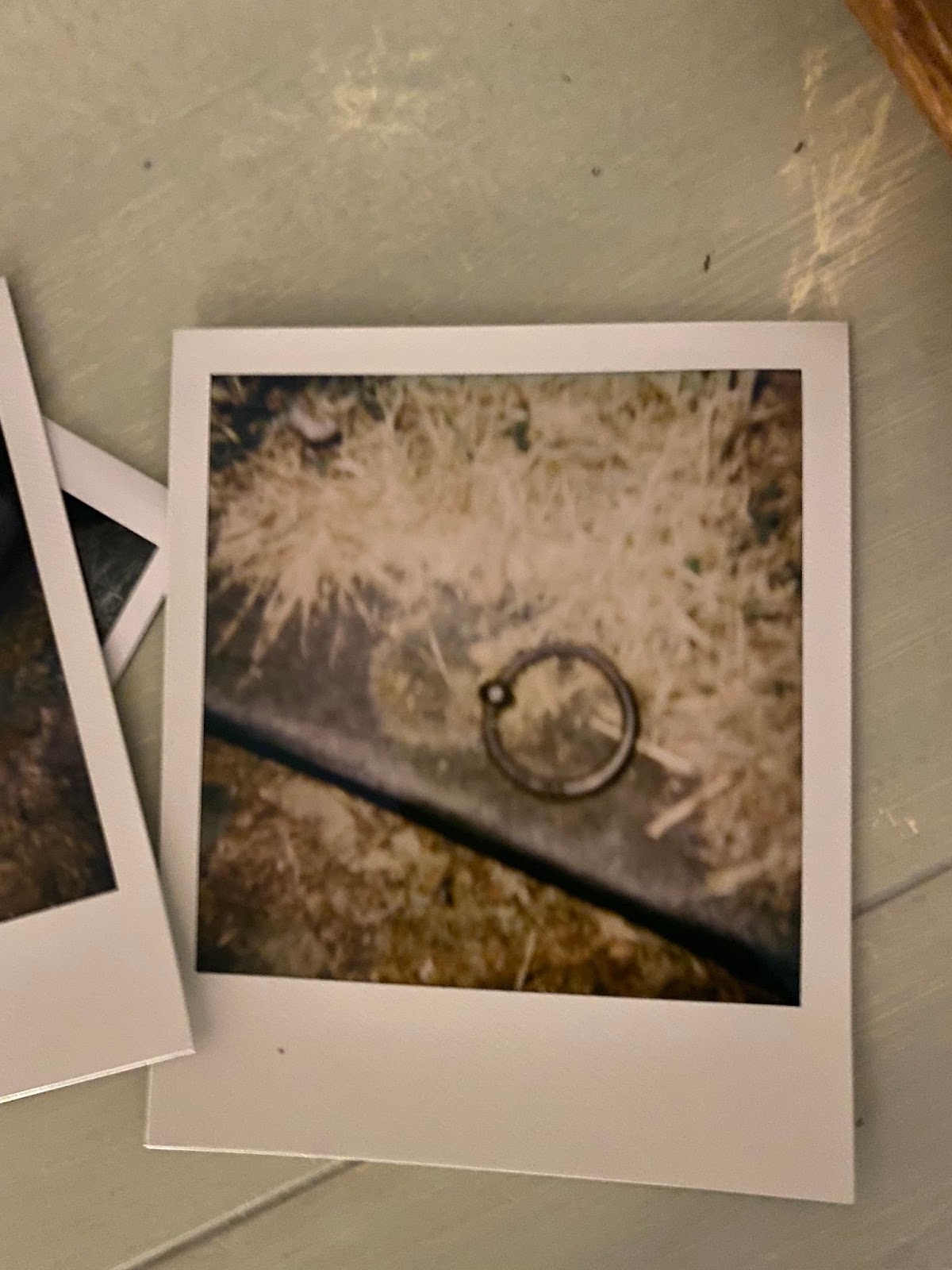
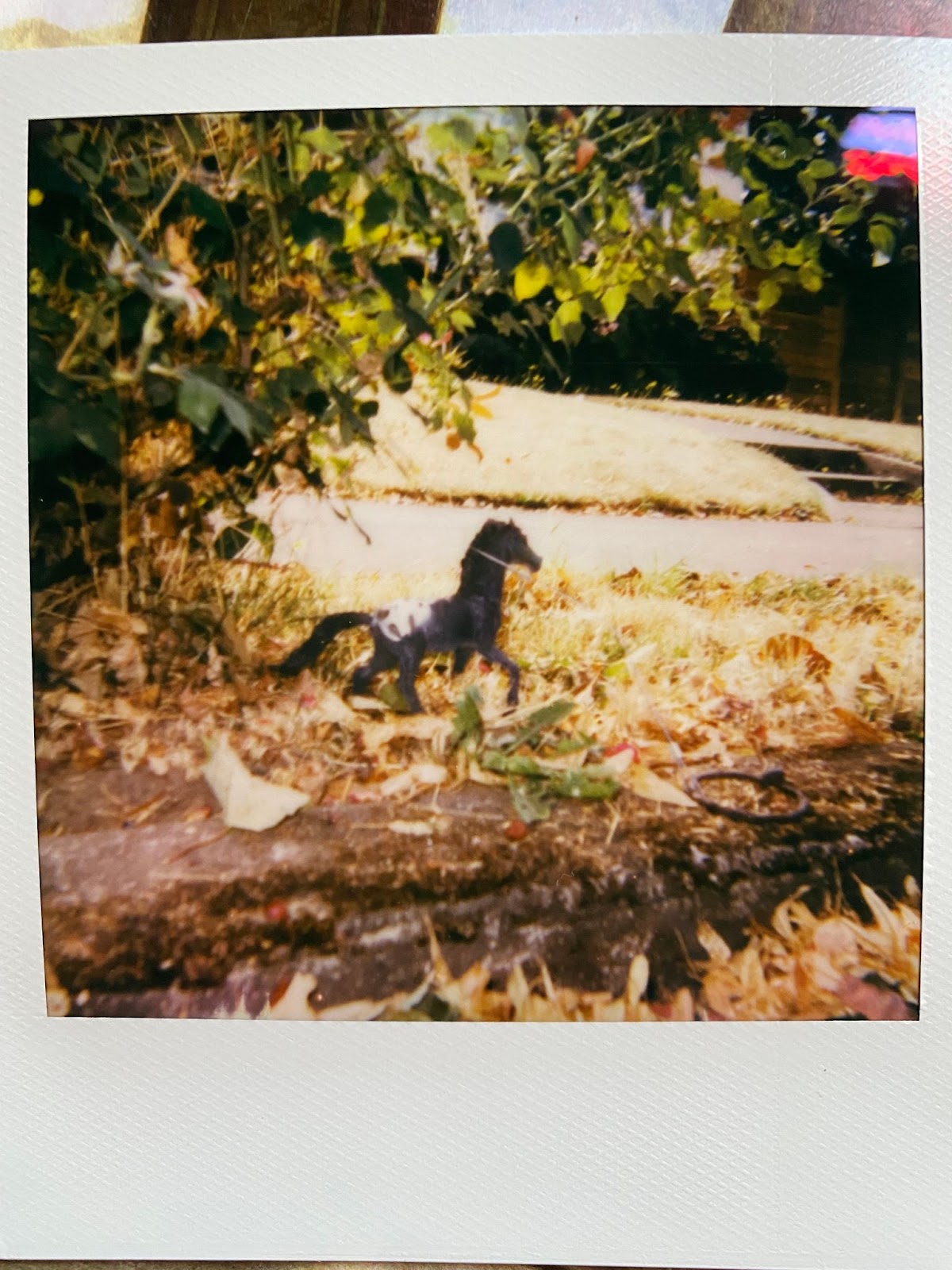
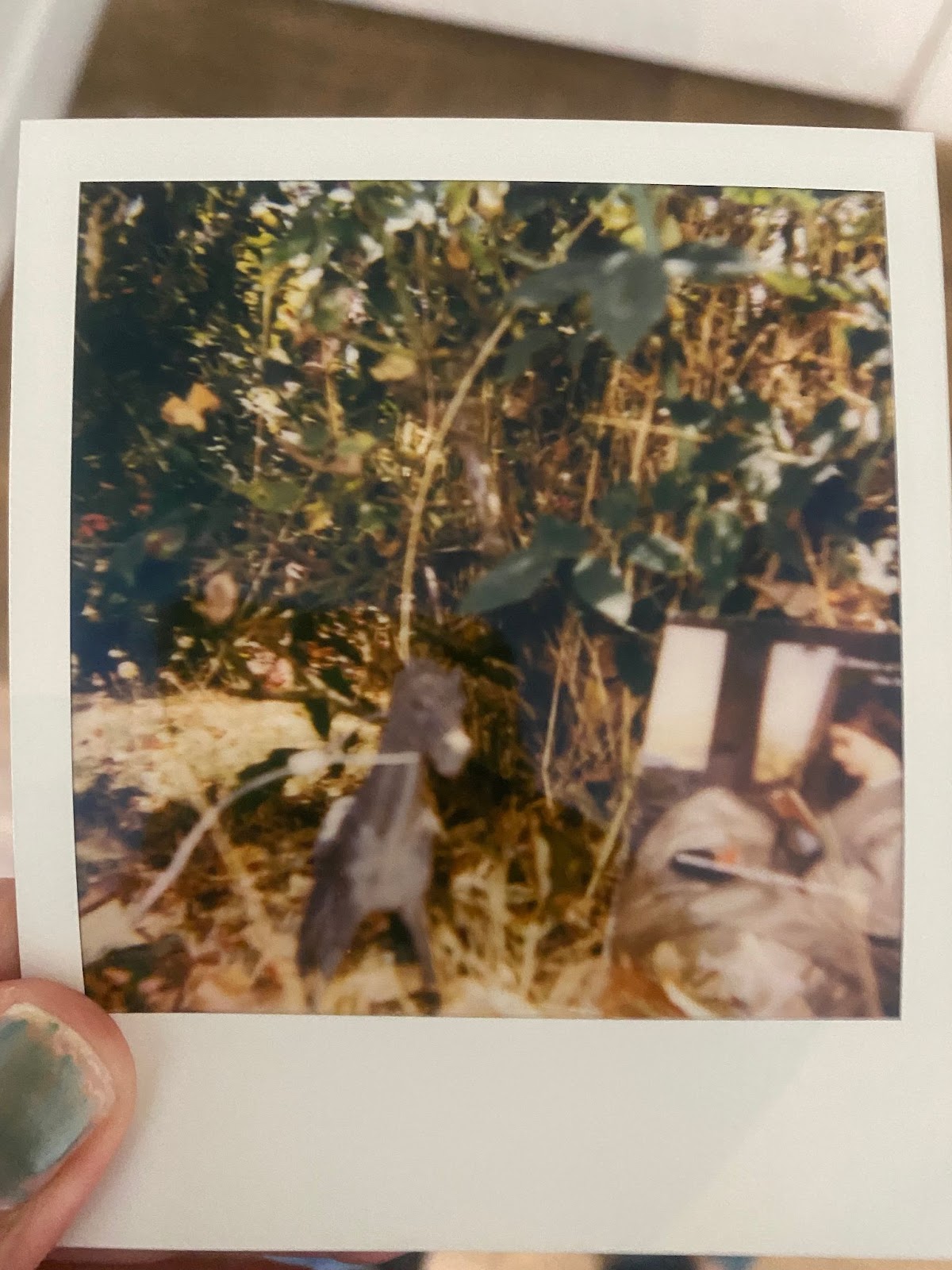
On my walks, I began to encounter, once again, toy plastic horses tethered to metal rings at the edges of sidewalks. The rings remained from a time when one might need to tie up their horse(s) while they went inside a shop or a friend’s house or their own. The tiny horse project had been around for many, many years—I think I began to see them in 2005 in NE Portland where my then partner and I lived, around the time our son was born. That first slow liquid year of our son’s life during which I walked with my son strapped into a chest pouch, initially facing me then eventually facing out to the world. We walked all over the neighborhood, miles and miles of walking, this before my son began to talk and I had my thoughts to myself. When we found a tiny horse tethered to the ring, I’d crouch us down to the curb, show it Oscar, and make up names for each horse, stories too, for as long as my legs and back could hold out. (Perhaps those horses continue to gallop through my son’s dreams.) Encountering the horses again felt like a sign to me, 17 years later, that I was on the right track, that being alone at this moment in my life was necessary, being alone in and with this moment, the pandemic era, all that necessary space between our bodies. I was grieving the end of my son’s childhood, mine too.
*
(I will pause to say that Gabrielle Civil has dones some brilliant writing about this experience of space between bodies amid the pandemic in her recent stunning book the déjà vu: black dreams & black time, which I highly recommend.)
*
I just picked up Marlen Haushofer’s novel The Wall, just translated from German into English for the first time by Shaun Whiteside and published by New Directions. The narrator goes on vacation with her cousin and cousin’s wealthy but unhealthy husband to a hunting lodge he has built in the woods, and the couple walks into the village but doesn’t return, and when the narrator tries to go to the village to find them, still in the forest, she encounters an invisible wall behind which she’s trapped and beyond which the human species, aside from her, no longer exists. The novel is about—thus far—her relationship with the creatures with whom she shares a landscape, in particular, her cousin’s husband’s hunting dog, Lynx. The writing shows a dynamic cross-species interaction, as described in the scene in which she first encounters this invisible wall:
When I finally reached the end of the gorge I heard Lynx howling with pain and shock. I walked around a pile of logs that had been blocking my view, and there was Lynx, sitting wailing. Red saliva was dripping from his mouth. I bent over him and stroked him. Trembling and whining, he pressed close to me. He must have bitten his tongue or chipped a tooth. When I encouraged him to go on with me, he put his tail between his legs, stood in front of me and pushed me back with his body.(9)
Lynx pushes the narrator back from the wall in order to protect her from the painful experience he’s having. Their bodies are touching—and often touch in the pages beyond this passage that I have read—in a way that suggests the narrator’s willingness to experience directly all the non-human beings surrounding her. Solitude gives way to feelings of loneliness. It also shapes a variety of other experiences, giving ourselves a better sense of who we are in the world.
Cain on page 34: “More importantly, it’s hard for us to see our own selves if we’re not ever alone.”
I return to Cain’s writing practice as one in which ekphrasis plays such a central role. In A Horse at Night, in reflection of darkness, Cain describes the process of paintings flowing into her body:
When I began looking at paintings of nighttime scenes because I wanted to write about them, I felt immediately comforted. It’s probably why I was drawn in the first place to write about darkness, but I wasn’t expecting to be soothed so quickly. It was a nice evening, going through different representations of dusk and twilight and gloom: two figures moving against a windy blackness; a dark Yosemite; Faust and Mephistopheles riding through a witches’ Sabbath; a summer night in Arizona. While I looked at these images, the darkness surrounded me as well, outside of my house. (39-40)
The paintings flow into her being in the present moment as her dreams about the figures and landscape flow back into the painting. To return to a sentence I quoted earlier:
And maybe more important, I began to feel that I could see my writing—not the words or the paintings—somehow in between. (27)
This sense of somehow in between language arises from Cain’s experience as a close viewer/reader—the visual experience and the language we use to conjure that experience—that, in turn, infuses her thinking about narrative, like a sort of meta-ekphrasis. Here are three stunning passages from A Horse at Night, pages 20-21, in which Cain, using words that define visual experience, considers various elements of story:
I find it enjoyable to make objects appear, and characters appear, which is different than how the characters look. And when objects and characters, and also landscapes, appear together, that is another way narrative happens for me…
I would rather work in front of or behind a narrative, where I can focus on these other things even if the story is still there. I want to leave a chain of images that remain in the reader’s mind. I want to write what heightened experience feels like…
In my own fiction, I sometimes find myself trying to conjure something that isn’t there, so that it both is and isn’t appearing. For instance, in my novel Indelicacy, when the narrator Vitoria is visiting the desert, she says, “I pulled my hair into a loose bun, but not like a dancer would do it.” There is no dancer in this sentence, yet I see the dancer. This is one way to haunt a sentence. Plainly. It is exciting to me to think I might haunt my own sentences, to believe that they can be haunted. That the reader might be taken over subtly, that there is room in fiction for an experience like this. And that something of this experience might remain. (20-21)
After I read this passage, I turn to a novel Cain discusses throughout A Horse at Night—Marguerite Duras’s (trans. Richard Seaver), The Ravishing of Lol Stein. This passage is from the very dramatic opening scene in which the narrator witnesses Lol Stein watching her fiance fall in love with another woman, which ends their engagement and forever changes the course of Lol Stein’s life:
The orchestra stopped playing. The ballroom seemed virtually empty. There were only a few couples left, including the one they formed, and behind the green plants, Lol and that other girl, Tatiana Karl. They had failed to realize that the orchestra had stopped playing; after the break, at the moment when it should have started in again, they had moved back together, like robots, deaf to the fact that there was no longer any music. It was at this point that the musicians filed past them one by one, their violins enclosed in funereal cases. They had made a motion as if to stop them, perhaps to speak to them, but in the end they did not. (11)
There is no funeral in this sentence yet Duras (and Lol) see the funeral in the violin cases, little coffins or body bags in transit, shut and packed and being carried from the room.
*
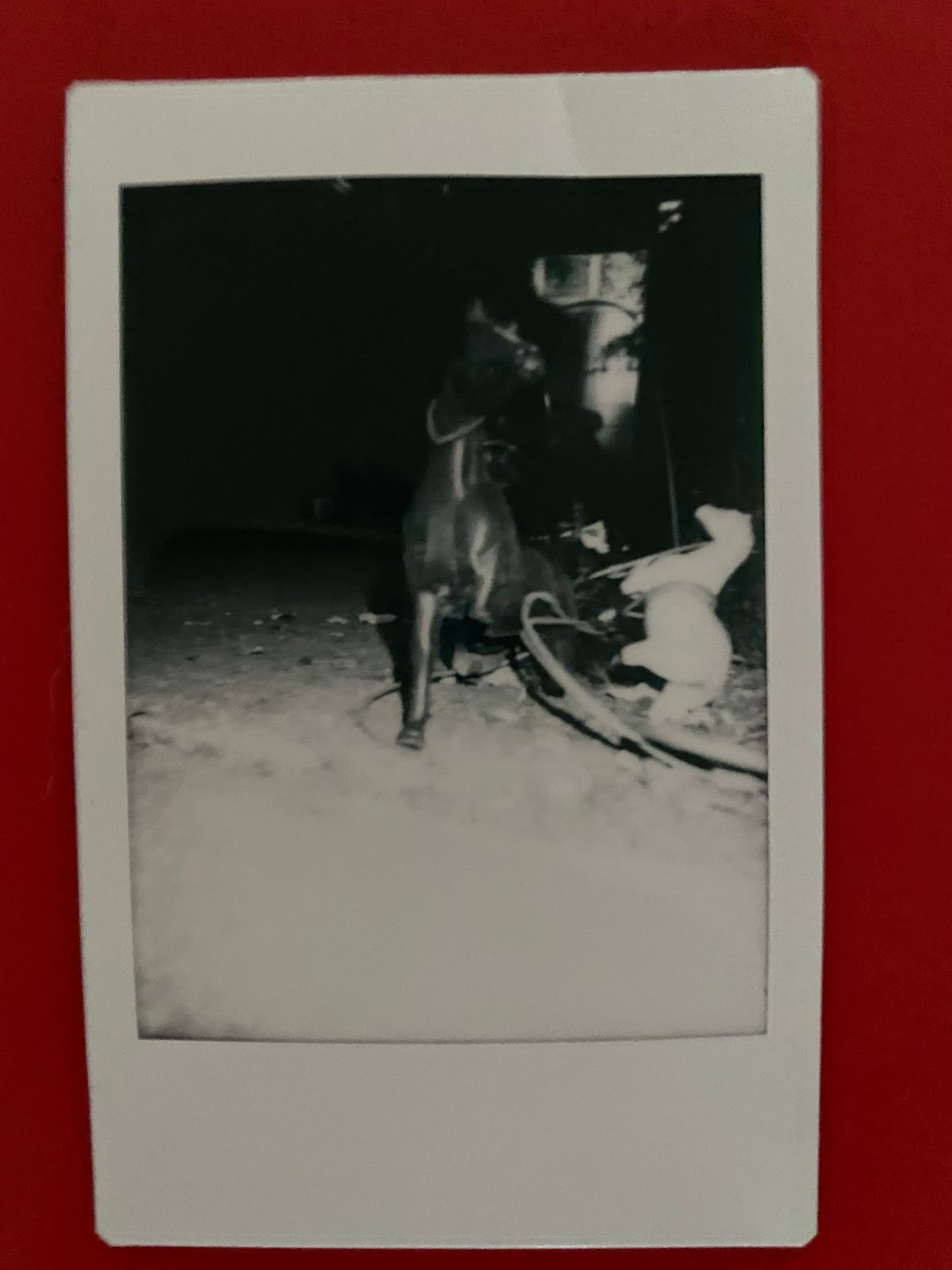
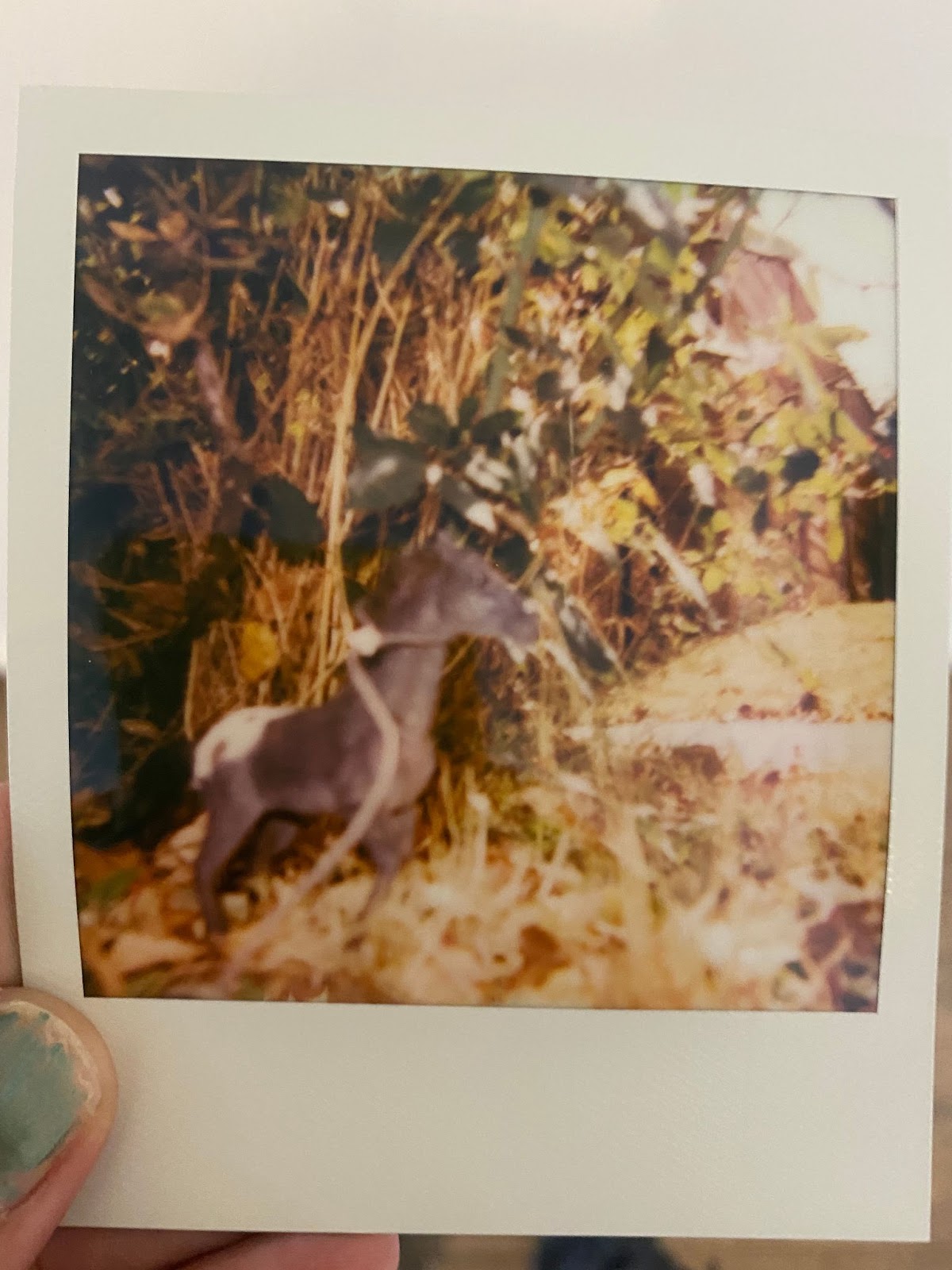
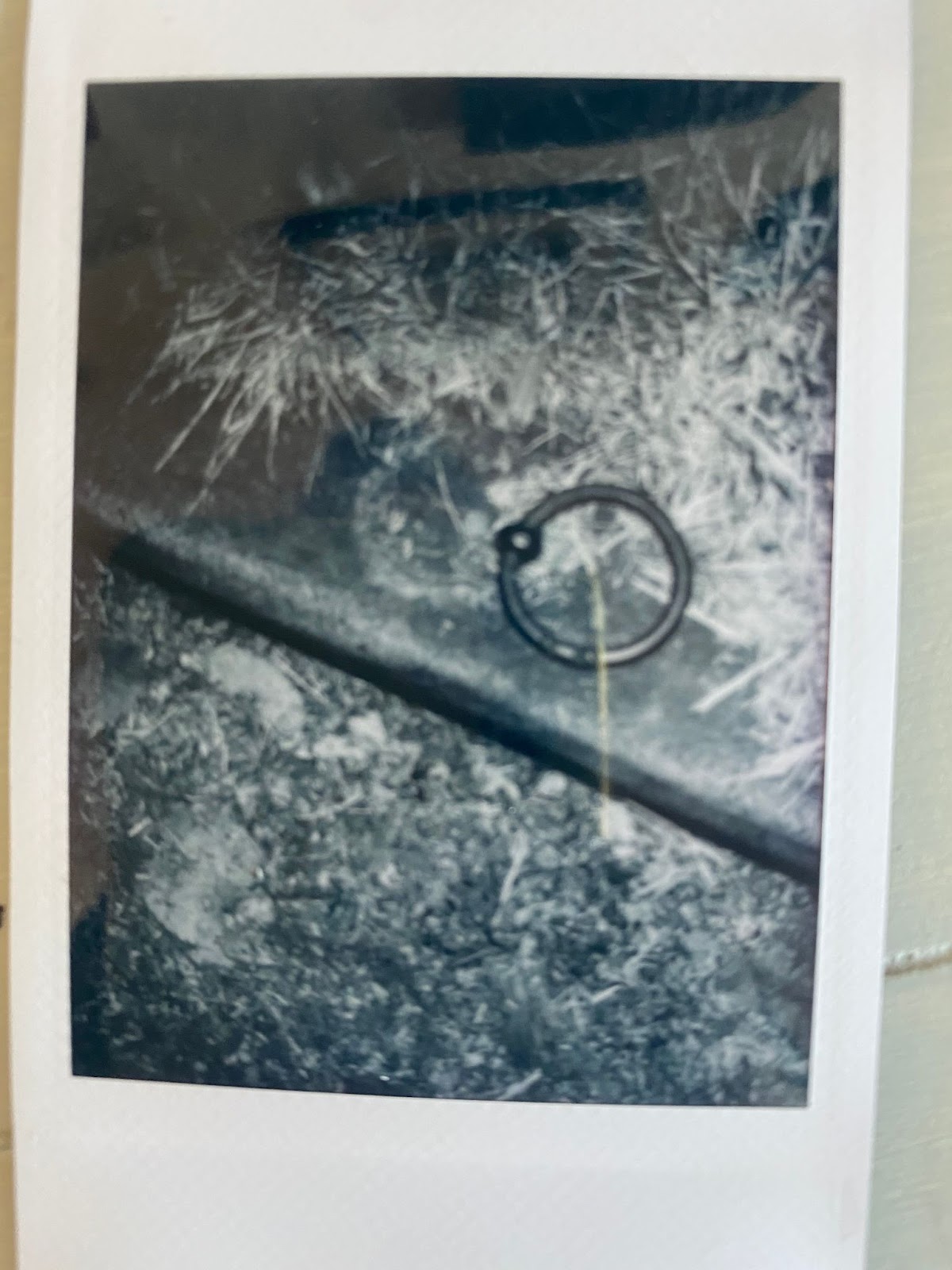
I have gone out looking for the toy horses tethered to the rings as I want to take Polaroids of them for this diary. I know there is one—a three-legged one—tethered to a ring near my apartment and I can even picture what side of the street to which the horse is tethered and how close it is to the busy biking roadway SE Clinton but it is not there. I cannot find it. I find photos of the rings but not the toy horses. Once I do find it, I realize I have walked by them—there are two horses and a bear—many times. They are so small, at ground level. I did not reshape my attention to locate something so small yet “small” is not the experience I have when I do view them.
*
Cain deepens the experience of her reading and writing by paying close attention, through language on the page, to her inner life, that weaving of feeling and thought—which comes first?—that helps us make sense of the mysteries we are becoming. She writes a section about her sense of authenticity and feeling, as she gets older, that she is losing something she once felt as a younger person:
My loss of authenticity is related to change, to how, as I’ve gotten older, I seem to have become a different person. In a way I have become strange to myself, and so how I am and feel around others has also been destabilized. I have more fears than I had when I was younger; I am more rigid: and there has been a loss too of the freedom I once felt, when the world seemed entirely open, and utterly beautiful. I don’t know if I can say that I have been able yet to move meaningfully toward authenticity in my life, but to face this loss with honesty has in itself felt significant. And in my writing I am able to be close to who I am, or at least access parts of myself I thought I had lost. (56)
I wonder about the connection between facing loss with honesty and accessing lost parts of selves. I mean to say, honesty in our lives, not entertaining illusions, speaking truths to ourselves and to our friends and family and community, facing and feeling difficult feelings, not avoiding them or numbing them, in turn, can reward the human artist with a fluid access to invisible realms. I want to live the remaining time I have in this mess of grief, to reach through and with this grief to live in connection with others. My friend the poet Emily Kendal Frey once told me Truth is love, and I believe this, and it only took me about 50 years to find this more authentic self. The things we have lost we cannot get back but we can feel the loss, we can, from these feelings, construct new bodies that connect out to other bodies, we can keep rebuilding ourselves and keep in touch with lost selves. We can see the gain in having had the experience in the first place. This is another way to haunt a sentence.
*
Over coffee, I tell my friend Janice about this diary and the toy horses, that I’m struggling to find them, and later walking her dog, she comes across one and texts me its location. I remember the time Janice and I, at the same cafe, a year before, sitting at the edge of the cafe’s courtyard, watched a moving lump begin to push up to the ground’s surface covered in wood chips. This lump, the size of a small loaf, tunneled just beneath the ground across the courtyard where it eventually surfaced near a fence post. Janice, whose relationship with flora and fauna is expansive and pouring—you must read her novel Imagine a Death, which dreams into the varied, interconnected lives of many animal species—identified the creature as a mole. I won’t speak for Janice but I know I didn’t want to see that mole surface. I wanted the mystery of what we were seeing—a partially surfacing creature-lump in swift motion across a courtyard—to remain beneath the ground just as I wanted the mole to remain protected too, tunneled, beyond human sight and hands. And to share the experience of that encounter with Janice, the mole’s tunneling then surfacing, felt connective and meaning-making, full of mystery, of possibility, of grief too, as if the triangle the three of us formed—mole : Janice : Jay—lit up a connection-web Janice and I hadn’t yet noticed, or no, we’d noticed it but hadn’t noticed it in this moment, in this particular form.
I understand now that my grief work was opening me up to these kinds of experiences, this kind of friendship, the intimacy of friends, even friends who see each other only a few times a year, that nourished me during such a difficult time, with so much space between my body and the bodies of others.
*
One among many strengths of Amina Cain’s prose is its ability to paint pictures with language. The title of the book—A Horse at Night—is a layered image, both discernible and open.
The horse at night, separate from humans, autonomous, its breath visible only to itself, exists unwitnessed by human eyes. It reminds me of this passage, or no, the entire prose piece, which I think of as an essay, by Clarice Lispector, “The Dry Sketch of Horses,” included in The Complete Stories of Clarice Lispector (translated by Katrina Dodson). Here are a few sections, spanning pages 451-455:
Stripping
The horse is naked.
Form
The form of the horse represents what is best in the human being. I have a horse inside me that rarely manifests itself. But when I see another horse then mine expresses itself. Its form speaks.
Sensitivity
Every horse is wild and skittish when unsure hands touch it.
He and I
Attempting to put my most hidden and subtle sensation into sentences—and disobeying my strict need for truthfulness—I would say: had it been up to me I’d have wished to be born a horse. But—who knows—perhaps the horse himself doesn’t sense the great symbol of free life that we sense in him. Should I then conclude that the horse exists above all else to be sensed by me? Does the horse represent the beautiful and liberated animality of the human being? Does the human already contain the best of the horse? Then I renounce being a horse and in glory I’ll go over to my humanity. The horse shows me what I am.
In the cold dawn
You could see the warm moist breath—the radiant and tranquil breath that came from trembling extremely alive and quivering nostrils of the stallions and mares on certain cold dawns.
The reader carries Cain’s image through the reading of the book and it’s not referred to or mentioned but the image is so strong and impactful you still look for the horse at night or you feel it is there all along and then you approach the book’s final paragraph:
But now that I am working on a new novel, I am not writing about shame at all. For the first time, it is love I seem to want to write about. I am still interested in pleasure. I am still interested in landscape. But how can I, how will I, write about these things now? I don’t think I have to figure it out beforehand; my subconscious mind is leading me. Already, under the pleasure, under the tropical landscape of the novel, I can see something ominous starting to arise. I have never been able to force myself to write about anything, or to avoid anything for that matter, and I don’t think I ever will, so I’ll just see what keeps arising, how I approach the difficulties of being alive in this particular moment in time. Once again, it’s freedom I want when it comes to writing, and in life, even within responsibility. Being unrestrained. Yet I know it will be different; it always is. Like a horse standing in darkness. The pasture gate has been left open. (125-126)
The human has left the gate open. The horse can wander off, can be free of fences and gates and the various forms of restraint humans gravitate towards. Cain wants—in her life and in her writing—to find the condition, that space, of freedom, sans constraint, and yet she understands “it will be different.” What will be different? Is it that feelin/being unrestrained happens only within spaces of restraint? Or that feeling unrestrained is only temporary? Or that feeling/being unrestrained feels different than we envision it feeling because we envision it as a concept, a future feeling/condition, as we feel restrained? And let’s consider the image: the horse in the dark, the pasture gate left open. (The “pasture of thought” gate left open.) Under the dark skies of night, the humans are not watching nor are they there to close the gate. And who left the gate open? And was it left open accidentally or purposefully? Or both at once? Considering the context—ART—the latter seems more valid, as in, artists attempt to make spaces for themselves to experience motion without restraint. And yet the horse stands in the darkness, the horse is NOT moving. It is unrestrained and perhaps its standing in the darkness, knowing it can walk through that open gate at any moment, is one way to express its freedom. Or perhaps it sees that the gate has been left open but it also grasps the truth, the reality of its existence, that the pasture fence still and will always exist. And what does it mean to stand under the cover of darkness? Let’s turn to the end of Cain’s own meditation on night:
A scene of darkness, whether in writing or art or film, allows for a break, and a bit of quiet, like having a small pillow laid over your eyes. Why shouldn’t we rest? But it’s not just resting, of course. I think it’s also a move to the unconscious mind, to what can be understood without thinking, without trying too hard. A way to sit for a moment with what you are experiencing in the work.
Whatever the reason, darkness captivates, holds its own kind of sovereignty, and we need the change from daylight to night and back again. We need to come down from the day. From Kazuo Ishiguro’s A Pale View of Hills: “Mariko moved across the room toward the window again. She was just tall enough to lean her elbows on the ledge. For a few minutes she looked into the darkness, her face close to the pane. ‘I want to go out now.’” (48)
Night, the time to go out, to return to the many selves.
*
And now thinking again about all of the rings on sidewalks I encounter, without horses tethered to them. Maybe this is the next moment Cain dreams about, the horse has trotted off, into the night and all that remains is that rusted ring.
The gate has been left open.
Let’s walk up to it together.
*
(This diary is for my friend Janice Lee)
*
Works Cited
- Boully, Jenny. Betwixt-and-Between: Essays on the Writing Life. Coffee House Press, 2018.
- Cain, Amina. Horse at Night: On Writing. Dorothy Project, 2022.
- Cain, Amina, Indelicacy. FSG, 2020.
- Duras, Marguerite. (trans. Richard Seaver). The Ravishing of Lol Stein. Pantheon. 1986
- Haushofer, Marlen. (trans. Shaun Whiteside). The Wall. New Directions, 2022.
- Lispector, Clarice. (trans. Katrina Dodson). The Complete Stories. New Directions, 2015
- Ruefle, Mary. Madness, Rack, and Honey: Collected Lectures. Wave Books, 2012.
- Shimoda, Brandon. “The Process of a Drawing Being Made.” University of Arizona Poetry Center, 2021.
Other books mentioned
- Adnan, Etel. The Journey to Mount Tamalpais. Post-Apollo Press. 1986.
- Carson, Anne. Short Talks. Brick Books, 1992.
- Civil, Gabrielle. the déjà vu: black dreams & black time. Coffee House Press, 2021.
- Lee, Janice. Imagine A Death. Texas Review Press, 2021.
- Levy, Deborah. Hot Milk. Bloomsbury, USA. 2017.
- Paul, Celia. Letters to Gwen John. NYRB, 2022.
*
Jay Ponteri directed the creative writing program at Marylhurst University from 2008-2018 and is now the Chair of PNCA’s Low-Residency Creative Writing program. His book of creative nonfiction Someone Told Me was published by Widow+Orphan House in 2021. He’s also the author of Darkmouth Inside Me (Future Tense Books, 2014) and Wedlocked (Hawthorne Books, 2013), which received an Oregon Book Award for Creative Nonfiction. Two of Ponteri’s essays, “Listen to this” and “On Navel Gazing” have earned “Notable Mentions” in Best American Essay Anthologies. His work has also appeared in many literary journals: Portland Review, Gaze, Ghost Proposal, Eye-Rhyme, Seattle Review, Forklift, Ohio, Knee-Jerk, Cimarron Review, Tin House, Clackamas Literary Review, While teaching at Marylhurst, Ponteri was twice awarded the Excellence in Teaching & Service Award. In 2007, Ponteri founded Show:Tell, The Workshop for Teen Artist and Writers, now part of summer programming at Portland's Independent Publishing Resource Center on whose Resource Council he serves. He teaches memoir classes at Literary Arts. He lives with his son Oscar and Oscar's pug MO.


