Tuesday, December 20, 2022

Advent 2022, Dec 20, Lawrence Lenhart, Toward an Unregulated Confessionalism: Prolegomenon to The Calling Party


Toward an Unregulated Confessionalism: 
Prolegomenon to The Calling Party

Lawrence Lenhart


*


With this sentence, I start a new essay.       Its concept is twelve years in the making.


Starting January 1, 2023, I will begin calling everyone in my phonebook. That's 431 calls total, or 1.18 per day for a year.

I am wary of this text [already] because it isn't mine. (Replace "text" with "life.")


How to begin writing a text for which I won't be the author? I stall by calling forth this prolegomenon.


My first false start was at a bonfire in 2015. I swiped through the digital rolodex as if it was a roulette wheel, and it landed on RM. I sputtered a bit before he hung up. Where I meant to break the seal, instead I soldered it shut.

"Each act of reading the 'text' is a preface to the next. The reading of a self-professed preface is no exception to this rule" (Spivak xii). Might someone, somewhere already be rereading the book I have not even begun writing?


The database is especially full of area codes in PA, OH, DE, AZ, and CA. My main milieus, strange avenues.  

This essay is no one's. Instead, "the text belongs to language, not to the sovereign and generating author" (Spivak, lxxiv).


I will call everyone, no exceptions: my best friend from the old neighborhood in Southwestern Pennsylvania; my old boss/lifeguard captain in Rehoboth Beach, Delaware; whoever picks up at the Buffalo Wild Wings in Akron, Ohio; my ex-fiancée's mom in Myrtle Beach, South Carolina; my estranged and incarcerated cousin in Huntsville, Alabama; my son's best friend's mom's best friend in Flagstaff, Arizona.

    I will likely call you too.


*


In communication theory, the Johari window is a “self-awareness tool that helps us understand the differences between how people see us and how we see ourselves” (Kesgin).


Fig. 1. The Johari Window


Epistemologically, the blind spot is where I wonder what you know about the frequency of my voice or the swirl of hair on the back of my head. It is what you whisper about me when I leave the room, the state, this relationship.


*


How about a new slur for millennials? Now they call us Generation Mute. An article by Alex Jeffries begins, “Ring, ring! Who’s there? If you’re a millennial, you have no idea.” Studies report that seventy-five percent of millennials screen their calls due to apprehension anxiety.        Most contacts in my phonebook are millennials, meaning perhaps I’ll only reach 153 of you 


—at least initially. I will call back. I will get through.


Starting January 1, 2023, I will begin calling everyone in my phonebook. That's 431 calls total, or 1.18 per day for a year.

I probably have “telephonophobia” too but have irreversibly committed myself to this dare

          
, a self-administered immersion therapy.  


“I do not care so much what I am to others as I care what I am to myself” (Montaigne). But what if we are made through others?


I am calling…

  • because I miss you and thus, I miss myself.
  • because I’ve forgotten you and thus, I have forgotten myself.
  • because I fear you and thus, I fear myself.
  • because I’ve neglected you and thus, I have neglected myself.
  • because I love to hate you.


In “Son,” Forrest Gander writes, “I gave my life to strangers; I kept it from the ones I love.” 


*


The Johari window idealizes the open arena as a site of public self-awareness. Think autobiography or personal essay. To get to the arena, one should strive to eliminate the hidden self through disclosure; reduce their blind spots by soliciting feedback from others; and mitigate against the unknown through self-discovery. 

Fig. 2. Essay Genres in the Johari Window


I believe each panel of the Johari window corresponds to its own unique epistemic domain of life writing. Self-awareness can be likened to autobiography or the personal essay; disclosure to regulated confessionalism; and self-discovery to meditation/revelation á la speculative nonfiction. But what kind of essay can be written from within the so-called blind spot? 

To clarify, most confessionalism is regulated. An author carefully selects sensitive information from their personal history and discloses it in the essay. However, this process of selection belies the artifice of the confessional genre. Selective disclosure has as much to do with the disclosive tendency as it does the concealing one. 

The personal essay says, “Our engagement ended because we were much too young.” The confessional essay says, “I called off the engagement because I was a shithead.” The speculative essay says, “In another possible world, are we still together in a loving relationship?”

Within the blind spot, though, I must admit the ways in which I cannot see me. Instead, I solicit feedback, ask others for their testimonials. The essential difference between biography and heterobiography is the emphasis on alterity. Crowdsourced heterobiography represents a kind of unregulated confessionalism. It is conveyed through a valve from which I cannot stop the flow. Here in the blind spot, my secrets are unsafe with you.

The heterobiography says whatever it wants about me, directly to me. 


*

Other Crowdsourced Heterobiographies

1. Marina Abramović’s The Artist is Present (MoMA; 2010) was a three-month performance in which the seated artist engaged in a mutual gaze with an audience of one thousand, most of whom were strangers, but also included friends, colleagues, and even a former lover (MoMa par. 3). 

My method—of reaching out to an audience of 431 people—addresses my writerly desire to be recognized as a writer by those who primarily exist outside of my artistic network. By inciting this encounter, I will momentarily, bureaucratically exist as an artist to each respondent. The consenting statement at the beginning of each call will include the following words: “this is for a new book project I’m working on.” This phrase will serve as a loose reminder that I am a writer. However, I will immediately cede that role as I coax my audience into the text-making. 

Q: Is it the public backdrop of MoMa that renders the seated artist as art? Is Abramović, later seated in her private apartment, inherently artless? A: Heterobiography begins at the turnstile, with the breach, in the gaze returned to sender. Only when the audience is present is her alterity ensured.

2. Bhanu Kapil’s The Vertical Interrogation of Strangers employs structured interview to elicit responses to a set of twelve questions. The questions are posed to woman of Indian descent living in India, the United Kingdom, and the United States. She then re-arranges the responses in docu-poetic collage. In her own prolegomenon, she writes:
—The project as I thought it would be:
an anthology of the voices of Indian women.
                              . . .
—The project as I wrote it: a tilted plane.
I have routinely referred to this as my favorite book.

3. Joseph Bradshaw calls Noah Eli Gordon’s Inbox a “reverse memoir, an autobiography composed using only others’ words.” Inbox is avowedly “uncreative writing” (Goldsmith), a copy-paste job that literally re-presents every email in the “author’s” inbox on September 11, 2004, arranged in reverse-chronological order. 

Gordon is nowhere and everywhere to be found in the manuscript. “Nowhere” as in this book was “written” with a mouse and not a keyboard. “Everywhere” as in Gordon is the book’s sole addressee. It is, above all, a heterobiography of the writer in thrall to “dinky pobiz stuff.” 

4. For The Last Interview, David Shields transcribed the 2,700 interview questions asked of him over the past forty years. Through a regimen of rewriting, editing, and remixing the questions, he arrives at an anti-memoir of sorts. According to the jacket copy, “the result is a lacerating self-demolition in which the author—in this case, a late-middle-aged white man—is strangely, thrillingly absent.” This is at least a conceptual solution to the existential question posed in the advice column, “Should White Men Stop Writing?” (The Blunt Instrument).    


*


I have made myself a slim deck of cards…


… to shuffle as the phone rings.


*

You think; therefore, I am.        I am building a new kind of answering machine. (This is not about posterity.) 


What then to do with the data of 431 phone calls? 

I will use a call recorder (Rev), transcription service (otter.ai), data analytics software (Dedoose), word processor (MS Word), and digital sound workstation (GarageBand) to create an audio-biography, a composite anti-memoir in the second-person comprised of my concatenated acquaintances. 


Derrida’s différance indicates both difference in and deferral of meaning.


Through différance, “meaning is disseminated across the text and can be found only in traces, in the unending chain of signification” (Mambrol).


The Calling Party is a collective heterobiography that signals the death of compartmentalization. A fuzzy feedback arena. 


One may choose to listen by area code/milieu. Or filter by theme. To hear all responses to, “What would be a fitting way for me to die?”  in succession, by toggling to Q13. There’s a randomizer too that produces a new text each time it is refreshed, resulting in a collage of sound bites. When I press that button on January 1, 2024, the resulting text will be the basis for the official codex for The Calling Party.  


*


If I’m being honest, parts therapy proved I was ready to write this book. Of course, it was never about the fear of confronting 431 others, but instead the fear of confronting 431 selves. 

Here I am, trying to reintegrate.

To survive the daily force field of complex PTSD, generalized anxiety, panic disorder, alcoholism, dyshidrotic eczema, insomnia, sleep paralysis, and auditory processing disorder.    

Internal Family Systems (IFS) says there is a family of sub-personalities within me, that I am my own psychic ecology. I am an only child; and yet I know how to brother and sister as I parent my kids. I mother even as I father. 

I am Lawrence and Larebear, professor and “dude,” normie and edgelord, Hilfiger and Hot Topic, devoted family guy and chronic bachelor, homebody and wanderer, etc.

The premise of IFS is that the sub-personalities are internally conflicted with the “core Self,” a phrase that makes me blush.   

The core Self smacks of personal essaying. If I am skeptical of the personal essay, it’s because I am equally skeptical (read: jealous) of the spectacle of the “core Self” supposedly anchoring it

For now, all I have are my sub-personalities. Subterranean, they must be called forth from the blind spot—by a therapist, exorcist, or you through this crowdsourced heterobiography. Please pick up.


*
Lawrence Lenhart is the author of The Well-Stocked and Gilded Cage (Outpost19), Backvalley Ferrets: A Rewilding of the Colorado Plateau (UGA: Crux), and Of No Ground: Small Island/Big Ocean Contingencies (WVU: In Place). With William Cordeiro, he wrote Experimental Writing: A Writer's Guide and Anthology (Bloomsbury, forthcoming). His prose appears in journals like Creative Nonfiction, Fourth Genre, Gulf Coast, Passages North, and Prairie Schooner. He is Associate Chair of English at Northern Arizona University and Executive Director of the Northern Arizona Book Festival.


Monday, December 19, 2022

Advent 2022, Dec 19, Nicole Walker, TikTok Manifestations by Non-Boomer, Non-Gen Z specimens: A Gen-X approach.


 TikTok Manifestations by Non-Boomer, Non-Gen Z specimens: A Gen-X approach.

Maxwell Sather (Gen Z), Zoe Sather (Gen Z), Nicole Walker (Gen X)


*


Abstract: TikTok is a media platform devoted primarily to social media users age 10 to 20. These users appreciate and are able to digest short-form films delivered to these adopters in 15, 30, and 60 second intervals. TikTok uses algorithms similar to older models of social media such as Twitter and Facebook. As the user ‘likes’ (by pressing an electronic button shaped as a heart) a video, follows a particular TikTokker, or searches for content by category, the algorithm then ‘pushes’ content that the user will fine diverting, amusing, or distracting. There is some evidence that how long one lingers on a TikTok video contributes to the algorithmic calculations but to an independent observer, this is difficult to verifier. Because a considerable number of TikTokkers are comprised of the Generation “Z”, our work here is to determine whether it is possible for a person of the Generation “X” to develop a TikTok strategy, or, algorithms willing, a following, without be called a “Boomer” by other participants. 

Keywords: Tik. Tok. Upload. Seconds. Chicken. 


Introduction

In an effort to promote Walker et al’s essay collection Processed Meats: Essays on Food, Flesh, and Navigating Disaster, which was released in March 2021 in the middle of a pandemic, Walker undertook an unconventional approach. While promotional plans had including serving charcuterie at various book-selling events, Covid 19 et al., prohibited the leaving of house, the sharing of food, and the selling of books. In 2022, Walker endeavored to produce several short videos and upload them to a new social media platform with the help of Sather et al. whose experience, attention span, and training prepared them especially for this work. 


Methods

Study Design: TikTok was selected as the platform for a dyad of reasons. 1. Subscribers to older model social media conglomerates like Facebook, Twitter, and Instagram had been previously inundated with attempts by Walker et al to entice them to read her collection, contaminating those platforms. 2. TikTok affords its users a companionable hashtag system, where different “tiks” can be sorted by “toks.” Thus, #Booktok proved the fecund yet unsullied ground by which we could conduct our experiment. 


Experiment One

Sather et al’s paternal parent is a filmmaker which is distinctly not the kind of video Walker intended to produce. Sather et al had both made TikToks with varying degrees of “likes” or “followers,” making them the ideal cinematographers for this study. Materials used included an iPhone 11, a frying pan, a refrigerator, boneless, skinless, chicken thighs, bacon, square-shaped Tupperware, and a copy of Processed Meats: Essays on Food, Flesh, and Navigating Disaster. While each videos strategies differed slightly, we adopted the ‘common’ form of video collecting, pointing the camera at the subject and engaging the ‘record’ electronic button. 

In preparation for the procedure, Walker first decided what would cook for dinner. Second, she found a passage in Processed Meats: Essays on Food, Flesh, and Navigating Disaster (the title of send book she has currently converted to Macro FN 32) that paralleled that particular meal. 

Limited resources, in both imagination and product, constrained the choice of specimen primarily to chicken. Cinematographer Sather positioned the camera implement of his handheld device toward Walker as she unwrapped boneless, skinless chicken thighs from the Foster Farms cage-free brand of chicken. In an attempt to preserve the integrity of the process, chickens raised in crowded but uncaged growth vessels determined our purchasing options. Once the chicken has been removed from the packaging and placed between layers of parchment paper, concern for the welfare of the chicken no longer limited the parameters of the experiment. In order for the chicken thighs to ‘cook’ evenly, thighs must be pounded flat. Sather et al recorded the flattening by aiming the camera implement from the handheld device toward Walker’s cutting board and rolling pin, thereby recording the process of pounding the meat into squares. Walker then laid the chicken thighs in an admixture of flour, paprika, celery salt, and garlic powder, covering both sides evenly, then lying flat in a beaten egg preparation, then again laid into bread crumb coating, designated “Panko.”

Here, the visual recording was halted and the audio recording commenced. Sather et al attempted to instruct Walker on the technological steps to implement an audio recording but gave up and recorded Walker as Walker read Processed Meats: Essays on Food, Flesh, and Navigating Disaster: 

I laid the chicken between wax paper and got out the rolling pin.

“Where’s the pizza?” she asked. She was used to rolling out pizza dough with me.

I showed her the chicken thighs and pointed out how fat and uneven they were.

“We’ve got to pound them thin,” I told her. “For chicken tenders, they need to be half an inch thick. Do you want to try?” She said yes but she hit the thighs with no force at all. “You have to hit them hard.” I took the rolling pin from her and gave them a whack. They submitted, flattening out, becoming more dough than flesh. 

In the middle of the next swing, Zoë yelled for me to stop. “That hurts the chicken.”

I understood her point. It was an odd thing to do: take these round thighs and make them flat. Chickens, factory-farmed grow so fat and thick, the chickens can’t walk. It’s ridiculous, I thought, as I continued to pound the yellow flesh into smooth medallions, that the chicken-growers spent so much time, energy, and DNA manipulation making their chickens grow unnaturally fat and here I am, just thinning them out again. But that’s the only way I knew how to make chicken tenders.


Experiment two

This procedure began as with Experiment one, with the packaging of the specimen: Walker unwrapping butter as she prepared potatoes for Thanksgiving. Given time limitations, Sather et al. cooked, read, promoted Macro FN 32 and conducted recordings simultaneously. It should be noted the Joel Robuchon suggests one pound of butter for two pounds of potatoes but not even Walker has been able to repeat this experiment without severe damage to both the lab, the specimen, and the personnel. However, these potatoes, peeled, quarter pound buttered, quarter cup milked, and whipped in the culinary centrifuge, turned out as expected: buttery but not disastrously so. The results of the promotional aspect of the experiment are less certain.  


Results: 


Experiment three

For the third experiment, due again to time limitations and the labile conditions of the specimen, Sather et al recorded cleaning the refrigerator instead of focusing on a singular aspect of a specimen such as chicken or butter as in experiment one and two. The cinematographer recorded Walker removing squares of Tupperware, petri dishes of microorganisms, and hazardous biologic material from the specimen for a 30 second interval and then recorded restocking the specimen with material inoculated with spores and microbes in conditions not yet catalyzed for spontaneous growth. 

Walker, still restricted in audio capacity, required Sather et all to adjust the technology for Walker to read from Macro FN 32: 

I spill applesauce down my shirt while trying to shape it into something palatable for Zoë. This little baby will not eat. Or, she won’t eat anything as perimeter-defying as applesauce. She will not eat anything that isn’t square, so I’m always sticking macaroni and cheese into the refrigerator in a Rubbermaid container. When it’s cold and hardened, I pop it out of the plastic and cut the newly formed mass into squares. Everything must be made square—because she likes the pointy edges or because I am limited to squares by my sculpting skills, I’m not sure. Mashed potatoes I take between my hands, pat into a square, and fry. Cucumbers, cut down the middle, edged, and quartered, she’ll eat. It looks strangest on the meats—chicken squares, steak squares. I try to resist taking her to Wendy’s daily for the pre-squared hamburgers. If you take the tops and bottoms off Wendy’s fries, they are practically Pythagorean.

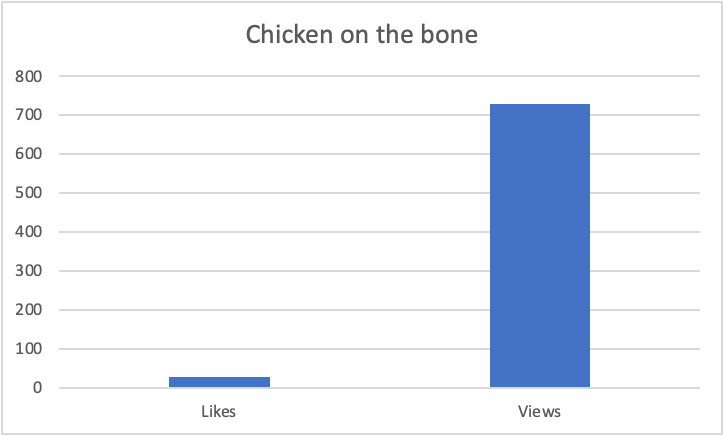
Because the specimen chicken has been well-studied herein and bone-in chicken may disturb our reader, the editors request Experiment four only be charted and cited. However, please note, Sather et al. coats the chicken in paprika, celery salt, and garlic powder in the data-collection. 

There is chicken on the bone. There is chicken off the bone. Chicken on the bone is the chicken I’d want in all its decadent renderings—by all I mean one. Fried chicken. There are many bone-in chicken recipes like chicken hindquarters in port and cream, barbecued chicken, buffalo wings, though they may be a kind of fried. But fried chicken is a testament to the beauty of the disarticulated chicken. Every piece a handhold. Every piece its own integrity. The coating wraps a thigh like snow, a breast like a scarf, a leg like a stocking to protect it from the cruel world of hot oil. Frying chicken is the nicest thing you can do to a dead chicken. 

But there are some who cannot eat the chicken on the bone. Breast of chicken, boneless thighs, cubed in korma, rolled cordon bleu, that’s doable. At the bar, spicy drummette in my right hand, hot sauce on my cheek, a pile of bones in front of me, I turn to my friend Ander, who will not eat the boney chicken but is currently eating chicken tenders. I do not comprehend his reluctance.

“It’s the same thing,” I argue.

“It’s not.” He pushes my plate of sticky bones further away.

“But you eat meat. Chicken. Steak,” I say. 

“I prefer hamburger,” he says.

Perhaps he does not like the resistance of muscle.


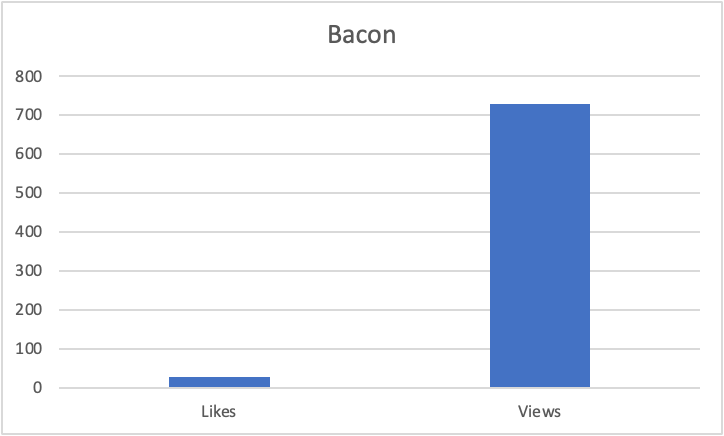
A final experiment, henceforth referred to as Experiment five, produced outlying results. While the primary visual record is of the specimen frying in a pan, inferences may be made that specimen bacon, while equally subjected to unseemly living and death situations, is easier to render digestible because of its exuberant effect on the tastebuds, even as perceived through a visual medium. The data here thus outlie our previous experiments but are noted for significance. Please note that while the inputs trend higher, the ratio remains the same. Sather et al include these data for reference only. 

During the H1N1 pandemic scare, I start stockpiling groceries. I buy twelve cans of Cento tomatoes, twenty boxes of spaghetti. It’s not as if I think the grocery stores are going to close tomorrow. But I should start preparing—part as pure logic and part as an offering to the gods of swine flu. I buy two pork tenderloins, two pounds of bacon, and a saver-pak of pork chops. A little protein in the form of cheese won’t save me but a lot of pig might. I’ll fight fire with fire. I’ll develop my own antibodies to the H1N1 out of bacon. I realize that it’s not the pig that will kill me, but, lacking any other sort of game plan, I reason that pig is a prophylactic. I will eat him homeopathically.


In conclusion, it shall be inferred that TikTok, while a forum designed for a generation well-practiced in giving short-term attention and incessant dopamine infusions, other generations may learn to adapt and avoid being called “Boomers” if collaboration with the generation Z may be forced. However, we must conclude that becoming a TikTok sensation is not likely. These experiments must be repeated for results to prove valid. Future study is indicated in the specimens of pomegranate, beef tongue, and beef Jell-o. The larger conclusions may be even less promising. Self-promotion is an embarrassing sport and the promise of finding book readers in a TikTok world is ever shrinking. And yet, the show must go on. 

Notes: Walker neglected to push “post” on Experiment one so Experiment one should now be imagined as Experiment five. Walker also included two additional hashtags: #food and #chickentenders which garnered, we believe, more views. It also drew three comments: “Is this a book? It seems like a book.” And “Thanks for the dating advice, coach” and “This seems like an audiobook.” And “You should write a book.” These comments seem linked to the fact that Walker neglected to record an image of Processed Meats: Essays on Food, Flesh, and Navigating Disaster. Walker’s Macro usage has been suspended until further investigations can be conducted.  

Chart for Experiment One updated as of 12/17/2022, 11:05 a.m.: 


*


NICOLE WALKER is the author of Processed Meats: Essays on Food, Flesh and Navigating Disaster, (AKA Macro 32) The After-Normal: Brief, Alphabetical Essays on a Changing Planet, Sustainability: A Love Story, Where the Tiny Things Are, Egg, Micrograms, and Quench Your Thirst with Salt. You can find her at https://www.facebook.com/nicole.walker.18041 Twitter: @nikwalkotter and website: nikwalk.com and TikTok @nicolewalker263


Sunday, December 18, 2022

Advent 2022, Dec 18, Julie Lunde, 100 Essayistic


100 Essayistic

a cover of Philip Ording’s 99 Variations on a Proof
which is a mathematical cover of Raymond Queneau’s Exercises in Style

Julie Lunde


*


If you give an essayist a math problem, for instance: 
x3 – 6x2 + 11x – 6 = 2x – 2
she’ll say, 
Fuck math, I’m an essayist.
Or else she might say, 
I love math, but I haven’t done it in years, I’m an essayist.
If she is a certain kind of essayist, she might respond to your equation with an abstract but ultimately unhelpful and likely pretentious allusion: 
“To know x = to know (everything – x).” [i]
Or else she might offer an equally ill-fitting, only vaguely math-adjacent, but more fun pop culture reference: 
“The limit does not exist!” [ii]
If neither one of these quotes feels sufficiently satisfying, she might begin again by retracing a tangential anecdote: 
There was a math teacher at my high school, I forget his name, who was married to the history teacher—I forget hers, too. They always held hands in the hallways. He was rumored to teach in hyper-speed so he’d have two whole weeks free at the end of the schoolyear to tell his students the story of how they’d met; apparently, it was The Greatest Love Story Of All Time. But his students were sworn to secrecy, and I never took his class…
If the essayist is sometimes a little uncomfortable with the personal nature of her chosen genre, she will choose to reply with an alter ego to help relieve the burden of the first-person, to speak with a stand-in sometimes called the speaker (where speaker ≠ writer), sometimes the essayist, or sometimes even just a single, simple letter, an ‘I’; which, in its vacancy, can become universal, a functional placeholder for multiple possible truths.
Let ‘x’ be a real number. 
If she loves a good braid, which what essayist doesn’t, she may opt to weave in another thread, which will, of course, feel random at first:
The first game of ‘ultimate,’ also called ultimate frisbee, took place in a parking lot at Columbia High School in New Jersey, in 1968. The sport was the casual after-school creation of a group of friends, but its appeal proved contagious; an alumnus of CHS got his hands on a copy of the rules and founded an ultimate team at Staples High School in Connecticut in 1970, and before long, there was a CT league, and from there the trend went national.
The essayist might consider numbering her paragraphs, to make her essay response into a fragmented work, as in this classic of the genre:
“100. It often happens that we count our days as if the act of measurement made us some kind of promise. But really this is like hoisting a harness onto an invisible horse…” [iii]
If she chooses to do so, she will then consider the way a numbered fragment is formatted. She’ll look back at the page full of fragments and think:
This looks just like math homework—like a sheet of word problems.
If you try, then, to redirect this essayist to your chosen problem by restating it, this time more directly: 
100. Let ‘x’ be a real number. If x3 – 6x2 + 11x – 6 = 2x – 2, solve for x.
The essayist is likely—at first—to once again skirt the question. This isn’t because the essayist doesn’t love a good math problem, but rather because she thinks a good essay, and a good essayist, always resists the finite or definitive answer. A good essay, she thinks, thrives in irresolution, indecision, uncertainty. As she’ll be all too happy to inform you:
An essay, from the French essai, is an attempt. It isn’t an answering, but a mind at work.
If the essayist is a writing teacher of some kind, perhaps the instructor of a college composition course, she might include this etymology lesson in her class materials one day; and if one of her students is playing games on their phone during that class, the essayist will recall Mr. Wetzel—who, of course, taught the essayist’s high school precalculus class and wrote her college recommendation letter, who didn’t give the essayist too much flack when she got bored of math and began solving the NYT crossword in class; who, in fact, after she’d gotten into college, would regularly stop by her desk to say:
You got 24-Down wrong. The first letter is ‘S’.
When some of the essayist’s students (the engineers) ask her then for some more concrete rules, what they should or shouldn’t use as a title, whether their essays should be five paragraphs or six or seven, and if there’s a good formula or template for an A+ conclusion, she’ll take solace again in writing’s lack of solutions: 
There’s no wrong answer when it comes to writing something new, something original, an essay that is yours.
She’ll even give them a second, more math-inspired response: 
There can be multiple correct answers (in writing). Multiple factors go into it (writing beautiful essays).
And if those students ever roll their eyes at the essayist’s exuberance for essay writing (which, let’s be honest, would not be unwarranted), she will find herself recalling her old AP Calc teacher, Mr. Wilkes, who bounced around the front of their classroom at Staples High with a puppy’s energy, puppy-eyed, exclaiming: 
I’m teaching you guys the highest level of math I know! Think about that—you’re only what, seventeen, and one day soon you’ll know more advanced maths than I do now! By the time you’re my age—and I’m not that old—think how much more advanced you’ll all be!
He was assuming they would continue studying math in college. His students, including the essayist, used to make fun of his overenthusiasm a little. Thinking of this now, the essayist will feel sorry and a little embarrassed that she never took another math class after that.
Instead, she studied how to become an essayist.
Maybe she stopped taking math then, when she started writing, because she assumed she no longer had a use for that kind of thinking—that, as a creative writer, now, she was done forever with all that hard logic. Or maybe she’d just fallen into the bad trap of demanding real-world applications from her academic pursuits—that common failure of imagination, learning not for learning’s sake, which her high school teachers had always been so frustrated by, and accustomed to:
“In my Pre-Calculus class last year, when Mr. Wetzel was asked, “When are we ever going to use logs (logarithms)?” He wisely replied, ‘In a fire.’” [iv]
By now, the essayist will be feeling the need to perform some essayistic research. She’ll start out by googling how to factor cubic equations but will get sidetracked clicking through links, chasing stray inquiries, seeking endless revelation ‘til she’s thick in the archives of her high school’s newspaper and then knees-deep in the axiomatic philosophies of David Hilbert, a mathematician who argued that geometry’s central concern was simply the relations of otherwise arbitrary terms:
“One must be able to say at all times—instead of points, straight lines, and planes—tables, chairs, and beer mugs.”  
The essayist may then take a different tack completely, and decide to deliver an aside to the reader stating her essay’s intentions directly:
I want to show you, show myself, how math is essayistic—how essays are math, or mathematical. I’m trying to examine how that overlap works.
Shift again, to the indirect, back to research. Another math teacher at the essayist’s high school, Mr. Jolley, was niche-famous for being a ‘Johnny Appleseed’ of Ultimate Frisbee, meaning he’d been one of the first to help the sport spread. Legend had it he’d founded the second ever Ultimate team at her high school in the ‘70s, out of a group of some math students he’d had who loved frisbee. 
“Last Wednesday, Al Jolley, Staples math teacher and frisbee coach, was seriously injured when he attempted to make the famed “oral grab” (trying to catch a frisbee in his mouth). Suffering a broken jaw and loss of three teeth, Jolley commented, “shirpvgmn….’” [v]
If you are left wondering how you got here and try, one last time, to rephrase your original question in a different way:
Suppose that among four consecutive numbers, the product of the first three equals twice the third. What’s the fourth number? [vi]
The essayist will hem and haw. She’ll change the subject again, not because she’s resisting, but because she’s just discovered she doesn’t actually know how to solve this one. She’s forgotten all her math moves, so, as essayists are wont to do when their chosen tools fall short, she’ll look elsewhere for a functional answer of sorts:
“All players are responsible for administering and adhering to the rules. Ultimate relies upon a Spirit of the Game which places the responsibility for fair play on every player. Highly competitive play is encouraged, but should never sacrifice the mutual respect between players, adherence to the agreed-upon rules of the game, or the basic joy of play.”  [vii]
An essay, too, has no referee. Thus the essayist may better be able to understand its basic relations if she is able to abstract some of the above terms, and say—instead of respect between players, agreed-upon rules of the game, and basic joy of play—the essayist’s fidelity to a reader, the expectations or qualities inherent in language, the basic joy of play (this one stays the same). 
Group like terms on one side: x3 – 6x2 + 9x – 4 = 0.
Math, as play which, too, operates under agreed-upon rules (let ‘x’ be a real number), might reasonably make for a natural gateway to a sport like Ultimate; or, at the very least, Ultimate’s proliferation by a math teacher and his students makes some sense. Both are concerned with the spirit of the game. Math isn’t just about answers or practical use, but also about fire, pursuit:
Rewrite to seek out commonality: x3 – x2 – 5x2 + 5x + 4x – 4 = 0.
At this point, the essayist will pause solving to consider how her high school math teachers instilled in her the same stylistic values which she still strives for in writing today, how they had waxed rhapsodic not over correct answers, really, but rather over their explanations, mathematical proofs:
Take a look at this solver’s organization, the elegance of expression, their creativity in seeking out the solution this way….
The essayist’s obsession with tracking the mind at work closely echoes math’s insistence on showing one’s work. The word proof originates from Latin probare:
To show; put to the test; inspect.
In a weird way, these math dudes, whose classes she remembers much better than most of her English ones, were the very first essayists she ever knew. No wonder, now, when the essayist is locked into the central heat of writing an essay, she always feels herself becoming more analytical, calculating; not formulaic, but determined to inspect the problem from all sides, willing to experiment with a range of tools…
Factor: x2(x – 1) –5x(x – 1)  + 4(x – 1)  = 0.
The essayist had not given up math at all, she’d just started solving with language rather than numbers. 
Factor: (x2–5x + 4) (x – 1) = 0.
If the essayist has gotten this far in her proof, she will be startled to make what, once made, is an obviously accurate realization, a turning point with proven veracity, shown out in her work: the essayist’s Ultimate game, her Greatest Love Story of All Time, is and has always been, since high school, math. 
Factor: (x – 4) (x – 1) (x – 1) = 0.
The correct answer, or a mathematician’s desire to seek it, isn’t irrelevant, exactly, but merely one of the necessary conditions for the game, a prerequisite for attempting to solve, much the way the essayist is guided to the page in pursuit of elucidating truth, or Truth. That truth is, in many ways, an arbitrary term; the meat or measure of any proof or essay is not the solution but how it is solved, how the game is played out, which makes any answer somewhat beside the point. But the win, admittedly, still feels rewarding:
x = 1, or x = 4.
*


[i] Pataphysical Essays by René Daumal.
[ii] Cady Heron, in Mean Girls.
[iii] Bluets by Maggie Nelson.
[iv] “Counting On Math in the Real World,” Inklings (Staples High School Newspaper). 
[v] Ultimate History, Staples Grads; https://www.ultimatehistory.com/founders/Pg/staples.html/.
[vi] 5 Puzzle, in Philip Ording’s 99 Variations on a Proof.
[vii] Spirit of the Game, World Flying Disc Federation.


*

Julie Lunde has an MFA in nonfiction from the University of Arizona. Her work has been published or is forthcoming in Western Humanities Review, Pigeon Pages, and the anthology Letter to A Stranger: Essays to the Ones Who Haunt Us (Algonquin, 2022) among other places. She serves as an assistant nonfiction editor at DIAGRAM and is the writer in residence at her dog's house. See more at julielunde.com.

Saturday, December 17, 2022

Advent 2022, Dec 17, Michael Martone, Ten and a Half Short Essays on the Short Essay


Ten and a Half Short Essays on the Short Essay

Michael Martone


*

Train Car Graffiti

The tags have largely disappeared from the urban canvases of subway cars and commuter coaches. Metal alloys were employed to foil the paint’s adhesion, the cars and yards surveilled. No, now the art is affixed to the pristine sheets of steel herded along the desolate rusting right-of-ways, the corridors of ruins, owned by the few remaining national railroads stretching across the nation.
     Boxcars and reefers, grain hoppers (with primer coats of paints the color of after-dinner mints), gondolas hauling scrap metals to mini-mills, and well-cars stacked with containers (not painted as the containers never dwell long enough to be tagged), flat cars, tank cars, litanies of letters, hieroglyphics, camouflages, ideograms, and the punch of punctuation. Their connecting knuckle-couplers could be commas, I think. Look! See what is done to the perforated siding panels (white cliffs to coat!) that protect the sky-scraping covered auto-racks! The fossil records written there!
     The economies of rail and scale are such now that the trains are longer and slower though they are express, stopping only in major cities and ports and mines or along long sidings to wait for longer trains to pass by. These drags are handled now by only one or two humans (an engineer, a conductor) stationed on the headend of the train. No way they are taking any notice about what is going on on the train they pilot. Their bosses would have them gone as well. Robotic trains would maximize profits….
     It once was the paint, the varnish and the livery of the cars, that ID-ed the companies (there were hundreds), advertised their speed and service, made proprietary their trademarks, illustrated the flanks of their rolling stock with maps, plastered with place names their cars, polished and edited, connected. But that’s all gone….
     Cars now are free-floating thought balloons, galleries on wheels, font books and follies, scrolling essays penned by some Pascal (in primaries and pastels) somewhere far away (the infinite spaces between the cars!) from where I am, here on this forgotten siding, reading these imaginary languages, in scripts that are at once organically expressed (in contrast to the framing machined edges beneath) and constructed in such a way (shading and chiaroscuro) the animated letters, trundling by, jump off their pages of steel like depression-era harlequin hobos.


*

Junk Sequencing 

There are regions of the human genome that contain strands of DNA that are not coding, that are noncoding. That is to say these long sequences of the genetic basic base nucleotidal bits of alphabet (A-T and C-G) seem to be just there…. There? Fallow? Scrapped? Forgotten? They express no protein that creates eye color, say, or the tenth cranial nerve, the vagus, that wanders through the gut, the heart, and the larynx….
     Junk sequencing then is a kind of debased basic babble of inarticulate nitrogenous bases, neutered nucleotides. The proportion of coding to noncoding DNA swings significantly from species to species. The bacteria’s detritus makes up a mere 2% of its genome. In humans, the clutter we carry, the trash we horde makes up 98% of genomic static. No one knows. No one knows. Or maybe the bacteria know what all this material is there for. Leftovers from some long-forgotten shell of the former beings we were being? The drafts of essays that were written and never erased, shelved, stored? Juvenilia? Marginalia? Glosses that have grown dull? Scribbles that are part of our “papers” we will donate to the Lilly Library when we retire?
     I attended The Johns Hopkins University in Baltimore. My mother, back in Indiana, would tell her friends that her son attends The Johns Hopkins University in Baltimore not saying what I was studying there, allowing the implication that I would become a medical doctor or biological researcher to float on the air, allowing that to go unspoken, a given. I was, of course, attending The Johns Hopkins University, where the human genome was then first being mapped, to “study” writing in its Writing Seminars, a long way from its laboratories and surgical theaters. I let it go….
     Though I did, one time, assist a friend, a graduate student in microbiology, as he practiced the new technique of gene splicing, gene editing. I watched as he introduced a junk sequence from a frog’s gene into the waiting arms of a random E. coli.
     Gertrude Stein too attended The Johns Hopkins University in Baltimore “reading” in medicine to become a medical doctor. I still have a clipping taken from the SUN newspaper that advertises a house for sale where she once lived. Have you read her books? Have you seen how thick they are? How many pages of text? Word after word after word? How much had she had to write, the noncoding coding, to produce this this: “A rose is a rose is a rose?” Or this this: “There is no there there?”
     “There is no there there” is, by the way, the epigraph attached to my unpublished thesis, written over forty years ago, that now resides in the Eisenhower Library at The Johns Hopkins University in Baltimore called Cardinal Numbers, Ordinal Lives.


*

“Catch!”

There are websites where you can buy a bomb or a missile, a shell, an artillery round. The transaction is with the Ukrainian military. They will then send the round downrange on its way toward the invading Russians to stem the tide, to cover a friendly advance, or even do retaliatory damage behind the enemy’s lines, a kind of potluck of targets. With the purchase (everyone likes to think of it as a “donation” to the cause), you have the chance to have a message of your choosing penned, chalked, or painted on the ballistic flanks. The messages need to be pithy, brief, graphic, specific of course. There are pictures of the bombs bedecked. Soldiers snap a shot before the shot is shot. There are rifled cheers and jeers, puns and wordplay, obscene wishes and concrete descriptions of the target, the explosion, the aftermath of the pain on its way. Special delivery is a theme. The idea of a gift is turned inside out like a kernel of popcorn, iconic, ironic. Around Easter, the season of resurrection, “Here is an Easter Egg that finds you.” They are, in their way, elegant projectiles of ragged raw spontaneous anger. And I am trying to end this paragraph with some way to explode the notion of the pen being more powerful than the sword or how lethal language can be especially when applied to the skin of a shell made up of a high energy propellant and a depleted uranium slug, a projectile that projects physical rage, fury swaddled in a barbwire net of text.
     This is not something new. The British Museum has in its collection a lead slingshot (# 1851,0507.11) from the Golden Age of ancient Greece, almond shaped with a winged thunder bolt on one side and the high relief inscription DEXAI “Catch!” on the other. There are spent missiles from a Roman siege that tell the recipient to “relax your ass” and another taunts “you can’t hide from me,” decorations of penetration from a distance.
     Sticks and stones can break bones but words? I ask my writing students if they know about shaped charges, how modern munitions are constructed to “pierce” armor, concentrating the explosive expanding energy all into one tiny narrowed focus, a jet of sun-scalding plasma. I warn them! I use a trigger warning before I start up with this metaphor, adapting it to the way one might think about one’s writing, writing that selects minute details and then hyper-amplifies them. We do talk about the power of the written word, its energy, the focus. Its ability to pierce through, to devastate, to deliver. I warn them. It is on the way. I warn them, a message on a bomb I am about to hurl: “Catch this!” 


*

Visible Invisible Prisons

I have a lot to say about the postcard. I have thought a lot about the postcard. How it is an analog Tweet. How I think of it as a kind of prayer, not a vehicle of correspondence. One does not expect a return message. Tom Phillips, the creator of The Humument: A Treated Victorian Novel, died a few days ago so I am thinking of him (a postcard cliché!) and of his other big book, The Postcard Century: 2000 Cards and Their Messages. But the postcard, for me is always about edges and sides (the front and back), borders and frames. “Your message here.” “The address here.” “The stamp here.” There is even now a box along the bottom that is for post office use to print its barcode clearly to be scanned for sorting. The postcard by design is always about limits and fit. It is a puzzling box of boxes, quarantined, and partitioned off. As this essay about postcards is as well. I am always already running out of room….
     Now, when I do receive postcards, I have noticed how the writers (most of them new to the form) are novices to the particular problems of postcard composition. They send messages I must decipher not on purpose, mind you, but because for them to write a postcard is unlike any other writing they have ever done. They’re handwriting, for one, perhaps for the first time in a long time. They could type the card but what are the chances they have a typewriter? They assume if they sign just their first name, I will be able to suss out their identity. I know many Susans, Sarahs, Davids, Dans. They neglect adding a place where the card was written or sent, assuming, I assume (if they even know about the postmark and cancellation) that the PO will address the issue of routing. But the PO is all robots now and centralized distribution. No help helping me pin dowm the where of the person whose penmanship I am trying to detangle. No place for return address! Besides the PO’s mechanized intervention is overprinting much of the scribble (the barcode, the cancellation) if the mechanical teeth feeding the mail through scanners and sorters haven’t already eaten away at the card itself. 
     In “Postcards from the Maginot Line,” W.S. Merwin recounts the strange liminal space created when he receives intimate messages from someone he does not know or remember. Who is sending these semiprivate semipublic billets-doux? It is perhaps this particular space, this special theater, the occasional occasion, this whispered public address that attracts me to this kind of essay, the postcard. Even more than “purloined” letters with their obscuring envelope, the postcard hides itself in plain sight. Every kind of writing may be a collaboration between the writer and the reader in the making of meaning. But the collaboration that takes place within the confines of the postcard creates this unique and concentrated emotional escape and, strangely, this sublime imprisonment.


*

Slips

Ephemera

I enjoy meandering through the office buildings of the university where posting is usually prohibited on hallway walls, restricted to bulletin boards. But the office doors of professors provide a blank canvas to install ephemeral collages of all kinds. Texts and images create (in their recontextualization) found poems, juxtaposed jokes, startling defamiliarizations. To read the office doors is to do a kind of archaeology. You delaminate the layers and work the grid. It is also a mental documentation of the eccentric academic documentation of the absurd, the Kafkaesque giggles adhering to thresholds between high-functioning insanity and measly manufactories of meanings inside the offices. I always find when I read a well-encrusted, thoroughly scaled, and chain-mailed door, that I am often a tweedy Zeno enroute to paradoxical, Escheresque illusions. I riffle through the slips of foxing paper, paper consuming itself with the leftover acid it took to make the pulp into paper in the first place that now crumbles into crisp burned curling edges.


Memoranda

The Marxist, in the office next to mine who would work while listening to public radio classical music played loudly, would not speak to me. I asked if he could turn the music down. He wouldn’t answer. He didn’t speak to anyone. He didn’t speak, he let us know in a written memo, because speech could not be critiqued. In my office next door, I’d compose elaborate theses about communal space, privacy, what is meant by the “ringing” in the ears and the “wasting” of time. I would type these critiques up on an old manual typewriter, hammering the keyboard as loud as I could, making a racket. When I finished, I’d slip the bruised and battered paper under his door. 


Fortunes

Attached to the doors of many offices were slips of fortune cookie fortunes. I think the size of the little strips often worked in the overall door design while indicating the popularity of SWEN’s (the nearest Chinese restaurant) lunch special. The slips were counter punctual, a contrast to the letter and legal-sized sheets elsewhere, to the four-panel comic strips, to the posters with the frill of phone numbers, to the printouts of spreadsheets and memes. For me it isn’t so much about the fortune per se (the parodic aphorisms and obvious predictions) but the fortune cookie fortune writer. As a writer, I think about the fortune cookie fortune writer. I picture the writer in some cramped minuscule office somewhere typing out the pithy pronouncements, a pantomime of “The Literature of Exhaustion.” The running out of words. The inevitable probability inherent in the endless act of creation, the dwindling ability to imagine another improbable probability. The writer, exhausted, staring at a screen, slipping down in the chairs, stacks of empty slips of paper spilled all around, the reeking smell of burnt sugar emitted by nearby assembly lines, always already baking cookies, seeping under the closed office door.


Aphorisms

An aphorism is a short “saying” in need of interpretation according to Andrew Hui in A Theory of the Aphorism. Maybe. In all the years I have haunted the hallways of English Departments, Creative Writing Programs, Textual Studies, Rhetorics and Compositions, Communication Schools, and Media Colleges there have been plenty of theories of language and meaning bandied about, scalloped and overlapped like the pith of paper bark on a pithy door. Interpretation? No. One never quite reaches an end to the reading-into of the reading into. I have always liked better the slipperiness of words, the play in their meanings the muddy banks of a river I can’t step into the same twice. You know, the slip in the poetry’s transmission that makes the nothing in nothing happening happen.


Props

Often after a famous writer gives a public reading and before the dismissal to the author signing books or the reception, there is a brief period set aside for questions and answers. The questions are pretty standard. How did you get your start? Where do you get your ideas? Do you write every day? What are you reading now? That last question (all of the questions, really), posed by an audience member who might also be an aspiring writer, is really hoping for a shortcut or some direction to “good writing,” good writing that might rub off on the writer who is reading that “good” book or story or essay.
     John Barth anticipated that question— “What are you reading now?”—at a Q&A I saw. He lifted to the podium an old over-large leather attaché case, pried it open, and, like pulling rabbits out of a hat, produced a whole series of things he was reading. He started with SUN newspapers, the mail (junk mail, bills, postcards, letters, flyers, offers, coupons), magazines in the mail, catalogues, advanced reading copies of books he wouldn’t blurb but still read, galleys, books he was reading for pleasure, the books that were texts for classes he was teaching, papers his students in composition classes produced, fiction typescripts his creative writing students had turned in, a thesis a graduate student was working on, a brochure on a sailboat he was thinking about buying, journals that his former students sent him of their published work, books by the same, one of his own published books, a book by a friend. He pulled out a cereal box saying he liked to read all the different things printed on the box while he ate the cereal. Then he said, of course, he reads every day his own writing, what he had written the day before, before he begins writing today. And then out of his pocket he pulled out a little slip of paper, a fortune cookie fortune, saying he got this after dinner before the reading. And read it to us. That was what he was reading now.
     In a way he was poking fun at the desperate unasked question of the question, “What are you reading now?” But at the same time, he was making a serious point. That one never knows what writing one reads will be useful, instructive, inspirational even. There is no “good” writing one can cozy up to to become a “good” writer. Notice all that you are reading all the time, and welcome, every day, everything you read as necessary and, yes, as “good.”


*

Memory Foam Moon

On the nightstand (nightstand! I never noticed the word until now) a notepad and pen are no longer provided by this hotel. The pushbutton (pushbutton!) telephone and alarm clock remain, objet d’art, obsolescent curiosities now that the phone, the alarm are folded into the handheld (handheld, another word to notice!) device that also provides (without a pen, a pad) a place to write a note and even a nightlight (nightlight! compounding compounding words) that ignites when a message arrives, an illuminated notepad (notepad!) on the nightstand (nightstand!).

*

I am allergic to down. And I forget when I make a reservation for a hotel room to request a foam pillow or one stuffed with polyester fill. I forget, and the first thing I do is wrestle with the pillow’s sham and slipcover (slipcover!), extract another sleeve, a shell this time, its zipper stuffed into the cover opposite the opening, and open the pillowcase (pillowcase!), flipping the pillow, searching for the tag, the tag, that should never be removed, to inspect the contents enclosed. Often, by then, some feathers have found ways to surface, float in the air, a cartoon of struggle. I have knocked the stuffing out of the stuffing.

*

I use the ancient phone to call the desk and request a hypoallergenic pillow, and they oblige, a clerk knocking at the door, telling me to have a good night, it is memory foam (memory foam!), the pillow, and before my head hits it, I remember you in bed next to me, the moon in the window, its light landing on the nightstand (nightstand!) next to you sleeping, illuminating the notepad, a moon in the moonlight, the glint of the nib, the barrel, the pen’s button, the tangled sheets, your breath, all of it, it must be written down so I never forget what I just remembered, within the paradox of a sheet of paper, even within this bounded space it contains an infinite number of points, and will I even recognize what I have remembered to write, written, will I even remember that I have written this in the night the next morning, this lucid dream of lucid writing, and I reach over you for the pen, the paper, not wanting to wake you but then not wanting not to wake you.


*

Floating Quotations

Four buildings, you are told, survived the burning of the University of Alabama’s campus at the end of the Civil War. You are told that one book was rescued before the burning of the library, a copy of the Quran, and that the president’s wife saved the president’s mansion by refusing to leave the house. The observatory is still there with a plaque that mentions the telescope either being scrapped for the war effort or tossed into Marr’s Spring to keep from falling into Federal hands. Oddly, the last building to avoid the torch was the only military structure, a guardhouse. The campus today is studded with plaques spelling out what happened here, the running battle, the strategic burn. The bronzed embossed letters cast shadows, foiling the stories and statistics. [1]
     Writers have come from all over the country to study writing here in the MFA program. They have their own received narratives about what has happened here, here where they now find themselves, what is happening here now. All the buildings, even the ones finished yesterday, camouflage themselves in fluted columns, in limestone metopes and triglyphs, decorative capstones and stuttering dentitions, disguising themselves, in whitewash and Alabama red-clay brick, as antebellum buildings.
     And plaques are everywhere addressing the biography of the names naming those building, the history of a tree, the footprints of football players, this well, that bell, the heralding of philanthropy. The lettering seems to levitate, jumps off the stern sheet metal page. One of my favorites is a modest tarnished tile saying simply that the new library was built by the WPA, another visit from the North. It doesn’t tell the story I heard when I got here that President Denny petitioned President Roosevelt for the library’s funds only to be told that there was no money left for such construction, only emergency money for acts of God and war. Denny made his case by reminding Roosevelt that the Yankees had burned the library, and Roosevelt, amused, released the funds. I don’t know. I am not sure. It is a good story. It’s something I heard. It isn’t, like so much else, set-in stone.
     A fact is a thing done. A fiction is a thing made. A fact having happened is finished. It leaves behind a residue, records of its happening, its occasion, evidence of the event. Even nonfiction, an essay, say, is a fiction in this sense. A made thing.
     I walk with the writers through a forest of plaques and carved stones, on paths of bricks inscribed with messages, the thick atmosphere of texts, a weather of words, reading the inscribed essays cast across campus.
     At the doorway of Foster Auditorium, a plaque that recounts the integration of the university. It is surrounded by others, newer plaques, revisions, edits. The writers read closely all that remains of that day, stamped in metal. I point out that the original plaque calls what happened here “The Stand in the Schoolhouse Door.” I think about, and I ask the writers gathered around me to think about, those floating quotation marks. Who “wrote” this? I wonder. Who wrote this and when? Who added the “quotation” that is buttressed by those marks? The writers deal every day in abstraction, using language to make those abstractions concrete. I tell them to go ahead and touch those raised letters, read by feel. Feel those slugs of punctuation, feel the prick of the periods worn smooth by the concentrated touch of others.

[1]  Of course, more than four buildings survived. The president’s mansion’s slave quarters survived. They are still there behind the big house. There are no plaques. There is a warning not to trespass. The last I looked, it was being used as a garden shed (hand-tools and hoes, rakes, a lawn mower, gloves, sunhats, clippers and pruners, a wheelbarrow) to tend the mansion’s property, its rose gardens and azalea hedges. 

*

One Hundred Frogs

Universities stage annual fairs to introduce their international students to the community, the community to these students from other countries who now find themselves in Iowa or Central New York or Alabama, Below the Bug Line. Each booth a new food or craft, a loop of music, a slide show of landmarks, accented by unique accents. Often at the Japanese table there is origami, and I am encouraged to fold a crane or two. Other paper is used to demonstrate calligraphic talent, the students offering to write your name in kanji. I always thank them, but then I request their take on Basho’s frog haiku:

Furuike ya/kawazu tobikomu/mizu no oto

“Old pond,” I say, I don’t dare the Japanese. “A frog.” “Splash,” I say, gesturing with my hands. They know instantly what I am asking for and are always willing, eager in fact, to take a break from the name-writing and paper-folding to attempt to capture again the most famous seventeen syllables on earth. Every student there takes up a brush, pauses, and jumps in. I do love the way the letters spill down the page, how the composing and the composition mimics the flight of the frog, the disturbance of states, the stirring of liquid stillness, the slight sigh as the writer breathes out at the conclusion. The physical performance of writing that is so often passive, private.
     We think of haiku as poems. It’s the syllable count, the line breaks, I guess. But I think of haiku as a kind of essay of course, an attempt, a meditation. Place is there. And motion contrasted with stillness from the microscopic to the cosmic. But also, season, time, a second and, then, a second second.
     In the anthology One Hundred Frogs, Hiroaki Sato collects over 100 attempts at translating Basho’s moment in time. I think as a writer of essays I worry time, worry it too much in that linear way, wishing in the next new essay for the next new thought, a next new insight. The existential nature of the art of writing is that it is linear. It wants to go someplace. Beginnings, middles, ends. It leaves a straight wake in the water and not the radiating ripples, circles after a frog jumps into….
     In what way does the essay, does this essay, think the same thought, nothing new, over and over again and again? Nothing new! This essay, a practice, a practice of practice.


*

Parasitic Texts or Enabling Apparati

I started teaching a class called “Contemporary Rural and Agricultural Literature” in Iowa where most of the students were from Iowa farms. Later, when I taught the same class in Boston, Syracuse, and Tuscaloosa none of the students had any real connection to farms or farming. I asked them to draw a picture of a farm. And they all drew a gambrel roofed haymow barn with an attached silo, a water-lifting windmill, and board or barbed wire fencing corralling mixed livestock—cows, goats, pigs, chickens and, often, a horse. My students in Iowa who had lived on farms, who still lived on farms, would never have pictured their farms like that—the barn, the bungalow, the garden, the picket fence—the idealized landscape of the American farm. The tableau exists if you stumble into the Amish community of Kalona, but it is mainly gone. For my purposes of teaching a class on contemporary rural literature, it was interesting to ask the urban students why they think a farm looks like this and/or why they desired farms to look like that.
     I could go on about that class, but mostly here I want to talk about a bag of potato chips—the bag more that the chips—Miss Vickie’s, Sea Salt Original. Each meeting, I would bring in food to my Farm class. One of the lurking questions in the class was “What is food?” so I would bring in examples of things purporting to be food. I could go on with that. Or I could go on with just doing a close reading of the various banners and headlines of the potato chip package—Made with Love and Care (a handwritten font), No Artificial PRESERVATIVES OR FLAVORS (a rubber stamp font), guaranteed fresh (in a crisp Helvetica)—but what most interests me is the body copy on the back.

Every bag of chips began somewhere, but ours began with someone. Miss Vickie wanted better chips for her family so she made them using ingredients fresh from her family’s farm.

In her kitchen –where work was respected, family loved, and honesty was a must—she spent years getting just the right crunch and flavors to put big happy smiles on every face in her farmhouse….

It goes on.
     I don’t remember when I began to consume words like this with my consumption of “food.” I don’t remember when they began printing essays on packaging, but I do know that the practice has grown, expanded, become ever more elaborate in my lifetime as the companies making the products became larger in scale, more anonymous, and well, less artisanal. They actually plagiarized the hand-made rhetoric to promote the handmade-ness of the product, borrowing from the competing actual artisanal artisans who were deploying the essay sincerely, not cynically, to reveal ingredients, craft, traditions, and histories they were attempting to revive.
     The “ours” above is the Frito-Lay PepsiCo Company. The package disguises the connection. The only tip-off being that someone or something in Purchase, New York, manufactures the chips for Miss Vickie. So, a snack company owns the copyright of the little personal essay and the trademark to “Miss Vickie.” Now, you might regard it as a fiction, but it is a fiction in the form of an essay, an essay of a particular kind.
     There are four times as many words in that parasitic essay as there are sea-salted chips in the bag. I counted. How many bags and boxes now come to us fortified or invested with the ingredient of language, a season of syntax?


*

Lastly, Lists, Listicles, Litanies

It is that time of year again, the season of countdowns and the tallying of lists. This short essay is the short essay that is about lists and will be contributed to The Essayist’s annual Advent Calendar’s list of essays. Originally, I imagined the larger essay to be made up of 24 short essays (for the 24 days of Advent—though the days of Advent in the western church tradition can range from 22-28 days), but I ran out of time.
     When one is not, as I am not, a narrative writer and does not depend on the skeletal structure of beginning, middle, and end (a little list right there!), one often employs a numerical scaffolding, cartilage instead of bone, to give the writing shape, structure, a sense of an ending. The number of minutes in an hour, the hours in a day, the days in a week, the weeks in a year…. I could go on…. But I’ve run out of time.
     Here is my original list, taken from my notes, of the short essays I was going to write for this essay about short essays:

  1. The Subtitle: The Colon or Titles: The Subtitle
  2. The Blurb (this Advent essay is due December 15th and that same day two blurbs are due too—the clock ticking)
  3. Last Words
  4. Nose Art/ The Writing on Bombs
  5. Fine Print
  6. Skywriting
  7. L’esprit de l’escalier
  8. Understatement: Sighted sub. Sank same.
  9. The Memorandum. The Extinction Layer?
  10. The Quip
  11. Junk Sequencing
  12. IKEA Directions
  13. Dance Steps
  14. Haiku
  15. The Postcard
  16. Labels
  17. 30-Second Ads
  18. Epitaphs
  19. E.B. White’s Rowboat
  20. Kurt Vonnegut’s Typewriter
  21. Those Church Billboards
  22. Train Car Graffiti
  23. Side Effects
  24. Candy Sampler Box
  25. Recipes
  26. Tattoos and Body Copy
  27. Fortune Cookie
  28. The Advent Wreath
  29. The Faculty Annual Report or FART

It was only after I started writing these short essays and when I mentioned to Theresa that I was running out of time that she suggested I add “Lists” to the list of short essays after seeing all the year-end lists online, on the TV, in magazines, and in newspapers.
     If there was time, I would write a little essay about the invention of the listicle and its connection to blogging and clickbait. I made a note to find Borges’s “The Analytical Language of John Wilkins” again and to read Umberto Eco’s The Infinity of Lists. I keep Italo Calvino’s Invisible Cities on my nightstand, used it as a backing when I woke up thinking of a list of short essays I could write. Invisible Cities was a model for Michael Martone, my memoir, a list, a list of “Contributor’s Notes.” But how to fit all that in?
     I took the time to re-read Henry Reed’s poem, “The Naming of Parts.” I was going to do something with that. “The Naming of Parts” is one of six poems in a cycle he called “Lessons of War,” a list inside of a list.
     The first edition of David Wallechinsky’s, Irving Wallace’s and Amy Wallace’s Book of Lists made the list of books that were banned in 1977 because it contains a list that described popular sexual positions and the pros and cons of their use. I thought, maybe, I could do something with that too.
     The nouns (the persons, places, or things) of the list are like little essays, just the names of names, written out after bullet points, behave like four-handed carbon, a bristle of bonding points, a schematic of out-of-the-box thinking, all juxtaposition and glancing associations.
     The writer of lists is not so much a composer of music but the music’s arranger. It is a kind of writing that dramatizes the collaboration between the writer and reader. The list presents as some kind of direct (my computer program is calling for concision here, but that’s the point of lists—you think they are channeled but they soon begin to meander) route going to a particular destination, yet it also gives you the unfolded and unfolding map as well on which the route is inscribed. The side trips and scenic byways, the periphery that draws the eye, the detours to the places you didn’t know to know.
     I know about the Great Lent, 40 days leading up to Easter, that practice of fasting. As a joke, I’ve posted on Facebook a list—40 days of Fish Sandwiches. Something to pass the time. You would not believe, or maybe you would, how many images exist of fish sandwiches and where my fishing took me on the internet to find them. And just now I discovered that Advent is the Little Lent, 4 weeks instead of 40 days of fasting in preparation for the Feast of Christmas. Instead of fish sandwiches I am posting short essays.
     Church Litanies were the bee’s knees in the Middle Ages. The prayer, made up of lists, a prayer of listing, became so popular (close to 100 different versions) that Pope Clement VIII forbade, in 1601, the publication of most of them.
     Here is a list of the litanies approved by the Roman Catholic Church for public recitation:

  • The Litany of the Holy Names of Jesus
  • The Litany of the Sacred Heart of Jesus
  • The Litany of the Most Precious Blood of Jesus
  • The Litany of the Blessed Virgin Mary
  • The Litany of Saint Joseph
  • The Litany of the Saints

A lot o’ litany.
     I don’t know what to make of these little scraps I have assembled here, lists of lists. I think it has something to do, for me, with time and our sense of how time moves. Time moves in a direction. We sense that direction is forward, toward something. The litany, the list, is a kind of prayer. It suggests a direction, a destination, but, as I said, it begins to spread, to resist the relentlessness, the relentlessness of time.
     We mark the time of Advent with a calendar, yes, but also by a wreath that is circular. It and the season will come back around. There will be another round of essays about essays.
     After Advent and the twelve days of Christmas, after Epiphany, we return, again and again, to Ordinary Time, another kind of time that is anything but ordinary.


*


Michael Martone was born in Fort Wayne, Indiana, and educated in the public schools there. His newest books are Plain Air: Sketches from Winesburg, Indiana (Baobab Press) and The Complete Writings of Art Smith, The Bird Boy of Fort Wayne, Edited by Michael Martone (BOA Editons, Ltd). The Flatness and Other Landscapes (University of Georgia Press) won the Nonfiction Book Award from the AWP.  His memoir, Michael Martone (FC2), is a collection of contributor's notes like this one. After teaching for 40 years in four different universities, he retired to garden and to attempt his first novel, Fort Fort Wayne.  He lives in Tuscaloosa, Below the Bug Line, with the poet, Theresa Pappas.