

f-Words: An Attempt at an Essay on Style (feat. Brian Doyle)
Patrick Madden
Years ago, when he was visiting BYU, Brian Doyle offered me what I think was meant as a compliment, saying that one potential downside of my teaching could be that scores of younger writers might notice and emulate only the superficial qualities of my essays, the easily identifiable traits (such as jump cuts from one topic to another seemingly unrelated one) without perceiving or achieving the deeper connectedness or the surprise of the buildup to a kind of epiphanic wholeness, the shock that what seemed like rambling has instead been a tightly controlled weaving, which readers apprehend viscerally if not explicitly. The comment landed well, felt good coming, as it did, from a writer I deeply admired and hoped to emulate, but I think it also began for me (or at least coincided with) a period of self doubt, or perhaps a dissatisfaction with my self, or my style. I began to grow tired of what I often did, not without effort, but naturally and habitually. I wanted to learn something new, as a challenge or an adventure.
Here might be a good place to pause and mention that this essay could strike some readers as self-indulgent, even self-congratulatory. I would fain reveal that I do not feel these ways about myself, and while I have a vague grasp of rhetoric that might otherwise lead me to dampen these qualities in my writing, I have, in this moment, as the kids say nowadays, no f---s left to give.
There, in that most recent paragraph, we have three f-words that might illuminate the inner battle I mentioned in the first paragraph. The first is fain, an archaic word that I know primarily or perhaps solely from Charles Lamb’s essay “New Year’s Eve,” wherein the author states that he would “fain lay [his] ineffectual finger upon the spoke of the great wheel” [of time, it’s understood]. Except I’d been understanding fain to mean something like “like to” or even “pretend to,” but in the older sense, which I feel in the Spanish pretender, which gives off a vibe that whatever you’re trying to do, it’s doomed to fail. Maybe I was equating fain with fail, in fact, though shifting its part of speech. But (I’m continuing my “except”) that’s not what fain means. Instead, it’s “gladly,” derived from an Old Germanic root meaning “rejoice.” What do you know. (Let the pretentious adverb, which I misunderstood when I wrote it, stand there, under my hand, to all posterity, as Louise Imogen Guiney might say.)
Following closely after fain we find feel, which I do, often, though I filter this or strain it so that what lands in my writing can sometimes seem devoid of it, of feeling, that is. I’m sorry about this. Lo siento.

The last f-word is the f-word, a word I’ve never committed to print, as far as I can recall. I am, I fear, too restrained by the culture’s taboos, but I quite like the sense imparted by the phrase I’ve invoked here, and I feel that it accurately describes my current mood. And anyway, it’s just the latest of several vague words stripped of any correspondence to things in favor of a kind of all-purposey emphatic functionality (see “Frankly, my dear, I don’t give a damn,” etc.). What, exactly, one gives or doesn’t give or refuses to give is beside the point.
But back to Lamb a moment: I admit to feeling a little disappointed that my context-gathered definition is “wrong,” because I feel that it works quite a bit better than “gladly.” “I would try but fail to lay my ineffectual finger upon the spoke of the great wheel” aligns with the fatalism elsewhere apparent (resplendent, even) in the essay. Or, better still: “I would lay my finger upon the spoke of the great wheel of time, but I’d fail to make any difference.” Maybe I’m commuting “ineffectual” over the whole event. Maybe Lamb intended something like this from the adjective but couldn’t find a place for it except on “finger.” Maybe everything I feel here is contained in the subjunctive “would” coupled with the metaphorical philosophical wheel.
Maybe you’re wondering where I’m going with all this.

I have titled my essay “f-words” in feeble homage to Rachel Blau DuPlessis, who begins her own essay of this title wishing she might call her work “The Essay as Form” (a well-known treatise by Theodor Adorno) or A Room of One’s Own (which likely needs no tag, but, for the sake of some, Virginia Woolf’s groundbreaking lecture/ essayella). Her piece is subtitled “An essay on the essay,” and this is where we diverge slightly, except that all essays are essays on the essay, including this one. There is no more self-referential form. And I do understand that “An attempt at an essay” is redundant, or self-distancing like one of those infinite parallel mirrors images or Pink Floyd’s Ummagumma album cover.
I’ve been spinning my wheels, catching my interest on small accidental (or at least subconscious) details in my own sentences, and I’ve gotten so tangled in the weeds that I feel like the best next move is simply to stop and declare that my occasion for writing this brief and personally limited essay on style was a recent exchange I had with Dinty Moore, editor of Brevity, about the title of an old Brian Doyle essay published there.
A student essay I was reading had reminded me of it, so I went to reread and then recommend it, but found that instead of “A Child Is Not a Furniture,” the title I remembered confidently, the essay was now (perhaps always?) titled, more “correctly,” “A Child Is Not Furniture.”
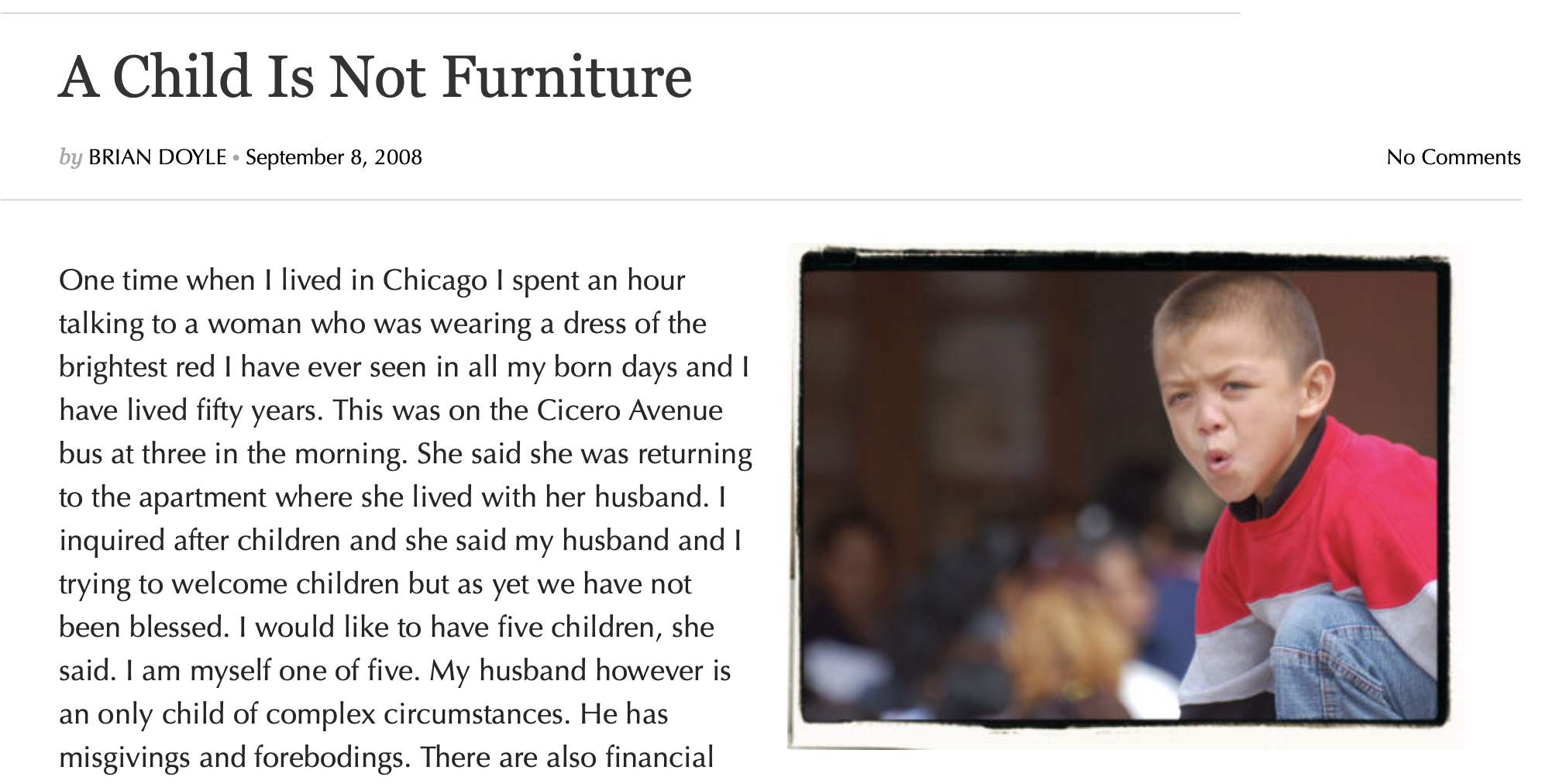
I felt faint at that missing determiner. Could I have misremembered? Could the journal be wrong? Why had I never noticed this before?
Upon rereading the essay, which recounts and recreates a conversation with a woman on the bus in Chicago at three AM, I discovered the phrase I’d remembered, intact, in Doyle’s interlocutor’s words. She is talking about discussions with her husband over whether or not to have children. She says (of him), “He measures and calculates. He arranges things just so. But you cannot arrange a child just so. A child is not a furniture.” While the saying is cast in the voice of the woman on the bus, it is exactly the kind of phrase Doyle would notice and highlight, and thus it feels like his style. After all, writing is only arrangement of preexisting words, and in general, when Brian Doyle quotes other people, he tends to inflect their voices with a little bit of his own. Or his own voice is the result of absorbing so many other interesting voices. Either way, this is one instance of that.
Given that Brian died five years back, I took it upon myself to write an email to Dinty, asking whether the title might have been accidentally changed. Then, while waiting for his reply, I found the essay in Doyle’s book Grace Notes, where its title includes the “a.” Then, inspired, I searched out an archived version of the webpage from back when and confirmed that it had indeed originally been titled “A Child Is Not a Furniture.” Meanwhile, Dinty responded, agreeing with my revision/reversion, and assured me that he’d fix the error.
This is a small thing, perhaps as small as it gets (while other single-letter words night occupy less space or use less ink than the humble lowercase a, I would argue that given its function in a sentence, its position in the alphabet, and even its variable pronunciations (long vowel or schwa), the indefinite article is the least noticeable of words and the most takenforgranted). But see how sharply its presence inflects the essay’s title and, by extension, the essay. When I hear it, I both understand the phrase’s meaning and wonder about its everslight variation from expected usage. Perhaps, I wonder extratextually, the speaker was translating from Spanish or another language where “furniture” is not an abstraction but is cast as a quantifiable noun. Un niño no es un mueble, indeed.
This would be example enough, but a very similar thing has happened once before, so I’ll tell you about that, too. I was reading Doyle’s “From the Editor” in the journal Phoebe when I noticed this sentence (amidst the sprawling hypothetical responses that an editor wishes he could send in response to an unsolicited submission):
A piece like yours, we are sometimes tempted to write, is not elevating or edifying to the reader, but merely performance, or comment, or confession, or rant, or the product of insomnia or inebriation or incoherence, or lecture, or sermon, or humility, or browbeating, or elusive goop, and is the very reason why so much of what is sold culturally as art is nothing at all like art.
Did you catch the misplaced word in the list? I did. There’s no way Brian would have written “humility” in the context surrounding it. I was certain that he’d meant, or a copyeditor had changed, “homily” in that position. I wrote to the editors (this happened at a time when Brian had just undergone brain surgery and was incapacitated, so we could not ask him directly) to argue my case. I had, I explained, read many of, perhaps most of, Brian’s published essays, and I’d absorbed his cadences and phrasings, and thus knew that he’d often rail against sermon and homily (a simple Google search confirmed this), but he’d never rail against humility.
Within a week I got an email back from editor Robbie Maakestad, who agreed with my logic and forthwith made the change.
I mean, great. Congratulations, Pat. You did it! Twice! You noticed something no one else had noticed or could possibly care about. Here’s your Pedant Certificate.
But maybe there’s something to be said for knowing someone by his voice. (After my first public reading, a friend commented, pleasingly, “You sounded like you.” After my first [anonymous] external tenure review, when I ran into her at a conference, the new associate professor commented, “I recognized your voice in the letter.”) Maybe noticing the smallest things corresponds with the kind of prayerful attentiveness that Brian was always encouraging.
There are the generalities of style: the long, sinuous sentences that challenge and surprise with their ordering and nesting of information. The short, clipped ones. The fragments. The preponderance of elemental or ornamental words. There’s also the understanding that whatever your style, it is not a thing you’ve invented; it’s a thing you’ve inherited, largely, overwhelmingly, without knowing it, or at least without knowing its intricacies. What’s important, it seems to me, is to strive for humility and to challenge yourself beyond your current defaults. When you get tired of yourself, experiment with something new. Take in influences consciously and voraciously, make new attempts, play, see what feels natural, what sticks, what becomes your own.
[Look. As far as I remember, Rachel Blau DuPlessis didn’t stick with the f-words thing religiously either. There was no structuring element built from it. So forgive me if I seem to have left it behind (some word of it may still be found off in a corner). I mean, I have. But also I haven’t.]
One more story: On the day I learned that Brian Doyle had begun hospice care—perhaps this was also the day he began hospice, I no longer remember if I ever knew—on that day, I went to see my daughter’s middle school dance recital. For the sentence you just read, I have channeled, at first subconsciously and then consciously, a sentence from a poem by Mark Halliday in which I feature as a character, the antagonist even, having conked Halliday on the head during a game of basketball. Halliday delays/resets several times where I’ve done so only once:
On the day that my lifespan matched my mother’s lifespan,
on the day when I had come to live as long as my mother had lived—
she died in 1975, of cancer, three days after her 52nd birthday—
on the day when I had lived as many days as she got to live
(though for her there were hundreds and hundreds of days of
miserable pain, which has not at all been my fate)—
on that day
I went to the gym to play basketball with some friends.
This is the sort of thing I do quite a bit: crib consciously from writers I admire, whose voice has imprinted itself upon my subconscious. Once, when writing about my infant son’s skull operation, I took from Brian’s phrasing about his son’s heart operation:
When have I been filled with grace? One time above all others, when my son was under ether.
One time above all others I felt the great divide between theory and practice, was closest and the situation heaviest: when my son was under knife and morphine and screaming ceaselessly.
I admitted the theft, still in time for a possible revision, but Brian gave his blessing, so I kept it. And I’ve borrowed knowingly other times as well, with things like skimping on punctuation to establish exigency, or shifting suddenly into the present tense to cast a moment into relief against the background. And then there was that one odd time when Brian attempted to write like me (at my invitation, for an essay subverting the simplistic view we sometimes default to about “originality”) but, in my view, couldn’t quite pull it off, or maybe didn’t care to. Readers familiar with his style will recognize him by his voice in this uncredited passage in the middle of my essay:
But to return, sidelong, diligently, like a small child who was going to check out that cool bird’s nest in the backyard but got distracted by how hard it is to hop on one foot for more than, say, eight hops, to plagiarism and the essay. One might well say, as certainly someone has, perhaps in another language, that the essay is by nature a magpie, a confluence of all the influences on its author; even Montaigne, for example, was soaked in Plutarch and the Bible and other literary glories of antiquity, and no force on earth can utterly erase the music and cadence of writers from the sponge-like crania of subsequent writers; the most honest essayists among us admit with admirable honesty that we all have, as Robert Louis Stevenson says, “played the sedulous ape” to writers we admired or admire. All that we can hope for as essayists, it seems to me, is to have learned something of rhythm and pace and sentence-carpentry from our predecessors, while gently leaving their particular styles behind like a teenager tiptoes away from the college of his or her parents; although I will here confess, in public, right on the page, right here at the end of this sentence, that there are some writers I cannot read while writing, because their music is so alluring it begins to dilute my own.

And readers who’ve been paying attention to this attempt at an essay will note that Doyle’s topic fits neatly with our considerations here. Not only have I played the sedulous ape to him, but he has to others, and they to their forebears, so that we realize the folly in claiming any kind of ownership, in the traditional, uncomplicated sense, of a style. And it’s worth noting that sedulous does not mean “copycatty” as I’d assumed from context, but “dedicated and diligent,” as in consciously attending to the writing styles of others in order to own our influences, beyond the inevitable osmotic assimilations.
So. What happened at that dance recital? As I waited impatiently for my daughter’s troupe to take the stage, I recalled, at first subconsciously and then consciously, Brian’s similar experience of seeing a “forgettable” amateur play, not wanting to be there, noting one particularly “execrable song” and its singer’s “groaning tractor” voice, and yet, by force of will perhaps, finding beauty and even joy in the imperfect attempts of the performers. From what I knew of Brian, this reversal would have been expected. That he’d “roar with delight” at the young man who sang so gratingly but also with “deep humming joy.” That he’d perceive the dreck made art, be willing and able to appreciate it. Of that singer he said,
He had made something wonderful of nothing but dreaming and labor and passion, something that probably not even he knew he could make with such eerie skill—and that is where I wish to begin talking about creativity, for dreaming and labor and passion are its ingredients, and wonder is both its engine and its product.
So in the midst of my silent caviling and kvetching, my wishing myself away as I watched others' children while awaiting my own, I thought What Would Brian Do?, and I knew, and so I did that. I shifted my perspective in such a way that I was enabled to sit calmly in my seat and gladly enjoy, truly enjoy, the hard-thumping electronica, the asynchronous jerky movements, the mistakes and the moments of harmony. And not in an ironic way. I became present for the dances. With the back of my mind trying to reckon with the inevitable and imminent loss of my dear friend, I borrowed his strength and found beauty where I’d been unable to perceive it before.
*
Patrick Madden, author of Disparates (2020), Sublime Physick (2016), and Quotidiana (2010), teaches at Brigham Young University and curates the online anthology of classical essays www.quotidiana.org.


