Monday, March 21, 2022

The #Midwessay: Lena Crown, The Colossus of St. Louis


The Colossus of St. Louis

Lena Crown


*


There were eyes on the walls as we danced. Each one round and black with an imploring fleck of light inside the pupil, bound by concentric circles of yellow and red, as if putting out a homing signal. Red brick peeked through the paint, and in the center of the room, cement columns stood apart like bodies.

I knew this gaze intimately. Eyes are nestled all over St. Louis like security cameras, the signature of a local graffiti artist. By the night of the party, I’d met a thousand eyes on the wall of my favorite brewery, tracing their tessellation in the wallpaper as the scent of hops pricked my nose like pepper. They glimmered from the wooden fence bordering the highway in the glare of my headlights, and they peeked up my skirt from the sewer grates when I jaywalked.

It was the thick of summer. As hours passed, the party picked up speed: upstairs, we flailed to electric funk in our own pillars of empty space; in the parking lot, we knit our fingers through the diamonds in the chain-link fence as we flirted with friends of friends of friends. The eyes on the wall seemed to wink in the headlight beams that melted over us and away like disappearing ink. One boy challenged another to a wrestling match, their shapes shadow puppets gobbling each other on the asphalt. A new DJ took the helm, a tall man with long red hair who twisted knobs back and forth with his eyes shut. The air clung in hot pearls to the peach fuzz at the napes of our necks as we closed the space between us.

That was three years ago. It was just a night, really. Nothing special. But that’s kind of the point—what I find myself craving from writing about the Midwest is indulgence, abundance, fun. It’s hardly fair for New York to hog all the nights that bleed into morning, the headlights, car horns, glitter, stranger sweat, apartments crumbling in a charismatic way. I want to read about unexpected destinations in cities like St. Louis, I want the names and faces that slip viscous and slick through your fingers when you take them in your hands. I think we deserve to be frivolous with our images, lavish with our gaze; we deserve to look and be looked at by a thousand eyes. We deserve excess. Yes, the land flings its arms wide and open; yes, there is space to fill. Watch as we fill it. 

We climbed my fire escape that night heavy with the satisfaction of a story in our bellies. We didn’t sleep for a while yet. Instead, we sat outside the back door to my apartment, next to the antique dresser a previous tenant had left on the landing. The top was stuck all over with melted candles, their white wax hardened into a tide pool topography. I lit every wick just to watch them work. Each flame glimmered at the heart of a dark wet halo. We made our own eyes and watched them dance.


*
 

Lena Crown's work has been published in Sonora Review, The Offing, the North American Review, and Porter House Review, among others. She is currently stationed outside Washington, D.C., pursuing an MFA in Creative Nonfiction at George Mason University. Find her on Twitter at @which_is_to_say.


*

 Like fellow Midwesterner and incredible essayist Sonya Huber, I loathe the harmful writing advice of “show don’t tell.” Yet, I am also a writer born and raised in the Show Me State. While Missouri is steeped in Southern front-porch storytelling, the Middle West’s characteristic pragmatism, understatement, and complicated* past and present are perpetual in our prose. We want it both ways: to show and to tell, to be Southern and Midwestern. Ultimately, there’s a certain resilience and toughness Missouri essayists must harbor because we can’t assume you, dear reader, share our points of reference or understand why we stay or live in this place, however long. Ultimately, though, describing what others do not know or have the words for makes for wilder, more inventive stories. The Missouri essayists in this project share the very Midwestern joys and terror of what it’s like to be in a state with “no particular place to go.” What constrains and releases us may surprise you.

Missourians: we'd love to have more essays riffing and rumbling on the #Midwessay! Contact me at michaella.thornton at gmail and I'll be happy to include your thoughts and insights in this project.

 —Michaella A. Thornton

* And by “complicated,” I mean openly racist, homophobic, transphobic, sexist, ableist, xenophobic, and more. We have a lot to unpack and improve on here.


Monday, March 14, 2022

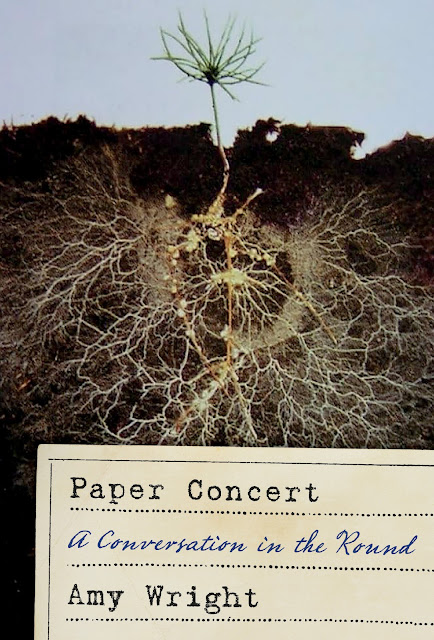
A Concert of Curiosity: Amy Wright in conversation with Jenny Patton


*

Amy Wright is curious.

She wants to know everything about those who surround and inspire her, even an ambitious spider that, in a feat of engineering, spins a fifteen-foot web from a backyard tree branch to the eave of the roof above the window by her writing desk. What sets Wright apart is that she doesn’t just marvel about the spider’s accomplishment to herself for a moment; she stops what she’s doing, she goes outside, she investigates, she records, she remembers. And then she integrates what she learns into her identity. 

In her most recent book, Paper Concert: A Conversation in the Round, published by Sarabande Books, readers get a front-row seat to Wright’s curiosity in action as she shares portions of over fifty conversations with artists, activists, scientists, philosophers, physicians, priests, and musicians. About the people she interviews, she says “Some are famous, some will be, some should be—but all of them refract the light of the unknowable mystery of the self.” Gathered over eleven years, these conversations stem from a question she has asked herself since childhood: What am I?

As the conductor of this Paper Concert, she showcases the gifts and insights of others, including writers Dorothy Allison, Dinty W. Moore, Sejal Shah, and Ira Sukrungruang; artists Marc Gaba and Raven Jackson, scientists David Haskell and Tim Flannery, and many more.

What underlies their insights is Wright’s desire to know and understand the world around her and, of course, herself. Along the journey, the reader receives an unexpected bonus.

Wright flips the script on the traditional Q-and-A interview format. In Paper Concert, the reader doesn’t immediately know who is being asked what. 

White space—like a curtain opening and closing—separates the questions from the names of the interviewee and their answers. The unpredictable pattern of interviewees gives the reader an opportunity to pause and consider the questions first for themselves.

What’s your favorite joke? How do metaphors contribute to your mode of thinking? How do you feel about ketchup? How does time enter art? What was your first job? Have you ever seen a ghost? Do you collect anything? Why were you attracted to your first boyfriend? How does a robot become more human than humans? What justifies your optimism? If you had to set fire to something, what would you burn?

The effect is that the reader becomes part of the concerto, adding their voice to the chorus.

Within this composition, solos rise and call attention to particular interviewees via questions about their specific work: It is not a given, you write, “that the heart is lonely and so must live forever.” What is a given?; How did your identity as a Native person shape your sense of self?; You lived in a papermaking village in Japan in the late seventies. How did living there shape your aesthetic? 

Questions like these encourage the reader to pause and reflect while simultaneously boosting curiosity about the response from the yet-to-be-revealed interviewee. We’re invited to take time to slowly unwrap each gift, savoring the moment of expectation. 

As what happens in conversations, not all questions appear as questions. Some take the form of statements that spark deep responses: You demonstrate the complexities of class anger through your characters and Your first writing teacher, Bertha Harris, told you, “Literature is not made by good girls.”

As readers gain insight from others about topics such as poverty, dance, queerness, neighborliness, cancer, and racism, they also learn about themselves—a gift Wright bestows on us.

Here’s the question she asks most often: When have you felt the freest?

Wright herself answers this question through her exquisite interludes between question-and-response sections. Many of them depict scenes from her childhood and young adulthood that showcase moments of both fear and freedom—fear stemming from uncertainty (of the dairy cows who watched her, of the Jackson boys who teased her, of her college roommate Manda who broke rules Wright had been taught) and freedom often grounded in nature through scenes of her younger self on her family’s farm in the Blue Ridge Mountains.

Her curiosity about others boosts our curiosity about her, and I’m grateful for the opportunity to ask her a few questions.


Jenny Patton: According to writer Joseph Heller, “There was no telling what people might find out once they felt free to ask whatever questions they wanted to.” Do you feel a sense of freedom when interviewing others? What response in the book most surprised you? 

Amy Wright: I love this question, thank you! It is indeed freeing—and a great privilege—to wonder. But we might also think of marvel as an obligation toward the communities we want to participate in and create, given that Toni Morrison said, “The function of freedom is to free someone else.” Our questions grow broader, more generous, and freer, when asked with that goal in mind.
     Surprise was one of the rewards in every conversation that became this book. Everyone I spoke with, at some point, shifted my expectations. My favorite moments came when they surprised me with a story—as when Dinty W. Moore described being a zookeeper to a female gorilla who developed a crush on him. I also loved those happy chances when stories opened windows into someone’s life, as when Ander Monson describes receiving a mysterious cassette that illustrates his friendship with Michael Martone. Since Martone is another of the book’s contributors that surprise felt like kismet.


You describe your younger self as a “reticent farm girl” and share that part of your desire to learn all you could derived from fear. Now that you’ve completed this “survivor manual,” what’s your relationship with fear? What else do you still want to learn?

Finding great answers emboldened me to keep asking hard questions. I have also grown unexpectedly fearless when others ask questions of me now, since I have a storehouse of responses at the ready. But the key insight of this book is how much more important than any manual or guide is an active witness to evolve our questions using the raw material of previous answers given across time. 
     I’m curious now how different questions—and new literary forms—can change the nature of our conversations, expand access, invite new voices, and deepen intimacies over the networks that technology has created globally. 


You asked Lia Purpura if she follows any advice columnists. In some ways, Paper Concert itself serves as an advice column—not only for artists but for us as humans trying to make meaning out of our time on earth. Why do you think people seek advice? How can we most benefit from the advice of others?

It’s paradoxical, but advice seeking trains us to listen to ourselves. When you listen to someone, you feel resonant or dissonant, right? Being open to advice lends training wheels to our intuition.  Plus, we evaluate others better than ourselves because we have more perspective. When questioning another, we can take a step back or away from ourselves, and sometimes that distance brings something into focus. 
     I do not mean to suggest that we need not listen deeply to each other as well. It’s a far more conscious and invested listening that must take place before one can sense an internal response to another’s statements. In that awareness, though, is something far more valuable than advice. Through it, we connect—with each other, yes—but also with our wisest selves.


Before your brother Jeremy died of cancer at age twenty, he promised to interact with you on earth from the afterlife. And on the morning he died, a rainbow filled the sky. In what other ways have you experienced “a line of communication” with him or others who have passed on?

I’ve experienced several such instances, some of which have shown up in my writing. My essay “Specimen” details an encounter I had with Jeremy when I was involved in a near-fatal car accident after he had been dead for nearly two years. Another, titled “Circle of Willis,” finds an unexpected affinity with the fiction writer Katherine Anne Porter, who also nearly died at age 28 in Denver—though not from a car accident but from the 1918 pandemic. 


Artist Kell Black told you, “When you start looking closely at something, you see how everything is connected.” What connections leaped out as you crafted this book? 

Kell makes brilliant connections between bodies, history, art, and objects. I would argue this idea if only to connect me to minds like his, but under repeated tests it holds up.
     My favorite proof in the book comes from Wendy S. Walters, another radiant artistic mind to draw near. In her writings, she scrutinizes and challenges language, including the narratives of slavery. Reading her work, I recalled the language of climate change, which similarly deflects and denies responsibility. As we discussed this commonality, she found other ways language shapes our thinking and the physical spaces we inhabit, including her home in an asthma zone in Harlem. Acknowledging the influences of language led us to recognize the power of our stories and voices to counter myths and reimagine our characters to offer new means and models. 


For me, your book served as a meditation, as it gave me the opportunity to pause and reflect on questions that took me away from the daily grind. How do you incorporate meditation into your daily life? 

Oh, that is gratifying to hear, thank you. The book had a similar effect on me, since it inspired a daily meditation practice. The introduction mentions my longtime yoga practice, but I find myself sitting more, and confronting more, even while in movement. The process of integrating varying and often contrary viewpoints is akin to meditation in the sense that we will never harmonize all our disparate voices, but that isn’t the point! Dissonance textures the concert, too, and silence gives it depth, by containing the conflict embedded in music and in us. 


As a child, you asked yourself What am I? How have you integrated into your identity some of what you learned from the folks who populate Paper Concert? In other words, how has “the light of the unknowable mystery of the self” become less unknowable for you?

What a profound question, give me a minute. 
     Okay, I’ll say the book made me aware of something I long suspected, which is that the self is not an individual but a collective. It’s not just that “No man is an island entire of itself,” as Donne said in the days before feminism, but that every island is an ecosystem dependent on countless seen and unseen relationships. Even our eyelashes are networks of interdependent connections! My starting quest for self is clearer now that I’ve gotten to interact directly with some of the voices that shaped me and go on shaping me. What remains engaging about its unknowable mystery is the clearer it becomes, the more you find remains to be explored.


*


Amy Wright is the author of Paper Concert: A Conversation in the Round (Sarabande Books 2021) as well as three poetry books and six chapbooks. She has received two Peter Taylor Fellowships to the Kenyon Review Writers Workshop, an Individual Artist Fellowship from the Tennessee Arts Commission, and a fellowship to Virginia Center for the Creative Arts. Her essays have appeared in Fourth Genre, Georgia Review, Ninth Letter, and elsewhere.

Jenny Patton has had essays cited as notable in the 2016 and 2021 editions of The Best American Essays. She has received the Ohio Arts Council Individual Excellence Award, a Pushcart Prize nomination, a scholarship to the New York Summer Writers Institute, and a Peter Taylor Fellowship to the Kenyon Review Writers Workshop. Her essays have appeared in Iron Horse Literary Review, Brevity, Kaleidoscope, and elsewhere.


Monday, March 7, 2022

Haley Swanson, Against Writing

My editing style is of the cut-n-run variety. If a reader tells me a moment in my essay isn’t working, I double-check the sentence in question, and promptly put it out of its misery with a cruel highlight and press of “delete.” After seven years in book publishing, the act is second nature to me—especially when I remember the authors who pleaded I spare their words. Like it or not, those are often the ones that must go.
     But after reading—perhaps experiencing is a better word—Christian Wiman’s "The Limit," I was hard-pressed to think of anything the essay could live without. It seemed every scene was at once slowed down and sped up: the visceral horror of Dr. Miller's face, a “sentient piece of meat”; the quiet motion of Aunt Opal, “a sense of pure horizon,” stumbling across the bullet that will kill her; and, of course, the cooling bodies of pocketed doves. Put quite simply, I was fighting for air from beginning to end—a rare occurrence.
     Meghan Daum’s “Matricide” similarly affected me. Before the pandemic, I had the pleasure of workshopping with Meghan, and though I was of course acquainted with My Misspent Youth (who could forget the weekly bouquet of unaffordable flowers?), I hadn’t read The Unspeakable. Meghan seemed more interested in internet toxicity and the infamous rise of cancel culture that summer than her own life, and so, I was awed to read her poignantly withdrawn account of losing her complicated mother. Once again, I was unsure if even a comma could be sacrificed.
     It bears mentioning that these are published pieces. They underwent an editor’s scrutiny long before mine, not to mention the many drafts the writers themselves no doubt produced. However, after seeing more than one storied author try and fail to polish their books, I can’t in good conscience say these two essays were surely the exceptions to what I hold as law: editing yourself is excruciating, often to the point of fruitlessness.

*

I’ve come to think of my highlight-delete urge as sniffing out moments of Writing, by which I mean those moments I think of as speaking directly to the reader about a theme or idea instead of using prose as a tool to illustrate truth.
     Sadly, the example that immediately comes to mind is Stephanie Danler’s memoir Stray, which was highly anticipated by me and everyone else alike but didn’t quite reach Sweetbitter’s high bar. Around page 70, at the close of a harrowing sick mom chapter, Danler says: “I understood that to love is neither exhilaration nor safety, but instead this: painful, too tender, forcing a forgetting that’s close to forgiveness.” Ah, the ancient task of summing up Love; countless writers have fallen prey to this trap practically no one survives. Stray is sprinkled with declarative sentences just like this one, attempting to pack ineffable definitions, Truth and Meaning, into one line (though admittedly not always with the same grating alliteration found in “forgetting” and “forgiveness”). I sympathize with the impulse, truly I do, but the essential challenge of nonfiction, of memoir, is to redefine these universal concepts without cutting corners; compacting something huge and unwieldy like Love into a sentence—one that closes out a chapter no less—is nothing if not an unearned pathos.
     Next, before anything else, I’d like to say I greatly admired and enjoyed Nina Boutsikaris’ I’m Trying to Tell You I’m Sorry. However, pretty early on (page 31 in fact), we get the following: “There is risk in the self-naming, the looking back, the acting out: parody and spectacle just appear so much alike.” Isn’t this—the “self-naming”—Boutsikaris’ central aim in recounting her unquenchable thirst for recognition in the eyes of lovers and strangers alike? And isn’t this moment appearing before we’ve seen enough failed attempts to slake that need, so we finally understand that when she says “self-naming” it isn’t to imply such an act is doable but instead always out of reach—both parody and spectacle? Which is the whole point of the work?
     When writing is preceded by Writing, the former is unable to do its job and the latter quickly deflates.
     However, these summing up sentences aren’t always weak points, namely when they aren’t coming from a place of fear that your reader won’t “get it” unless you explain it to them (don’t worry, I won’t now launch into the tired argument of “show, don’t tell”). In short, moments of Writing—moments of directness about the pieces “so what?”—are bright lights instead of stumbling blocks only when they’re earned.
     For example, Wiman imparts the following insight after seemingly unending paragraphs of pain: “For those of us who have gone to war with our own minds there is yet hope for what Freud called ‘normal unhappiness,’ wherein we might remember the dead without being haunted by them, give to our lives a coherence that is not ‘closure,’ and learn to live with our memories, our families, and ourselves amid a truce that is not peace.” If this moment of Writing had come earlier in the essay, perhaps the second or third page, my finger would’ve itched for the “delete” button. Instead, it comes after such effort and toil that it successfully makes sense of the senseless—something Wiman, I’m sure, has spent most of his life trying to accomplish, and we, as readers, require after this brief, violent walk through his life.
     It’s a bit more difficult to identify a similar moment of Writing in Daum’s piece, which I think speaks not only to her long career as a journalist but also to her skill. Her closing scene of miscarriage and how it relates not just to her mother’s death but also her continuing grief is a perfect example. Only the miscarriage is relayed; the meaning of it, I gleaned on my own, which of course is influenced by my own life experience and not solely Daum’s (which perhaps it might have been if she told me what she wanted me to think of the ordeal). “I know only that I’ll probably never finish telling [the story] and it most certainly will never be whole,” she says. The close of the piece is strong because it’s anything but neat; instead, it’s up to the reader to order the mess they’ve just endured.
     Isn’t this nonfiction at its most powerful? When someone’s private mind becomes yours for a page or two? The best essays surrender an experience, a memory, so it can multiply within the context of other worldviews. The magic lives in this loss of writerly control.
     It’s then that the singular story somehow, impossibly, becomes as infinite as its readers. 

*

I don’t know if I can unlearn seven years of cut-n-run editing. Perhaps I’ll always struggle against those telling feelings of scrutiny where I just know something has to go, rarely reveling in sentences that read like earned relief, a purging of knowledge and meaning.
     Still, I wonder, can one discern with certainty between writing and Writing in their own work?
     Instead of definitively answering my question, I remind myself that just as there’s no one way to write or read an essay, there’s no one way to edit one—no matter how many times I labored with authors over words they found essential and I argued were expendable. There’s simply a sentence. Followed by the next, and then another, and another, which, if I’m brave enough, has the potential to become an unruly creature, just as beautiful unexplained as it is understood.  


*


Haley Swanson is a writer and editor based in New York. Her essays have appeared in The Rumpus, Glamour, Electric Literature, Creative Nonfiction, Brevity, and elsewhere. With Eliza Smith, she's co-editor of the anthology Sex and the Single Woman: 24 Writers Update Helen Gurley Brown's Cult Classic for a New Era (Harper Perennial, 2022). She's currently an MFA candidate at Sarah Lawrence College.

Monday, February 28, 2022

Karen Babine, In Praise of Zero Drafts

I was really young the first time either my parents or my grandparents taught me to find the North Star, then the Big Dipper, then the Little Dipper. I didn’t understand stars beyond star light star bright first star I see tonight, which never netted me the sweater for my Cabbage Patch doll that matched my own. But as a kid growing up in northern Minnesota, it meant something to always know where to find North Star, how to use my tiny imagination to connect those dots to create a vessel to catch the Milky Way. I grew up in a small northern Minnesota town free of light pollution, a place that named its hockey team the North Stars, before the team moved to Texas and lost one of the most unique names in professional sports.

Anne Lamott has shitty first drafts. I have Zero Drafts.

If SFDs are a constellation, then Zero Drafts (ZDs) are the darkening of the sky so that the stars have the space to become visible.

I was really young the first time either my parents or my grandparents taught me to find the Big Dipper, then the Little Dipper. I didn’t understand stars beyond star light star bright first star I see tonight, which never netted me the sweater for my Cabbage Patch doll that matched my own. But as a kid growing up in northern Minnesota, it meant something to always know where to find North Star, how to use my tiny imagination to connect those dots to create a vessel to catch the Milky Way. 

  • In the UK, it’s called the Plough—and I like that imagery too. The digging into the ___ to find what’s buried. 
    • The ZD leaves room for placeholders, for repetition, for putting things in multiple places to see where they fit best.
    • The value and function of placeholders, so you don’t lose your momentum. Here be dragons! Wrong words in brackets, blank spaces for the phrasing that just isn’t coming to mind.
      • The movement, momentum—it’s tough for a zero draft to catch momentum. Maybe, instead, the ZD is the sails themselves—if the sails themselves aren’t up, the boat isn’t going anywhere.
        • Polishing the brass, constructing the map because I know what this book is about, but the sails aren’t up, so there’s nothing to catch the wind.
  • The gathering, the tipping out, the excavating, the gathering of water.
  • A Shitty First Draft would have decided it’s a dipper, a Zero Draft is still playing connect the dots.
  • Trying out connections, some connections feel more fruitful than others.
  • This might be where I’m going, but not decided. 
    • Sailors using the constellations to navigate, but not sure where I want to go. In some ways, a Zero Draft is still building the boat.
    • Feeling my way through which metaphors might work.
    • This might be a separate essay, but might not, so I’m keeping it here.
    • I think this thought might be connected to this one, but I’m not sure how or why yet.

Is a Zero Draft a place for idea dumping? Possible source texts and quotes/examples, thoughts, questions. Might not all make it into the same piece, but becomes a staging ground for how you’re framing your ideas until you figure out what’s relevant.

  • What is the motivation—or what is uncovered—by a Zero Draft? My point is that it’s not yet a SFD, but it’s more than scattered notes in a notebook. A lot of the time, mine looks like a fat outline, and it’s more an expansion than it is a linear path of discovery. The outline/bullet point works because I can start to organize similar thoughts together.
    • Weird hybrid of thought, bullet points and bolding and sentence and thought fragments
    • Making visual what the brain is doing
  • A zero draft recognizes that the blank page is the scariest part of the process and does whatever it needs to un-blank the page. 
  • The purpose of a zero draft is to manage risk, not create or foster it. A zero draft writes all the painful, ugly, hurtful things that you know will never make it past a third draft, because you need to write all that emotion into the atmosphere you’re creating. When I was drafting Acadie, I wrote all the things I really felt about my paternal grandparents, all the things I wish I could have said to them, but knew that I’d revise all that out because to keep it would hurt my dad in the long run, and that wasn’t something I was willing to do. It’s not so much that you can do anything in a Zero Draft, but the purpose of a zero draft is to create the atmosphere that your page will breathe (to paraphrase Janet Burroway). If you want an underlying atmosphere of pain and hurt, it starts here in the Zero Draft, not the shitty first draft. Even if you revise out the cutting thing your grandmother said when you were fifteen, the specter of it, the space that it once occupied in the draft, still remains. 
    • The zero draft shows the viability of the page, which is not something we had before. But it’s complete enough that it’s not just freewriting, or notes. 
  • A SFD is complete as a draft, it has all your thinking laid out—however thinly—on the pages. Zero Drafts are still transparent. Zero Drafts are playing with technique, trying out what might work. 

We don’t always write Zero Drafts—sometimes we go straight through to a SFD. 

  • Zero Drafts have a sense of potential, of creating enough material on the page to craft and manipulate between our fingers. There’s little vulnerability to a Zero Draft because it’s not to that place yet.
  • A ZD is a bunch of light sources, bearings—because you don’t know how to navigate it yet.
  • Stars are pretty, but constellations have a function?
    • Which light sources are significant? Which are pole stars, which  are lighthouses, which are somebody with a flashlight on a beach,  random shooting star?
  • The point at which your collection of thoughts has a function? A bearing? Actual movement? The moment where you think I KNOW WHAT THIS IS ABOUT, I KNOW WHERE THIS GOING—because you haven’t quite gotten there yet.

Vulnerability, viability.

On the wall of my parents’ house, there are two 8x10 photographs my father took while a navigator on C-130s for the Air Force in the 1970s. One is of the Acropolis, the other of a thunderstorm taken above the cloud layer. The shape is sharp against the pale blue beyond and it reminds me how I grew up with this language of anvil clouds, wind shears, and how to count the beats between lightning and thunder to know how close the storm was. I remember once he showed me the sextant he had to learn how to use, just in case the mechanics failed somehow and he needed to still get the plane into Guam, or Hawaii, or South America. 


*


Karen Babine is the author of All the Wild Hungers: A Season of Cooking and Cancer (Milkweed Editions, 2019) and Water and What We Know: Following the Roots of a Northern Life (University of Minnesota, 2015), both winners of the Minnesota Book Award for creative nonfiction. She also edits Assay: A Journal of Nonfiction Studies. She is an assistant professor of creative writing at the University of Tennessee-Chattanooga. 


Monday, February 21, 2022

Being Swallowed Whole and Spat Back Out: an Interview with Abby Hagler

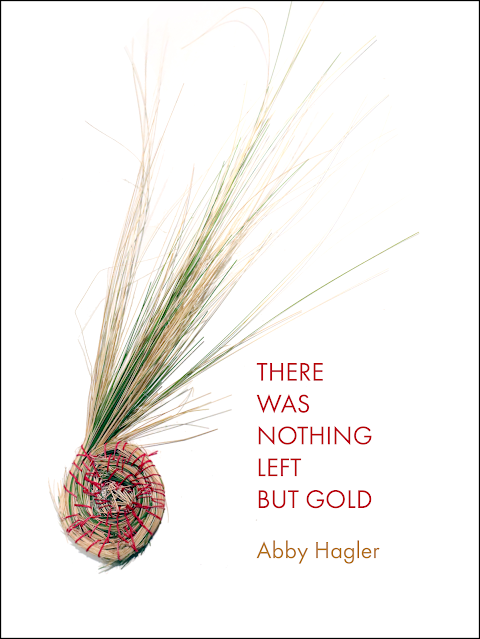
The following is an interview with Abby Hagler, the winner of the 2020 Essay Press Chapbook Prize. The chapbook, There Was Nothing Left But Gold, dives into the landscape of Nebraska, dwelling on what it means to grow up in a small town only to leave it in order to understand forgiveness and what it means to accept one's self. Meditating on the breakdown of her relationship with her mother, Hagler reaches for Willa Cather as a fellow Nebraskan exile, Derrida's hauntology, and theories on girlhood development. These essays construct a portrait of girlhood and Nebraska as wild and hungry, full of mourning, tenderness, and rebellious figures. 


*


Hannah Hicks and Tory Irmeger: Could you talk a bit about your childhood and your path to becoming a writer? 

Abby Hagler: In relation to childhood, I think about being alone quite often. My family had a farm and everyone was very busy with work, which resulted in me being by myself on a day-to-day basis. I’m really grateful for that. Periodically, I see articles like this that talk about giving children alone time and letting them get bored. I’m not trying to tell anyone how to raise their children. I’m just saying that I read these articles in reference to myself as a child. It’s helped me to realize the profound effect of a childhood spent in fields, with animals, and on dirt roads marked on no map. 

I like the way Amy Wright characterizes her rural upbringing in the introduction to her book Paper Concert. She says, “I was pretty free as a kid… I did not have to direct myself toward anyone else’s expectations for hours at a time. Those hours, too, were an essay, a foray into life’s experiment, and they taught me that research always begins and ends in the field.” That moved me because I know the prism of those hours she speaks of. 

However, I consider my time back then to be more constructed. There was expectation. My family all worked together but I am the youngest and the only girl so I didn’t do the same jobs. I never had to fix machinery or run the combine until midnight or get up at 2 am to check for newborn calves in February. From an early age, I was the one burning piles of thistles, filling the water tank for the heifers, mowing cattle pens, watering the rows of treelings that would grow into windbreaks. And also doing the grocery shopping, cooking, and housework. My parents taught me to drive around age seven. The old 4020 was my favorite tractor because it piped thick black smoke like a cartoon and the seat was sproingy. 

There was also adult responsibility in my childhood—possibly the way it is for any child who is part of their family business. There was also a noticeable transition between being an employee during the day and being a kid in the evening. Sometimes I feel like I was raised as both a hired man and little girl. But that is a false dichotomy. I was a tomboy and a reader day and night. Always with a book on me and always writing diaries out loud. Which means I was imagining myself as a character in mundane places in the past, in fantastic situations that never happened. Fay Bound Alberti writes about a similar experience growing up after her family moved to Wales in her book A Biography of Loneliness. She said, “I was isolated and alone. And yet I did not endure loneliness. I enjoyed it. A natural introvert, I spent my days in the woods, making up stories, plotting alternative lives. My community was populated by fictional characters.” And I, too, don’t remember feeling all that lonely. There’s a connection to writing in that.

Remembering what I thought about as a kid is something I treasure in adulthood. As if I know and stay true to one more thing about who I am at core. Maybe writing as a process of saying aloud the associations that have long existed in our minds is also a method of connecting to time gone, time that did not exactly exist, time that is experienced by a person uniquely. Or maybe it just means time became a room of my own built inside my brain since I was usually asked to show my practical self at home. I don’t know. Maybe, through a larger lens, freedom alongside work ethic is a metaphor for what writing really looks like in my life. I’m not shooting for a metaphor here. At the time, I was very caught up in my imagination and was most definitely an awful employee. However, I don’t remember ever feeling bad about it. The part of me interested in telling stories has always been a clear, refreshing voice to me. It’s always been a buoy.


Hannah Hicks and Tory Irmeger: We are taking a class that emphasizes the ideals of creating a lifestyle of writing, specifically not limiting ourselves to writing when there is a grade and diploma attached to it. What is your “day job” and how does this influence your writing life?

Abby Hagler: I manage research grant funding at a university. It took me several years of working multiple jobs to get this one job (in an office with so many people dedicated to kindness, no less) that can support me, which is a big deal. This job doesn’t influence the topics I write about but it does have an effect on whether or not I have the health, energy, and emotional space to get writing done or participate in the literary community. This may fall into “the work of work” conversations—what basics a person necessitates in order to show up to do anything requiring labor. So many little things go into this on a day-to-day basis. People living paycheck to paycheck will know what I’m talking about. That’s something that’s often missing from the discussion of what it’s like to make art. How does one actually arrive at the page? Sometimes I think it took me years of commuting, working through broken bones, eating cheap, choosing to pay the fines on my taxes for not having health insurance because it’s cheaper than the actual insurance, stretching my last $10 for a week before payday so I could to get to the morning I wrote the first paragraph of this chapbook. Overall, I’m fine with being a writer outside academia. As college becomes more unaffordable, I see more opportunities open up for writers without the degrees or the faculty appointments. I think it’s important for working class writers to be publishing and speaking to their experience to boost these equalizing efforts. I wouldn’t mind seeing more writing published stemming from this perspective. 


Hannah Hicks and Tory Irmeger: Right off the bat, we connected with the themes within your chapbook, particularly, “If you grew up in a small town and you got out, you deserve a medal.” For anyone who moves away, I think there is an element of growth, and often grief, inherent in becoming a person outside of the context of that small town. While this could be a rewarding experience of “finding yourself,” it’s isolating, as there is no trail to follow or step-by-step guide to finding a new place to belong. Amidst these tensions, what was your starting place when writing your chapbook? 

Abby Hagler: I love this question because it gets at the idea that perhaps growth and grief are concurrent. Like two rail lines running next to one another. I relate very much to the way you describe growth. To me, when I first left home, the yawn of what exactly all those years ahead of me could contain felt obliterating. I was so ready for it too. There were, as is common in small communities, impressions of me that people had in my hometown that I was ready to shed. But, more than that, leaving was like stepping into living that really felt alive. 

And I think Cather might have felt a little bit of that growing up knowing she was gay in Nebraska in the early 20th century. To me, her life goals were simple. She wanted to become a career artist and to find real love. And Nebraska outside the University—I mean Nebraska as a social body—was not going to easily afford those to her. So she left in pursuit of getting to the page. However, even after she’d become a writer and found a wife, Cather had to write several books before she could move on from Nebraska. That kind of return is so ingrained. Our minds are always grappling with the past, trying to wrestle it into a narrative that will, without doubt, be blown up with some new realization. Return, to me, feels inevitable, especially if there’s hurt there. It’s important work whether it is done physically or in thoughts. I think I have been writing myself into and out of Nebraska for almost 20 years.

I also don’t want to say that grief, anger, trauma, or any layered emotion ever really gives way. I’m more interested in how people co-exist with these complexities instead of the overdone narrative of trying to resolve them. I’m interested in a relationship with feelings. When I was drafting the essays that would become this chapbook, I had already been thinking a lot about holding two different people in my body in the same way we can hold two (or more!) separate, even conflicting, emotions. 

It was no mistake that I purchased Hermione’s Lee’s book on Cather titled Double Lives in the Cather Museum bookshop. “Double Lives” was also the first essay I read. Discovering that Cather characterized her childhood as being “buried alive” blew my mind. I had no idea, though her contempt is hardly disguised in the fiction. Realizing her anger was liberating to me because a lot of writing about Nebraska seeks to make it a quaint and bloodless place. Buried alive is a strong image. Both death and not-death present. A kind of Jonah and the whale. I knew the story I was telling was an act of return but I also knew it was wrong to write about it as some kind of hero’s narrative centered on healing or conquer. I wanted this narrative to be true to those of us who left for a reason. Return in this instance, whether physically or emotionally, is an akin to being swallowed whole and spat back out. 


Hannah Hicks and Tory Irmeger: You are careful in writing about your mother to acknowledge the generational trauma and context of your mother’s behavior. This speaks to a genuine struggle for many as they reach adulthood and struggle with shifting parent/child dynamics. How did you balance writing about family, knowing they might read the chapbook?

Abby Hagler: This chapbook didn’t happen in one draft. It was two other books before it reached this form of three long, meandering, grass-dense essays. The first was a book of prose poems called Everybody’s Girlhood. It’s a riff on Gertrude Stein’s Everybody’s Biography and used a definition of girlhood some friends and I thought up one night in my living room. The definition didn’t really have anything to do with sex or gender, just what existentially demarks girlhood from other -hoods in life. We discussed the age range of girlhood and how this time period is different from childhood, boyhood, manhood, womanhood, adulthood, etc. Age started to feel arbitrary to the characterization we were going for, as if, through descriptors, each of these periods became spaces people enter or exit. I started wondering: Is it possible to slip into girlhood even if one is not a child or a girl? And so I started writing poems out of memories of my own girlhood, then moved onto moments in my family members’ lives when they might have been experiencing a girlhood too. 

I took parts of the girlhood poems and made them into a chapbook of researched essays titled Goldenrod of the Here and Now. However, the essays were too focused on telling my mom’s story, which felt wrong. That’s her story to tell, even if things that happened to her have an effect on me in a generational sense. 

All of my anxiety in writing any of these drafts was focused on claim and how to change the ideas of claim I have inherited. My goal was to release claim where it felt necessary in order to honor someone else’s struggle. 

Letting go of any claim to my mom’s history—especially after our relationship dissolved—was what propelled me to look for other ways of writing another person into an essay that honors boundaries. Two books that were really helpful were Anne Boyer’s The Undying: Pain, Vulnerability, Mortality, Medicine, Art, Time, Dreams, Data, Exhaustion, Cancer, and Care and T. Fleischmann’s Time is the Thing a Body Moves Through. The way they each use research to shift narrative focus is fantastic. After reading these authors, my strategy became: When I felt I was going too far into territory that isn’t mine, I reflected instead on my own body, my own feelings. And from there, that smaller place of myself, I could start growing a discussion about the larger issue of a government, a history, and an economic system that imprints its brutality onto our love and relationships. 


Hannah Hicks and Tory Irmeger: When writing “To Fill the Spaces Where My Body’s Been,” you listed examples of the color gold you found in books by Willa Cather. Did you know early on that Cather’s presence in your chapbook would be so prevalent? How are you hoping your book emulates Cather’s legacy, or would you rather readers understand your relationship with Cather differently? 

Abby Hagler: I actually didn’t know that I would be writing about her starting out! She was one of several authors in the book pile. After deciding to start the essays over, I cast a pretty wide net for what I was researching. Louise Pound, who was not only Cather’s classmate in college but was also a great folklorist in her own right, was a favorite. Pound’s work led me to making a map of places where myths and legends occurred in Nebraska—or allegedly occurred anyway. A map of places that don’t necessarily exist and events that didn’t exactly happen. The slippery space of legends about land and people. But the trip was a bust. I didn’t have the energy for it after falling out with my mom. So I spent the day in Red Cloud at the Cather Museum and bought Hermione Lee’s Double Lives, a book of Cather biography and criticism that opened up the whole project. 

To me, Willa Cather has a double legacy much like Nebraska. In the classroom, her identity is never really discussed. At least, I don’t remember learning anything about her life or personality or beliefs in general education. History’s process of simplifying and forgetting. As an author, she is remembered in conjunction with Nebraska’s mythology—as bland, quaint, nature/ farm-focused. This legacy has asked us to forget that she was determined, and she was aware of oppression and inequality in America. She was not religious, was critical of Christianity, and was unabashedly queer from a young age, which is not present in her Nebraska characters. But her anger is. Anger often disguises pain. I didn’t want that to be forgotten. It was a reminder not to forget who I am in writing either. There are lots of ways we are erased even as we live and breathe, lots of ways we obfuscate or erase parts of ourselves, especially in efforts just to get by or fit a mold. I suppose I’m seeing myself in the legacy of time passing, in the legacy of a life lived American culture would like to fabricate for us all. 


*


Abby Hagler lives in Chicago. She is the author of There Is Nothing Left But Gold (Essay Press, 2021). Previous work has appeared in Entropy, FANZINE, Ghost Proposal, and Deluge, among others. With Julia Cohen, she runs an interview column at Tarpaulin Sky magazine called “Original Obsessions” about writers’ childhood obsessions manifesting in their current work.

Hannah Hicks is from Atlanta and attends college in Cleveland, TN. Her work has been published in the American Poetry Library and Whale Road Review.

Tory Irmeger is from Elizabethton, Tennessee and attends college in Cleveland, TN, where she is an English writing major. 

Monday, February 14, 2022

The #Midwessay: Anna Baker Smith, Croissant

It's possible all the writing I've done over the years has been in some way a response, a pushing back against the isolation and loneliness I felt at sixteen, driving an endless loop between home and school and work, speeding through the rolling country 'burbs of southeastern Wisconsin. There, a farm. There, a subdivision. There, a snowy field. Lots of trees. Another farm. Another subdivision. Endless fields. Growing up in this landscape my edges were smoothed; I was shaped. For me, this landscape was so cold, isolating, lonely. Constantly, I seek warmth, body, connection; I seek community, conversation. 

To some degree, all of us here are shaped by the landscape, by the way the highways bend, by the way one watershed tilts towards the lake, another to the river, and by all the cold and snow this winter. And yet, each of us inhabits a landscape uniquely our own, built of our own experience. We are Wisconsin-born, -bred, -rooted, but we live alone in our own version of wherever we are. And Essay Daily, this #Midwessay project, what are these but elaborate feelers, searching, finding, sharing, celebrating a coming-together? I'm not sure I care all that much about what a Wisconsin essay is or isn't. I just want to hear your voice, your thoughts, your stories. The Wisconsin essay is whatever you say. 

Craig Reinbold

We'd love for you to join the conversation. Reach out @craigreinbold // craigreinbold[at]gmail.com     


Tuesday, February 8, 2022

Marcia Aldrich, On Edge


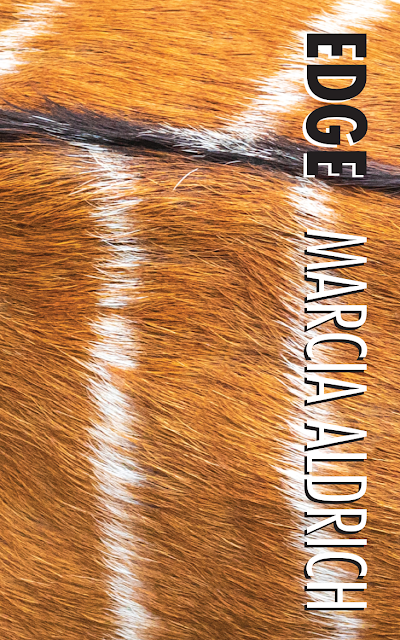
It’s awkward to speak of one’s own work. We want to believe an artist’s work should speak for itself. When I received my copy of Edge and sat down to read it through, I was surprised by the physical intensity of my response. I was shaking, shivering, and shot through with some kind of vibration that resists a neat definition. It was physical, that’s for sure, but emotional too. Euphoric. Cathartic. The vibrations encompassed my whole self, the whole system that makes up who I am as a person and a writer. I have no idea if anyone else will feel the way I do reading Edge. That’s the writer’s dilemma, isn’t it? As a writer I have to go my own way, write what it is my lot to write, and hope that what I communicate speaks to others. I suspect if anyone responds to Edge it will not be the way readers follow a narrative. They will be responding to the lyric intensity, the lack of masks, the voice, the way certain images walk out of their frames. The painter Edward S. Casey has remarked that “the edges of a painting act not to close off but to open up possibilities for the emerging image.” So too, the essays in Edge while discrete have edges that open up the possibilities of amplification. In the writing of Edge I can’t name a particular work that has influenced its composition. It feels as if Edge has emerged from a lifetime of reading, especially modern poetry, especially William Carlos Williams’s long poem Paterson. Edge is my ode to Michigan.

This is a way in. 

I grew up in Pennsylvania. Born in Allentown and until the age of seven I lived in a white house with black shutters smack-dab in the middle of the block on 22nd street. It was not a wild place but there were fields nearby on the outer edges that had not yet been turned into subdivisions. My mother was a believer in turning me out as early as she could. She was not troubled by the troubles I might find or make. As a consequence I don’t carry powerful memories of the house itself on 22nd street. I don’t have rich memories of my room, for example, or the kitchen. I was more attuned to what I might find in the alleys running between streets, to the fields backing up behind the neighborhood houses and the river at the bottom of the hill. It was in one such field that I found my sister’s cat caught in a trap where I heard him crying and brought him home where unfortunately he died. Rescued but not saved. That phrase might describe my early experiences. I was always trying to save an injured bird or animal and mostly failing, learning the limitations of my human interventions. I remember the trap better than I remember the dolls I was given. Metal with teeth. Ghastly lying deep in the tall grasses. I almost stepped on it. What I didn’t know then and don’t know now is why there were animal traps in the fields by the river. Who set them and what were they trying to catch and to what purpose. I didn’t have answers but that experience was the beginning of my story when I was awakened to what I’ll call the contact zones that clash between animals and human beings and ideas about who has the right to the land that they both inhabit. Human beings have the upper hand and this was my first encounter with that dark truth. Now I’m amazed that as a girl of six I stepped out of my zone to pry open the trap and release the cat.

Not long after when my older sisters went off to college we moved to a place strangely called East Texas, about twenty minutes outside Allentown where the Little Lehigh River ran through fields of corn, wheat, and soy beans and dilapidated farms, once brightly painted red and now faded, anchored the corners of rambling roads. My parents bought ten acres with a house sitting on the crest of a hill that overlooked the curving river below and was banked on both sides by woods. During the time I lived there, the land around us remained undeveloped. There were threats of a highway being put in behind our house but it never happened. If there’s any place I should feel connected to this is it because that’s where I grew up, where I kicked around largely by myself, accompanied by my dogs. That’s the river I skated on in winter and fell through the ice trying to save a trapped dog, the roads I rode my bike along, the woods I scrambled through on my way to my neighbors. Again it was not the house that called me or made me think home, it was everything around the house and the life lived outside, what might be called home range that anchored me. The mundane life of my parents struck me as almost alien. My mother often called me in at the end of the day and I would not come, at least not at first. I would step back behind a screen of trees or stoop in the high growing wheat at the top of the hill and watch my mother and father go about their nightly routines. I lived in the spaces between the life of the house and the life of the fields and woods, a back and forth that has shaped me.

Much later, after graduate school and marriage, I took a job teaching at Michigan State University and moved to East Lansing, a town built of neighborhoods bounding the large sprawling university. There was the town and the university and the contact zones between them. We bought a modest house on Orchard Street named for the orchard that had once existed in the town’s history but was now erased. From our house on Orchard I could walk to campus and my children could walk to elementary, middle, and high school. Everything was walkable on tree-lined streets with broad sidewalks. From our house I could smell what was cooking in our neighbors’ houses, hear their arguments when the windows were open. Close-knit is what I’d call it. Heavy on human presence, low on privacy. 

And then later still, when our children went off to college, I couldn’t wait to get away from the domesticated town of East Lansing and we moved to Tacoma Hills in Okemos, a place that once again resembled the move my parents had made from Allentown to East Texas. We named our house in Tacoma Hills Riverhouse because it sat up on a hill overlooking the Red Cedar River. Once again woods bordered both sides of our property. It was as if an invisible hand was leading me back to a place I might call home. Homecoming, however, was complicated for I was no longer a child standing at the edges, I was a home owner, implicated in the damage we do to the natural world and the animals in it. In my name fences were built to keep out unwanted animals and mark ownership. In my name roads with high density traffic plowed through old farmlands, displacing the animals and driving them into unsafe territory. I also rediscovered my identification with that animal world, specifically the deer who shared a home range with me. The writing in Edge emerged out of that kinship. Living on the Red Cedar River in Michigan I became reacquainted with myself as someone who wanted to rescue and save but largely failed. My husband recently asked me if the local officials in charge of reducing the deer population I write about in the essay called “Edge” would have been swayed if I gave them a copy of Edge. The answer would be no. Sadly they would not understand what it means to say “That is the deer I know.”


*


Marcia Aldrich is the author of the free memoir Girl Rearing, published by W.W. Norton, and of Companion to an Untold Story, which won the AWP Award in Creative Nonfiction. She is the editor of Waveform: Twenty-First- Century Essays by Women, published by the University of Georgia Press.