Showing posts with label Patrick Madden. Show all posts

Sunday, December 21, 2025

Dec 21: Patrick Madden, Pietà

Pietà

Patrick Madden

*

There's a scene near the end of the last episode of Midnight Mass that, the first time I saw it, evoked from me an involuntary sob, a kind of bubbling up of weeping emotion, sadness and joy together, from an instantaneous recognition of the visual allusion that I was unconsciously sure writer/director Mike Flanagan intended. The sound I heard from my own mouth can best be rendered in text as one of our simplest words, "O!," a word that precedes and resists resolution into meaning, a sound of which Rebecca McClanahan asks, "Is there a vowel more heavy or sad than the long o? It hollows out the mouth, intones the deepest sorrow."

There's a scene near the end of the last episode of Midnight Mass that, for fifteen seconds, between cuts of the climactic breakdown of Crockett Island's society via mass vampire conversion, centers in a vast frame of apocalyptic fire the recently rejuvenated Monseigneur John Pruitt and his long-ago lover Mildred Gunning, kneeling on a bridge caressing their daughter, Sarah, who's been mortally wounded by a bullet just moments before in the midst of the chaos, shot by a confused Sturge, who'd not yet realized that it was time to give up the misguided quest for eternal life.

There's a scene near the end of the last episode of Midnight Mass that struck me pre-linguistically, pre-consciously, as an homage to the many sculpted and painted Western representations of a moment unreported in the gospels: of Mary the mother of God caressing her son, who's been crucified unjustly but necessarily, and who's died just moments before and is now again in his mother's arms in echo of the days decades before when, wrapped then too in swaddling clothes, he nestled in her bosom, just moments after he was born.

There's a scene near the end of the last episode of Midnight Mass that seems so clearly a pietà in its arrangement and prefacing, though there are two parents present, and the dead child is a daughter, a doctor, a lesbian, one of very few people on the entire island uninfected by vampire blood, which Monseigneur Pruitt has been slipping his congregation in the Communion wine, unwittingly, or foolishly not wanting to know the true nature of the grotesque "angel" he's shipped back from the Holy Land. The family has gathered in mourning on a wooden bridge over a creek with Father Pruitt sitting on our left, Mildred to our right, and Sarah slumped across them, head resting in her father's lap, legs lying inert in front of her mother. John holds Sara's head; Mildred her hand. The scene's clearest referent is Michelangelo's 1499 sculpture, so prominent among similar artistic representations that it merits the definite article: The Pietà. Unlike so many stiffer, indefinite-articled and lowercased pietàs I've studied, Michelangelo's Jesus seems truly dead, subject to gravity: his long, lithe body slumps, supported only by his mother and the rock she sits on. Despite the inflexible medium of marble, the muscles and sinews and fabrics ruffle and flow in pyramidal grace from his arched head on the left to his languid legs on the right and centered with Mary's eternally youthful visage above it all.

There's a scene near the end of the last episode of Midnight Mass that follows and fulfills so much else that it's impossible to convey the intricacies of the story. But let it be said that, as in the gospels, the proud get their comeuppance and the humbled and the outcast come to a peace and understanding, and that earlier themes of sin and forgiveness and earnestness and hypocrisy resolve in satisfying ways as Sarah dies setting fire to the island's shelters where the vampires might escape the sun, and her conspirators likewise die in noble, painful ways, including Erin Greene, who, beneath the Ur-vampire, her lifeblood draining as he suckles, slices his leathery wings and returns outside time to a conversation with her friend Riley Flynn, in which she now re-members her answer to the question "What happens when we die," narrating her revelations as she experiences death, as a legato piano touches a simple melody: "Were you there when they crucified my Lord," a soundtrack beneath all the burning and Erin's soliloquy until we reach a moment of transitionary silence and a shift in the spirit as the remaining townspeople, repentantly aware of their hubris and resigned to their fate once the sun comes up, sing aspirationally, "Nearer, My God, to Thee."

There's a scene near the end of the last episode of Midnight Mass that evokes the meaning of pietà: "pity," most cognatively, or "sorrow," "compassion," maybe, shared feeling. Maybe it takes a whole series to get here, or maybe it takes centuries of intricate Christian stories told and taught, repeated and recreated, inculcated, indoctrinated. Maybe it takes something both intimately personal and culturally repeatable. But for me, this brief scene meant, not even meant something, just meant. And I’ve been sitting with its meaning for years now, sometimes content to leave it unexamined, uncriticized, and other times, like now, eager to seek a dinghy of words to take me somewhere from it, or towards it. I know, of course, that the whole of my response to my response is assembled in its aftermath; it is not what happened, or what I understood. I don’t know if I can be said to have understood anything, in fact. But I felt something. There was my sudden unbidden utterance, then a long while to think on whats and whys. There is now a memory of what happened, but not what happened. That is gone. But there’s the lingering conflict: a reluctance to trouble the innocence of the response, a resistance to resolving “something” into some thing, but also a hearty desire to untangle and share what I felt, which is not, never was, a thing I could point at or label, no matter how many words I try out toward that end. So maybe the best response was my first response, a genuine, unpremeditated, unpretentious "O!" Or maybe there is just the scene of John and Mildred anguishedly holding their daughter in similitude of Mary holding her son. Sometimes it causes me to tremble.


*


Patrick Madden, author of Disparates (2020), Sublime Physick (2016), and Quotidiana (2010), coeditor of After Montaigne (2015) and a 25th anniversary collection from Fourth Genre (2025), teaches at Brigham Young University and curates the online anthology of classical essays www.quotidiana.org. His next book, Recenses/Recencies, will be published before the next Advent Calendar.

Saturday, December 21, 2024

Dec 21: Patrick Madden, Enough (on tense, timing, recreation, evocation, and eternal happening)


*


This is part of our yearly Advent Calendar, which publishes an essay a day each year during advent. Find the rest of this year's and previous years' calendars here. 

*

Enough (on Tense, Timing, Recreation, Evocation, and Eternal Happening)

Patrick Madden

*

I have just enough sugar left in the jar for Karina's morning Postum (which is what we call a cebada in English, given that the Postum brand has eclipsed other brands of barley-based coffee substitutes), so I dispense with the teaspoon as measurer and simply dump whatever's left into her cup before measuring out the toasted powder, then adding milk, little by little as I stir, so that the dry ingredients are evenly absorbed into the solution. My assumption is that over so many years of meting out ingredients, my judgment has been trained to recognize closely enough what constitutes a teaspoon's worth, and that given the inherent and inescapably inexact nature of such a crude volumetric method, it won’t matter much to the taste of the completed beverage whether it contains exactly 18,136 grains of sugar, as one intrepid online mathematician has calculated (using the weight, diameter, density, and packing efficiency of sugar), or the more nicely rounded but therefore less believable 20,000 grains, as others estimate, always with the qualifier “about” appended. Note that nobody (nobody who’s posted online) has bothered to count the grains of sugar in a teaspoon, and who can blame them? I mean, besides the tedium of such a futile exercise, there's the inevitability of missing something or losing count and guessing or having to go back to the beginning and start again.

So let's start again. You didn't think that I was actually now dumping the rest of the sugar in Karina's cup and adding the barley and milk and stirring gently to ensure a proper mixture, did you? You understood that my choice of present verb tense was a stylistic one, right? But did you perceive that it was determined by the pattern I've established over many essays in the past years, where every piece begins "I have just," usually followed by a verb, which gently allows us to exist in both past and present (the catalytic event is nestled in the recent past, but the writing happens in the present), but in this case, where I've intentionally goofed into another idiomatic expression, following "I have just" with the determiner "enough," we lose the pastness of the witnessed event and are stuck both experiencing and writing now?

Now this doesn't entirely preclude the possibility of some cosmic alignment where in the exact moment you read "I have just enough sugar..." etc. I am, somewhere else on the planet, simultaneously contemplating the enoughness of the sugar jar's dregs and deciding to simply dump them in the cup, and then spooning out the burnt brown powder, then gradually pouring the milk while stirring to achieve optimum creaminess. I mean, maybe. Who knows? If you've got my number (as you likely do, given the audience for my essays), shoot me a message when this happens, and I'll let you know.

You surely already know that in the more general sense, things like this are cyclical: we settle into patterns and routines, sleeping and waking, going about our daily business, working and playing, eating and drinking for tomorrow we die... So, sure, if you're reading this essay with your morning coffee in a time zone near mine, I very well might be meting out the ingredients again, even if the sugar jar's not almost empty yet. I do it many, perhaps even most, days. It's nothing special. One more insignificant example of "love's austere and lonely offices," as Robert Hayden revealed.

In any case, I'm not averse to the idea, which I've discovered here and there, especially in Brian Doyle's essays (hey, this is a Pat Madden Essay Daily Advent Calendar essay; writing about Brian Doyle is in my contract), that the act of reading revives the things written, happens them again. As in:

I am not just reporting this, or trying to recreate the moment, or telling you this story to escort us both toward a cool theme or conclusion near the end of the page. Nope: I want the moment again, fresh and wild and hilarious. I want it so bad I can taste the stony chalky desperate of it. I don’t want to remember it; I want it again right now before this sentence ends. If I write it I’ll have it again.

And, a bit later, though if we believe what we’re saying here, then "later" becomes meaningless:

While I am bruised I am not yet broken, aged but not yet dead, and my shaggy brain still works, and I can type fast and try to make sentences that sing and roar and snarl and sob and insist that everything that ever happened is still happening and will happen again.

As he wrote just a few years before his shaggy brain was overrun with cancer, leaving him very much dead, very much recoverable only in what he wrote, or what others wrote about him.

In this crude, most-obvious of universes, we do decay, we do die, we drain our cup of roast barley mixture, we use up the last of our ingredients. But we who read reside elsewhere: here, again, we find me judging the grains left in the bottom of the container to be about a teaspoon's worth, spilling them into a ceramic cup, spooning the cebada, pouring the milk, the gentle stirring, all happening sporadically forever, in spite of the inevitable.


*


Patrick Madden, author of Disparates (2020), Sublime Physick (2016), and Quotidiana (2010), teaches at Brigham Young University and curates the online anthology of classical essays www.quotidiana.org.

Wednesday, December 20, 2023

Patrick Madden on Exactitude in Translation (feat. Eduardo Galeano with a Christmas Eve pun)

I have just finished reading Eduardo Galeano's last book, Hunter of Stories, in English translation, against Karina's advice, and I admit that she was utterly correct to question my judgment. I know Spanish well enough, and I do own the book in its original language, but that copy is miles away at my office, and I am sick, and I'd been waiting so long to say goodbye to Eduardo, who died many years ago, and I've been rereading my favorites of his books but avoiding this one, I suppose because the act felt too final, but this long weekend seemed like the right time to finally do it, "it" being to read, but also to bid farewell, which is not really farewell, as Eduardo himself learned as a young man in the old cafes of Montevideo:

I discovered that the past could become the present, and that memories could be recounted in such a way that they would stop being yesterday and become right now.

So maybe I was just missing my old friend and I wanted him present again, and Karina was right that I should have listened to his voice unfiltered through a translator. This point came home to me most clearly near the end of the book, in a scene from years ago in Montevideo's Parque Rodó, which the translator renders (in part) thusly:

suddenly I found myself surrounded by an uproarious crowd of children, dressed in their school uniforms, the girls with big blue ribbons in their hair.

As I've mentioned, Cazador de Historias is ensconced on a shelf in my university office. I will write the next bit before I get the book.

Reading that line, I knew it was mistranslated. I felt curious, a bit miffed, a bit betrayed, a bit territorial, a bit elitist. I wondered why Mark Fried, who'd translated eight of Galeano's books, who'd worked with him for twenty-five years, would have interpreted the idea this way into English, knowingly or unwittingly. My cavil was with the ribbons. While it's possible that some girls wore blue ribbons in their hair, I'm certain that Galeano was noting the big blue bows on the front of every Uruguayan schoolchild's uniform, boys and girls alike. I imagine the translator, encountering a strange detail that didn't map onto his experience, deciding that Galeano must have meant ribbons in the girls' hair, a logical place for such things. Who ever heard of a school uniform featuring giant blue bows, or, for that matter, flowing knee-length white smocks buttoned up in back? Who would design such a cruel outfit, not for private school students, whose risible getups are an expected part of their hazing, but for every child in the public schools of a country that led the Americas in establishing free, obligatory, laical education for all (1876)?

I guess I'm surprised that Fried seems either never to have visited Uruguay, or never to have noticed the ubiquitous schoolchildren in their silly uniforms, or maybe he visited only in the summer, or he didn't think to check on what must have seemed an odd phrasing in Galeano's Spanish (Galeano would have been dead by the time Fried got to this part of the book, I believe, so he couldn't have consulted). Or perhaps he decided not to "go there" in describing the reality Galeano had written, knowing that most of his English-speaking readers would be confused by an accurate depiction of the scene. But not this reader.

I have just found the Spanish edition of the book and checked the original phrasing. I was right (of course; I wouldn't complete this essay, or release it into the world, if I were wrong). Here it is:

me encontré súbitamente rodeado por una alborotada multitud de niños, vestidos con sus túnicas escolares y sus grandes moños azules.

I like "uproarious" for "alborotada"; "crowd" is better than the cognate "multitude." Same for "uniform" instead of "tunic," though the latter term gets us much closer to an accurate visual. Syntactically, "suddenly I found myself" is the expected rendering of what reads as "myself [I] encountered suddenly" in word-for-word translation. Nearly everything feels pleasing, both accurate and artful, but maybe even the non-Spanish speaker can see that there are absolutely no "girls" and no "hair" here. Just "grandes moños azules" = "grand moños azures" = "big blue bows" ("moño" is supposed to have entered Latin from Etruscan, where "muhn" meant "knot").

I don't know why this bothers me so much, but I imagine it has something to do with the unavoidable imperfections of translation, or even the imprecisions of writing generally. For instance, I have been to Parque Rodó, numerous times, so I can locate Galeano's scene in a kind of general scenery/geography. In fact, I do locate it (unconsciously) just outside the Museo Nacional de Artes Visuales, where I once ran into the novelist Mario Delgado Aparaín. Obviously, the happenstantial similarities deepen the topographical. In this transposition of memories, I guess I am the rowdy schoolchildren and Delgado is Galeano (note the near anagram: 5 of 7 letters). But I am certain that my image is "wrong," not only because what are the chances, but also because Galeano used to always walk along the riverfront, which intersects the park several blocks from the museum, nearer to the amusement park, which seems like a more likely place for kids to (want to) be. Of course, a reader doesn't have to visualize the scene with any measure of specificity (and even my sharpest experiential memory of the park is only hazy and vague) to get the point of the vignette, which is that the children were excited to see an author they'd read in school; that they hailed him as "lord of the flames," misattributing to him a story he'd recounted from an unnamed man from Neguá, Colombia; and that, as Galeano points out to end his piece, this was "the only title of nobility [he'd] ever received." There's a lot here, but mostly the inversion of our expectations about value, about whom we ought to impress. Not only does the piece celebrate children; it undermines the whole system of back-patting honorifics. It's typical Galeano, in a good way.

So why should it matter if the translator transplanted the blue bows to the girls' hair?

I guess I could ask you how you would read "an uproarious crowd of children, dressed in their school uniforms and their big blue bows." Would you breeze by the description? Pause to consider it? Wonder what those bows were doing? Where they were located? Might you place them in girls' hair anyway? And does knowing that they’re on every child, dangling just below the neck, on a dresslike white smock, advance the plot? Does it help you understand anything about any message? Or does it give you another kind of pause? Are you heading to your search engine right now to see this sight?

Here. I'll save you the trouble:

For me, who didn't grow up in Uruguay and who's never worn the uniform, but whose children have (betimes, when we have lived in Montevideo long term), the sight of those comical dandy-painter costumes always elicits a smile, sometimes even a chuckle. Karina repeats the party line about how the uniforms equalize rich and poor, because nobody sees whether your clothes are ratty or fashionable, but I'm not so sure. For one thing, you can see pants legs and shoes; for another, maybe your smock is not in the best condition. A related justification she gives is that kids never have to worry about what clothes they'll wear to school because they're covered up with the uniform anyway. I mean, yes, those are possible interpretations of the tunic-and-bow, but couldn't we also be perpetuating a minor humiliation on our children, or, better said, a humbling, to good purpose? Enforcing a kind of uniformity as a means of, well, uniting them, us, not just spatially-socioeconomically but temporally-historically? Children wear the same uniform their parents wore, same as their grandparents and great-grandparents wore, same as those kids who thronged Eduardo Galeano that day. Dress (as redress) is yet another way past becomes present. Everybody does it. Has done it. See? We all survived. We're still here.

And while we're still here, extrapolating ad nauseam from such a trifling mistranslation, I should clarify that I'm resolutely against the idea that writing is purely secondary to what we commonly call "reality." Galeano first taught me this:

We begin with the moment an act happens in reality, outside an author's head, and then the author reproduces in himself what happened outside himself. Then this idea, this reproduction of the act inside the author's head, also becomes part of reality. The original act, which comes directly or indirectly from reality, is transfigured in the process of creation.

You would be right, given all we've been through, to wonder what this statement sounded like when Galeano spoke it through the air to my ears two decades ago in Cafe Brasilero in Montevideo's Old City. For the benefit of Spanish speakers or Google translators, I'll share a transcription here, noting, with a humbled smile, how my own translation smoothed over quite a few extemporaneously rough edges:

...y de algún modo siempre a partir del momento en el que un hecho que proviene directa- o indirectamente de la realidad, o sea un hecho ocurrido en la realidad que está fuera del autor, o un hecho nacido en la cabeza del autor, que al fin y al cabo es un ser en sociedad, por lo tanto reproduce dentro de sí lo que acontece afuera, por lo tanto eso también es parte de la realidad. Ese hecho que viene directa- o indirectamente de la realidad se transfigura en el proceso de creación.

When he said it, amidst hours of jovial conversation, it struck me as something utterly new and vitally important to understand. I comprehended, epiphanically, the power behind the motto Galeano printed on all his books: "la creación literaria": literary creation: the idea that the written word not only derived from but created reality. Reality expanded infinitely, immediately, it seemed.

Before we move on, allow me a brief additional consideration of transfigurations. All this reminds me of another Galeano piece, one of the "Walls Speak" segments in Walking Words, where an unknown graffitist has written

Las vírgenes tienen muchas navidades, pero ninguna noche buena

which was translated as

Virgins have many Christmases but no christenings

The grace of the Spanish joke is that Christmas Eve is called "Nochebuena," or "Good Night." So the sentiment of the graffiti is that virgins (recalling Mary, the Virgin mother of Jesus, of course) may celebrate many Christmases, but they don't have any good nights. Ever. Because...well, you get it. The problem with the translation is that, while it's technically true (or is it? a virgin could attend the christening of a friend's child), it's not funny. Yes, there's the alliterative wordplay, but there's no pun. So I tried my own translation:

For virgins Christmas comes but once a year, but every night's a silent night

While the rhythm stutters at the outset (that pesky "for"), it settles into a pleasing, regular trochaic nonameter. And what's more, it finds a pun in the same last position, and with the same literal Christmas-Eve connection, and with a very similar double meaning, as the original. In order to pull off that feat, it has to revise the initial premise (from "many Christmases" to rare Christmases), but this feels like a more forgivable revision than ditching the joke altogether.

Which reminds me of yet another nitpick I've had with a Galeano translation, but I'll spare the backstory and simply let Eduardo remind us that

every single one of us has something to say to the others, something that deserves to be celebrated, or forgiven.


*


Patrick Madden, author of Disparates (2020), Sublime Physick (2016), and Quotidiana (2010), teaches at Brigham Young University and curates the online anthology of classical essays www.quotidiana.org.

Monday, December 5, 2022

Advent 2022, Dec 5: Patrick Madden, f-Words: An Attempt at an Essay on Style (feat. Brian Doyle)


f-Words: An Attempt at an Essay on Style (feat. Brian Doyle)

Patrick Madden


Years ago, when he was visiting BYU, Brian Doyle offered me what I think was meant as a compliment, saying that one potential downside of my teaching could be that scores of younger writers might notice and emulate only the superficial qualities of my essays, the easily identifiable traits (such as jump cuts from one topic to another seemingly unrelated one) without perceiving or achieving the deeper connectedness or the surprise of the buildup to a kind of epiphanic wholeness, the shock that what seemed like rambling has instead been a tightly controlled weaving, which readers apprehend viscerally if not explicitly. The comment landed well, felt good coming, as it did, from a writer I deeply admired and hoped to emulate, but I think it also began for me (or at least coincided with) a period of self doubt, or perhaps a dissatisfaction with my self, or my style. I began to grow tired of what I often did, not without effort, but naturally and habitually. I wanted to learn something new, as a challenge or an adventure.

Here might be a good place to pause and mention that this essay could strike some readers as self-indulgent, even self-congratulatory. I would fain reveal that I do not feel these ways about myself, and while I have a vague grasp of rhetoric that might otherwise lead me to dampen these qualities in my writing, I have, in this moment, as the kids say nowadays, no f---s left to give.

There, in that most recent paragraph, we have three f-words that might illuminate the inner battle I mentioned in the first paragraph. The first is fain, an archaic word that I know primarily or perhaps solely from Charles Lamb’s essay “New Year’s Eve,” wherein the author states that he would “fain lay [his] ineffectual finger upon the spoke of the great wheel” [of time, it’s understood]. Except I’d been understanding fain to mean something like “like to” or even “pretend to,” but in the older sense, which I feel in the Spanish pretender, which gives off a vibe that whatever you’re trying to do, it’s doomed to fail. Maybe I was equating fain with fail, in fact, though shifting its part of speech. But (I’m continuing my “except”) that’s not what fain means. Instead, it’s “gladly,” derived from an Old Germanic root meaning “rejoice.” What do you know. (Let the pretentious adverb, which I misunderstood when I wrote it, stand there, under my hand, to all posterity, as Louise Imogen Guiney might say.)

Following closely after fain we find feel, which I do, often, though I filter this or strain it so that what lands in my writing can sometimes seem devoid of it, of feeling, that is. I’m sorry about this. Lo siento.

The last f-word is the f-word, a word I’ve never committed to print, as far as I can recall. I am, I fear, too restrained by the culture’s taboos, but I quite like the sense imparted by the phrase I’ve invoked here, and I feel that it accurately describes my current mood. And anyway, it’s just the latest of several vague words stripped of any correspondence to things in favor of a kind of all-purposey emphatic functionality (see “Frankly, my dear, I don’t give a damn,” etc.). What, exactly, one gives or doesn’t give or refuses to give is beside the point.

But back to Lamb a moment: I admit to feeling a little disappointed that my context-gathered definition is “wrong,” because I feel that it works quite a bit better than “gladly.” “I would try but fail to lay my ineffectual finger upon the spoke of the great wheel” aligns with the fatalism elsewhere apparent (resplendent, even) in the essay. Or, better still: “I would lay my finger upon the spoke of the great wheel of time, but I’d fail to make any difference.” Maybe I’m commuting “ineffectual” over the whole event. Maybe Lamb intended something like this from the adjective but couldn’t find a place for it except on “finger.” Maybe everything I feel here is contained in the subjunctive “would” coupled with the metaphorical philosophical wheel.

Maybe you’re wondering where I’m going with all this.

I have titled my essay “f-words” in feeble homage to Rachel Blau DuPlessis, who begins her own essay of this title wishing she might call her work “The Essay as Form” (a well-known treatise by Theodor Adorno) or A Room of One’s Own (which likely needs no tag, but, for the sake of some, Virginia Woolf’s groundbreaking lecture/ essayella). Her piece is subtitled “An essay on the essay,” and this is where we diverge slightly, except that all essays are essays on the essay, including this one. There is no more self-referential form. And I do understand that “An attempt at an essay” is redundant, or self-distancing like one of those infinite parallel mirrors images or Pink Floyd’s Ummagumma album cover.

I’ve been spinning my wheels, catching my interest on small accidental (or at least subconscious) details in my own sentences, and I’ve gotten so tangled in the weeds that I feel like the best next move is simply to stop and declare that my occasion for writing this brief and personally limited essay on style was a recent exchange I had with Dinty Moore, editor of Brevity, about the title of an old Brian Doyle essay published there.

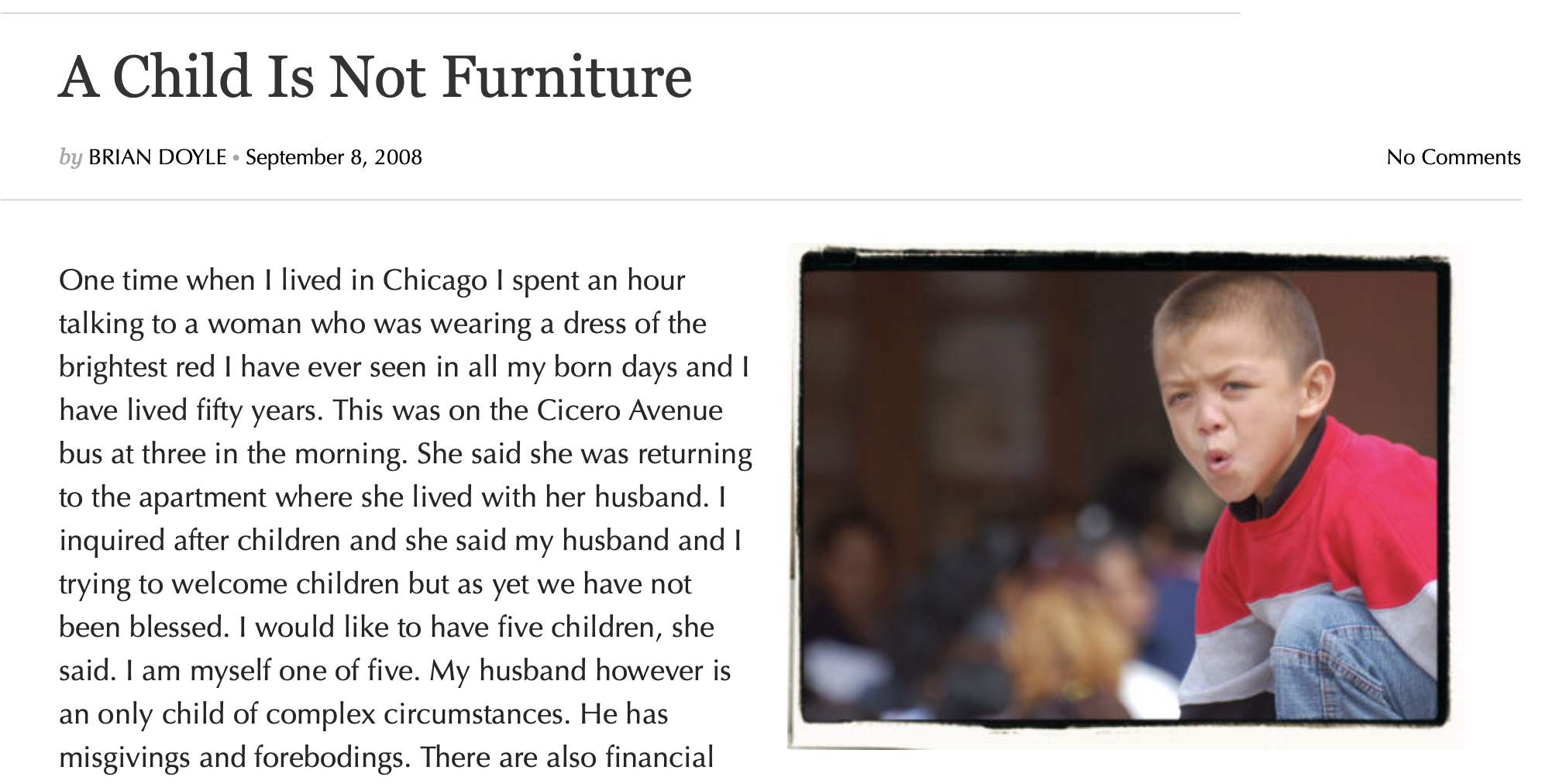
A student essay I was reading had reminded me of it, so I went to reread and then recommend it, but found that instead of “A Child Is Not a Furniture,” the title I remembered confidently, the essay was now (perhaps always?) titled, more “correctly,” “A Child Is Not Furniture.”

I felt faint at that missing determiner. Could I have misremembered? Could the journal be wrong? Why had I never noticed this before?

Upon rereading the essay, which recounts and recreates a conversation with a woman on the bus in Chicago at three AM, I discovered the phrase I’d remembered, intact, in Doyle’s interlocutor’s words. She is talking about discussions with her husband over whether or not to have children. She says (of him), “He measures and calculates. He arranges things just so. But you cannot arrange a child just so. A child is not a furniture.” While the saying is cast in the voice of the woman on the bus, it is exactly the kind of phrase Doyle would notice and highlight, and thus it feels like his style. After all, writing is only arrangement of preexisting words, and in general, when Brian Doyle quotes other people, he tends to inflect their voices with a little bit of his own. Or his own voice is the result of absorbing so many other interesting voices. Either way, this is one instance of that.

Given that Brian died five years back, I took it upon myself to write an email to Dinty, asking whether the title might have been accidentally changed. Then, while waiting for his reply, I found the essay in Doyle’s book Grace Notes, where its title includes the “a.” Then, inspired, I searched out an archived version of the webpage from back when and confirmed that it had indeed originally been titled “A Child Is Not a Furniture.” Meanwhile, Dinty responded, agreeing with my revision/reversion, and assured me that he’d fix the error.

This is a small thing, perhaps as small as it gets (while other single-letter words night occupy less space or use less ink than the humble lowercase a, I would argue that given its function in a sentence, its position in the alphabet, and even its variable pronunciations (long vowel or schwa), the indefinite article is the least noticeable of words and the most takenforgranted). But see how sharply its presence inflects the essay’s title and, by extension, the essay. When I hear it, I both understand the phrase’s meaning and wonder about its everslight variation from expected usage. Perhaps, I wonder extratextually, the speaker was translating from Spanish or another language where “furniture” is not an abstraction but is cast as a quantifiable noun. Un niño no es un mueble, indeed.

This would be example enough, but a very similar thing has happened once before, so I’ll tell you about that, too. I was reading Doyle’s “From the Editor” in the journal Phoebe when I noticed this sentence (amidst the sprawling hypothetical responses that an editor wishes he could send in response to an unsolicited submission):

A piece like yours, we are sometimes tempted to write, is not elevating or edifying to the reader, but merely performance, or comment, or confession, or rant, or the product of insomnia or inebriation or incoherence, or lecture, or sermon, or humility, or browbeating, or elusive goop, and is the very reason why so much of what is sold culturally as art is nothing at all like art.

Did you catch the misplaced word in the list? I did. There’s no way Brian would have written “humility” in the context surrounding it. I was certain that he’d meant, or a copyeditor had changed, “homily” in that position. I wrote to the editors (this happened at a time when Brian had just undergone brain surgery and was incapacitated, so we could not ask him directly) to argue my case. I had, I explained, read many of, perhaps most of, Brian’s published essays, and I’d absorbed his cadences and phrasings, and thus knew that he’d often rail against sermon and homily (a simple Google search confirmed this), but he’d never rail against humility.

Within a week I got an email back from editor Robbie Maakestad, who agreed with my logic and forthwith made the change.

I mean, great. Congratulations, Pat. You did it! Twice! You noticed something no one else had noticed or could possibly care about. Here’s your Pedant Certificate.

But maybe there’s something to be said for knowing someone by his voice. (After my first public reading, a friend commented, pleasingly, “You sounded like you.” After my first [anonymous] external tenure review, when I ran into her at a conference, the new associate professor commented, “I recognized your voice in the letter.”) Maybe noticing the smallest things corresponds with the kind of prayerful attentiveness that Brian was always encouraging.

There are the generalities of style: the long, sinuous sentences that challenge and surprise with their ordering and nesting of information. The short, clipped ones. The fragments. The preponderance of elemental or ornamental words. There’s also the understanding that whatever your style, it is not a thing you’ve invented; it’s a thing you’ve inherited, largely, overwhelmingly, without knowing it, or at least without knowing its intricacies. What’s important, it seems to me, is to strive for humility and to challenge yourself beyond your current defaults. When you get tired of yourself, experiment with something new. Take in influences consciously and voraciously, make new attempts, play, see what feels natural, what sticks, what becomes your own.

[Look. As far as I remember, Rachel Blau DuPlessis didn’t stick with the f-words thing religiously either. There was no structuring element built from it. So forgive me if I seem to have left it behind (some word of it may still be found off in a corner). I mean, I have. But also I haven’t.]

One more story: On the day I learned that Brian Doyle had begun hospice care—perhaps this was also the day he began hospice, I no longer remember if I ever knew—on that day, I went to see my daughter’s middle school dance recital. For the sentence you just read, I have channeled, at first subconsciously and then consciously, a sentence from a poem by Mark Halliday in which I feature as a character, the antagonist even, having conked Halliday on the head during a game of basketball. Halliday delays/resets several times where I’ve done so only once:

On the day that my lifespan matched my mother’s lifespan,
on the day when I had come to live as long as my mother had lived—
she died in 1975, of cancer, three days after her 52nd birthday—
on the day when I had lived as many days as she got to live
(though for her there were hundreds and hundreds of days of
miserable pain, which has not at all been my fate)—
on that day
I went to the gym to play basketball with some friends.

This is the sort of thing I do quite a bit: crib consciously from writers I admire, whose voice has imprinted itself upon my subconscious. Once, when writing about my infant son’s skull operation, I took from Brian’s phrasing about his son’s heart operation:

When have I been filled with grace? One time above all others, when my son was under ether.
One time above all others I felt the great divide between theory and practice, was closest and the situation heaviest: when my son was under knife and morphine and screaming ceaselessly.

I admitted the theft, still in time for a possible revision, but Brian gave his blessing, so I kept it. And I’ve borrowed knowingly other times as well, with things like skimping on punctuation to establish exigency, or shifting suddenly into the present tense to cast a moment into relief against the background. And then there was that one odd time when Brian attempted to write like me (at my invitation, for an essay subverting the simplistic view we sometimes default to about “originality”) but, in my view, couldn’t quite pull it off, or maybe didn’t care to. Readers familiar with his style will recognize him by his voice in this uncredited passage in the middle of my essay:

But to return, sidelong, diligently, like a small child who was going to check out that cool bird’s nest in the backyard but got distracted by how hard it is to hop on one foot for more than, say, eight hops, to plagiarism and the essay. One might well say, as certainly someone has, perhaps in another language, that the essay is by nature a magpie, a confluence of all the influences on its author; even Montaigne, for example, was soaked in Plutarch and the Bible and other literary glories of antiquity, and no force on earth can utterly erase the music and cadence of writers from the sponge-like crania of subsequent writers; the most honest essayists among us admit with admirable honesty that we all have, as Robert Louis Stevenson says, “played the sedulous ape” to writers we admired or admire. All that we can hope for as essayists, it seems to me, is to have learned something of rhythm and pace and sentence-carpentry from our predecessors, while gently leaving their particular styles behind like a teenager tiptoes away from the college of his or her parents; although I will here confess, in public, right on the page, right here at the end of this sentence, that there are some writers I cannot read while writing, because their music is so alluring it begins to dilute my own.

And readers who’ve been paying attention to this attempt at an essay will note that Doyle’s topic fits neatly with our considerations here. Not only have I played the sedulous ape to him, but he has to others, and they to their forebears, so that we realize the folly in claiming any kind of ownership, in the traditional, uncomplicated sense, of a style. And it’s worth noting that sedulous does not mean “copycatty” as I’d assumed from context, but “dedicated and diligent,” as in consciously attending to the writing styles of others in order to own our influences, beyond the inevitable osmotic assimilations.

So. What happened at that dance recital? As I waited impatiently for my daughter’s troupe to take the stage, I recalled, at first subconsciously and then consciously, Brian’s similar experience of seeing a “forgettable” amateur play, not wanting to be there, noting one particularly “execrable song” and its singer’s “groaning tractor” voice, and yet, by force of will perhaps, finding beauty and even joy in the imperfect attempts of the performers. From what I knew of Brian, this reversal would have been expected. That he’d “roar with delight” at the young man who sang so gratingly but also with “deep humming joy.” That he’d perceive the dreck made art, be willing and able to appreciate it. Of that singer he said,

He had made something wonderful of nothing but dreaming and labor and passion, something that probably not even he knew he could make with such eerie skill—and that is where I wish to begin talking about creativity, for dreaming and labor and passion are its ingredients, and wonder is both its engine and its product.

So in the midst of my silent caviling and kvetching, my wishing myself away as I watched others' children while awaiting my own, I thought What Would Brian Do?, and I knew, and so I did that. I shifted my perspective in such a way that I was enabled to sit calmly in my seat and gladly enjoy, truly enjoy, the hard-thumping electronica, the asynchronous jerky movements, the mistakes and the moments of harmony. And not in an ironic way. I became present for the dances. With the back of my mind trying to reckon with the inevitable and imminent loss of my dear friend, I borrowed his strength and found beauty where I’d been unable to perceive it before.


*


Patrick Madden, author of Disparates (2020), Sublime Physick (2016), and Quotidiana (2010), teaches at Brigham Young University and curates the online anthology of classical essays www.quotidiana.org.

Tuesday, December 21, 2021

Advent 2021, Dec 21 Patrick Madden: On a Pleasing Encounter without a Pickpocket

after Louise Imogen Guiney's "On a Pleasing Encounter with a Pickpocket"

"It struck me that the sweet symmetry of the thing ought not to be spoiled; that I was serving a new use and approximating a new experience; that it would be a stroke of genius, in short, almost equal to the king pickpocket's own, to make love to the inevitable."

This essay is a cover in the prewriting primarily, in the doing more than in the reporting. In other words, I may not talk the talk, but I did walk the walk. (Yes, I am happy with this slight inversion of the cliched phrase, but not proud. I'm sure this particular reversal has been done before ["Woo hoo hoo!" sing the Barenaked Ladies in their song attesting to this truth, and I always imagine them performing on Jay Leno's Tonight Show, with David Duchovny accompanying on a shaker-egg (more or less) in time and singing along]. But perhaps a pilgrimage to that "lonely street corner [still] not adorned by a gas-lamp" is a thing unique in the footnotes of the annals of literary history.

An explanation is in order. I was attending the AWP Conference (weren't we all?) in Boston in March of 2013 (a month before the Marathon bombings, as it turned out, and in the same vicinity). The Hynes Convention Center where it was held was only a few blocks away from the corner immortalized in Louise Imogen Guiney's lamentably unknown essay "On a Pleasing Encounter with a Pickpocket." I knew this not from the essay itself, which is appropriately vague about its exact location, but from a letter the author wrote the day after the fateful titular event (which, felicitously, occurred exactly 129 years before today, on December 21, 1892). There, writing to her friend Sonny Day, whom she owed money (which she could no longer repay, now that she'd been robbed), she pinpoints the location as "Berkeley St at the corner of Chandler St, between the grain elevator and the vacant lots."

I was off, in the keen winter air, toward who knew what, but with a fire of enthusiasm for the comewhatmay. Not a block from the center, striding confidently off a curb, I stepped in a mound of what I thought was snow, and found myself shin-deep in slush, liquid freeze slurping over the edge of my boot and sliding in, soaking my sock. "Propitious!" I thought, and kept on marching toward destiny.

Twenty-odd minutes of purposeful striding, with appropriate pauses for automobiles and zigs and zags for subsequent mounds, and I had arrived. Five-story buildings met the sidewalk on each corner, to my right a smattering of street-level shops, to my left nondescript walls of stone and glass. No granary, no vacant lots, no "coal-sheds and broken tins" anywhere in sight. Nor any people. Nonetheless, I strategically placed a dollar in my left jacket pocket. I crossed on the WALK light. Wandered around, waiting for someone, anyone. There was no one. It was too cold. Perhaps too early. I would not be pickpocketed today.

Unless...I tugged at the dollar (yes, it occurred to me that I was being far too cheap in my experiment, but the budget for essays had recently been cut), pulling it half out of my pocket. If no "tiger-lily of the genus 'tough'" were available to help me fulfil my mission, perhaps the whipping wind would. I peeked out from the shelter of a windward edifice and stepped into the gusts.

Really!? I'm subjecting myself to this suffering so I can say that the wind took my dollar? And of course, it didn't, either. The bill remained firmly in the pocket, delicately stirring but unremoved by the buffetings. I want to say that I was always self-aware enough to laugh at the ridiculousness of my quest, but especially once, in the absence of the possibility of a "real" pickpocketing, I turned mystical. I mean, how would I have written that? And what was this whole enterprise, anyway? Homage to a beloved essayist? Essayistic thrill-seeking? A record of my contemporaneous sensations? I had begun the day expecting something to work out, as it always does, creditable or the reverse, and if "nothing had happened" as yet, perhaps it would. Or it wouldn't. I suspected that the answer to this dilemma lay not so much in the external world, but in my openness to it, my perceptiveness and willingness to understand and to connect. I might trust, still, that something would become clear, or that I would make things clear. That things would work out. That the universe would provide.

To the vacant air I sang out my silliness, then decided to return the way I had come.

All the way I walked (squish, step, squish, step; my left foot still wet and cold) with the abstracted Marcus Aurelius Antoninus, whom I knew only in the vaguest sense, but whom I expected might have some wisdom for me were I to consult him. I have done so now, at long last, with the help of an interpreter, George Long:

"To be vexed at anything which happens is a separation of ourselves from nature." (II.16)
"Do the things external which fall upon thee distract thee? Give thyself time to learn something new and good, and cease to be whirled around." (II.7)
"Of human life the time is a point, and the substance is in a flux, and the perception dull, and the composition of the whole body subject to putrefaction, and the soul a whirl, and fortune hard to divine, and fame a thing devoid of judgment." (II.17)
"Either it is a well-arranged universe or a chaos huddled together, but still a universe." (IV.27)

That afternoon, I attended conference panels asserting the importance of essays that essay, celebrating essays that flash (into, out of, around existence), that think on themselves self-referentially. Other than my still-soaked sock and shriveled toes, there was no record, were no lasting effects from my excursion. The thousands of people milling about me were completely unaffected by my pilgrimage. No matter.

"Everything harmonizes with me, which is harmonious to thee, O Universe." (IV.23)

Later that evening, on my way to who remembers where, I gave the dollar to a stranger singing in the cold on another street corner, less lonely, quite adorned (still no gas lamp). The next day, upon retrieving a bag of chips from a vending machine and scooping up my change, I discovered four quarters too many. When I returned to my office the next Monday I found, pinned to the cork board outside my door, a crumpled dollar bill.


*


Patrick Madden, author of Disparates (2020), Sublime Physick (2016), and Quotidiana (2010), teaches at Brigham Young University and Vermont College of Fine Arts. He curates the online anthology of classical essays www.quotidiana.org.

Wednesday, December 18, 2019

Patrick Madden: Summary / Judgment

One of writing’s axioms is that the large can be found in the small, the universal in the particular. I have seen this idea expressed a million ways (or, more realistically, a hundred? one-hundred-twenty-seven, more particularly, if not more accurately?), one of the most memorable, for me, in an informal lecture given by Scott Russell Sanders one Thursday morning years ago in the Dean’s Conference Room on the fourth floor of the Joseph F. Smith Building at Brigham Young University. I have shared here the specific details I can remember, omitted or elided the ones I cannot. But give me a moment to consult the Oracle (a moment passes; the writer types some keywords into an internet search engine, then reads the results): it happened in room 4010 of the JFSB on Thursday, October 15, 2009, sometime in the twelfth hour of the day, which means sometime after 11:00 Mountain Standard Time, given that the first hour of each day (like the first year of each person’s life, or the first century after the traditionally agreed-upon birth of Christ) begins at zero [or twelve, a dissatisfying and/or quirky feature of the repeated twelve-hour clock], a detail that the writer, who is also a teacher of writing, always checks when he encounters it in his students’ essays, such as when they write, “In my thirteenth year…” when what they clearly mean is that they were thirteen years old when such-and-such happened, which would be their fourteenth year. How have I found myself suddenly in the third person? the writer wonders.

Sanders spoke of his students’ reluctance to particularities, manifest in their assertion that by leaving their stories vague, they allowed room for readers to insert themselves and provide their own interpretation. Sanders liked to reduce their argument to its absurd case, he said, by suggesting that they ought, then, to leave their pages completely blank.

This comment, as I recall, got a hearty laugh and knowing nods from those assembled, a group that included both earnest professors and eager students. From the southwest corner of the room, the high-backed Eisteddfod chair sat in silence watching over the assembly, inscrutable but for its ornate carvings, which no one noticed or cared to decipher. A diffuse light shone in from the west-facing windows, through external metal slats, as the sun approached southerly vertical. On the south end of the room, on floor-to-ceiling bookshelves, an assortment of professors’ books rested unmolested but for the steady rain of dust accumulating on their pages’ edges. My own first book, which would soon occupy a place of prominence on the middle shelf, outward-facing and eye height, comfortable and confirming to the default perspective, was not yet among them, nor, indeed, yet in existence, quite, as an object.

(Sanders did not reduce his own argument to its absurd case: to the utter extreme of detail, where not a mote floating in the air would go unremarked or undescribed. While a blank page is easy enough to produce in reality, such an infinitude of detail can be conjured only in the imagination, and in the abstract.)

My mind did not then wander, though it wanders now, to the 1967 Batman episode “Pop Goes the Joker,” in which Cesar Romero’s character wins an international art competition by leaving his canvas blank. Responding to the befuddled judges’ “What is that?” he says “My painting is titled ‘Death of a Mauve Bat,’” and when he’s asked for further explanation, the gallery host, Baby Jane Towser, buts in to declare, “It’s symbolic [of] the emptiness of modern life. What else?” Towser’s subsequent announcement that the Joker has won gets hearty applause and knowing nods from those assembled, Bruce Wayne and Dick Grayson excepted, of course.

To my very limited knowledge, no artist has attempted quite what the Joker pulled off with his blank canvas, but in 1918 Kazimir Malevich painted the best known of his White on White series, a white square floating at an angle in a larger, slightly yellower white square. Of it, he said, “I have overcome the lining of the colored sky. . . . Swim in the white free abyss, infinity is before you.” Which sounds quite inviting, I must say. Or perhaps terrifying. (Depending on one’s interpretation.) The painting currently hangs in New York’s Museum of Modern Art in a wing named for David Geffen, who made his money middle-manning pop music and movies to the masses. (I’m fine with that, I should say. I mean: Lennon’s Double Fantasy; Nirvana’s Nevermind; the Bee Movie! [see what I did there? Two unquestionable works of art followed by a famous flop? You’re not sure whether to believe my assertion. This is intentional. Or is it?])

Similar examples abound, from Malevich’s own works to Ad Reinhardt’s 1963 Abstract Painting, which at first glance is a plain 60-inch all-black square (upon longer and deeper observation, it reveals itself to include various shades of black, perhaps some shapes [Nigel Tufnel appears in mind, answering his own question about Spinal Tap’s pure-black Smell the Glove album cover, amidst a flurry of interpretations by bandmates: “How much more black could this be? And the answer is none; none more black.” Which in turn brings The Beatles, of course, but I refrain, because invoking The White Album would bring along Charles Manson’s murderously wrong interpretations, and after Manson would follow Joan Didion, and we haven’t got time, though her work is certainly worthy, and I’ve spent much time reading, admiring, and teaching it, noting especially the overly simple way so many of us understand “We tell ourselves stories in order to live,” which Didion herself subverts and complicates in the sentences immediately following, so, before we get too far off track (too late!), to Metallica’s self-titled album, or to Jay Z or to Danger Mouse, for instance, I’ll pause only to explain that I cannot get my computer to place the n in Spinal Tap beneath an umlaut, just in case you were wondering]). It is difficult to experience such works via the computer screen, which flattens and translates them into pixels, which do not respond well to changes in viewing distance or angle. I recall seeing just one such work in person, Robert Motherwell’s 1958 Iberia, which hangs in the Guggenheim Museum in Bilbao, Spain. I found the painting—a horizontal swath of brush-stroked black with a tiny unpainted white swatch in the lower-left corner—to give rise to many questions, mostly of the philistine’s “this is art?” variety, but some of a less skeptical, more earnestly curious kind. Later researches revealed that Motherwell was long obsessed with the ravages of the Spanish Civil War, and that while painting a series of Elegies to the Spanish Republic, he “discovered black as one of my subjects—and with black, the contrasting white, a sense of life and death which to me is quite Spanish.” A note at the Guggenheim website accompanying the painting admirably complicates Motherwell’s recollection or interpretation of his own work, stating, “Given that the Elegies date from an ink sketch made in 1948 to accompany a poem by Harold Rosenberg that was unrelated to the Spanish Civil War, and that their compositional syntax became increasingly intense, it seems all the more apparent that the ‘meaning’ of each work in the series is subjective and evolves over time.”

I have been thinking recently for a long time about what language does well and what it doesn’t. Also about what it maybe cannot do at all. I have arrived at no conclusions, not really, but I have reduced my wonderings to a two-item answer: summary and judgment, each of which serves a kind of efficiency, provides a container that reduces the “size” of life for ease of transport, enables a kind of crude communication among people, perhaps primarily of the informational or commercial kind. By summary we compress time and space and detail to portability, often to highlight the important parts, or to get through an explanation quickly. “This is an essay about variable interpretations and the importance of using specific details in writing,” I might claim about this very piece. But the summary, self-defeatingly, misses the specific details that make up the essay, even if I append them to my summary: “...including examples of single-color abstract art by Malevich, Motherwell, and Reinhardt.” And by judgment we shortcut the sometimes arduous sometimes glorious process of coming up with our own interpretations from our own experiences. “How was New Zealand?” people have been asking me lately, because I’ve just returned from there. “It was great/ lovely/ beautiful/ relaxing/ inspiring…” I respond with the obvious, and we both consider the exchange sufficient, finished. Most such communication results in no communion, no connection in the artistic or spiritual sense. Perhaps this is why literary writing, especially nonfictional literary writing, is so rare and vital and valuable: because it not only captures but creates an experience of reality akin to (or even surpassing) what our senses register as we move through our lives. Because as it uses language for more than summary and judgment, it rescues detail that most of us miss or forget (and then miss, in the long-for sense).

In matters of law, a summary judgment is one in which a judge issues a verdict “summarily,” which is to say without a jury trial, because the evidence unquestionably favors one party’s claims, because no significant facts are in dispute. For example, in May of last year, Judge Naomi Reice Buchwald of the US District Court for the Southern District of New York issued partial summary judgment in favor of a group of Twitter users blocked by @realDonaldTrump, ruling that such blocking is unconstitutional as it violates their First Amendment rights. And in May of this year, Judge Amit P. Mehta of the US District Court for Washington D.C. issued summary judgment in favor of the House Committee on Oversight and Reform, which had requested (and has still not received) the financial records of Individual 1. Or just a couple of months ago, Judge David Briones of the US District Court for the Western District of Texas issued summary judgment in favor of El Paso County, Texas, and Border Network for Human Rights, which claimed that the president’s declaration of a national emergency at the southern border was unlawful and that use of emergency funds to build a border wall would violate the Consolidated Appropriations Act. A summary judgment is one that no person in their right mind could interpret differently.

*

Patrick Madden is the author of three essay collections, Disparates (forthcoming in 2020), Sublime Physick, and Quotidiana, and co-editor of After Montaigne: Contemporary Essayists Cover the Essays. He curates www.quotidiana.org, co-edits the journal Fourth Genre with Joey Franklin, and, with David Lazar, co-edits the 21st Century Essays series at the Ohio State University Press. He teaches at Brigham Young University and Vermont College of Fine Arts.

Friday, December 7, 2018

Dec 7: Patrick Madden: "heh heh heh heh" (a correspondence with Brian Doyle)

I wanted to find one of Brian Doyle’s old emails whose subject line, I knew, was “heh heh heh heh.” Gmail turned up ten qualifying messages, though their number of hehs varied, and I was grateful for the loose interpretation of my query. I smiled at the revelation, the habit I had never before discerned: ten messages, all aiming to brighten my day with laughter. This fact alone is perhaps sufficient, and I should turn quietly away here, I suppose, but for the fact that I began using Gmail only in 2012, and I wanted to check older emails, too, so I searched another online archive, which turned up an additional nine, going back two further years, to 2010. I know there must be more, as Brian and I became friends at the end of the last millennium, and while our correspondence trickled slowly at first, it soon became frequent, fitful showers, with emails every few weeks, at least, nearly always initiated by him, nearly always including a brief piece of light prose, sometimes formatted in a thin proemic column, always designed to delight and grant insight, eliciting my grins and chuckles, sometimes my tears, always my admiration and wonder. But for now those other probable ephemeral messages remain inaccessible to me, hidden on some remote server somewhere just out of reach.

I pause here for a moment to collect my thoughts and gather my emotions, as it has been eighteen months since Brian died, too young, suddenly, his teeming brain overtaken by a cancer. I write the previous sentence and feel that it is insufficient, too crafted, leaning too hard into something fabricated and feigned, yet I cannot design anything better to explain myself while also informing my imagined reader of the fact of Brian’s still-recent death.

Back at it: I have just now (the essay is written in the eternal now) revisited and reread the nineteen Brian Doyle emails with subject lines of variable hehs in order to create this Advent essay to share with you.

I can report that they are a glorious hodgepodge, a marvelous miscellany, by which I mean not to exaggerate their literary greatness, but to recognize in them an exuberant immediacy that could be said to fail as often as it succeeds, if one were binarily inclined, which I am not. There are two essays alluding to E. B. White and two essays that refer to or derive from the same small moment before horseback riding and two essays about Doyle’s unorthodox writing style and two inspired by nature and two about the strange creatures called writers and more than two about the strange creatures called children. There is a reminiscence about playing freshman football (badly). An elaborate expansion of the proverb “If you give a man a fish…” A retelling of Daniel in the Lions’ Den from the lions’ perspective. Moral advice against the sins of envy and thievery. Timestamped field notes from a “Mammalian Observation Project” involving his toddler son. A humorously nervous return to the Doyles’ wedding day, during which Brian’s father compliments him, “You look dashing all dressed in white like that, although I wouldn’t be surprised if someone takes you for an ice cream vendor.”

Many of the essays are silly like that, at least temporarily, before they pivot deftly into significance, but I think that for Brian these categories were not opposed in the least. He believed that laughter is holiness. Thus he tells us that “I would drift into the play when I judged it safely over, and dive onto the pile, so that it seemed I was all over the field making tackles, whereas really I was happily jumping on my teammates, who didn’t seem to mind… and now that I think about it, I see that I had practiced this very thing for years with my many brothers; about half our childhood, I would guess, was spent in wriggling piles and jumbles of limbs.” He remembers “a small statue that may or may not have been Jesus, presented to me in sixth-grade basketball, although the coach, one of the dads, and not one of the dads who had ever played or seen basketball played before, it turned out, told me that if it was Jesus, which he was not totally sure it was, it was a rare case of a long lean Jesus portrayed in tight gym shorts, sculpted as if he, basketball Jesus, had just launched a jump shot, his right hand following through correctly so as to impart backspin on the ball.” And he writes of his mother, who was usually “gently amused, or mildly entertained, or bemused, but occasionally she lost it completely, and fell into helpless giggling, so much so that she would actually weep with laughter, which is maybe the most infectious thing in the whole world, someone you love just totally completely utterly helpless with uncontrollable merriment, which finally shudders and staggers to a halt, although you keep bursting into smaller fits for a while, like a thunderstorm petering out in fitful showers.”

One of the oldest “heh heh” emails I found, from eight years ago, I had stored in my “todo” folder, which I named thusly for its different yet sequential interpretations in English and Spanish, so that the infinitive question “to do” becomes the daunting answer “todo,” everything. I had suggested that perhaps Brian’s proem “On the difficulty of translating the American writer Brian Doyle” might work well as a translation, and I’d offered, perhaps too ambitiously, certainly naively, to translate it into Spanish, which Brian agreed would be funny, but, unsurprisingly, I never did it. Here, then, is a halfhearted half-attempt:
Primero de todo, el estilo es incomprensible; ¿que está pensando
Con estas frases elefantinas? ¿Tiene miedo a los puntos de puntuación
O que? ¿Y que hay con la adicción al punto-y-coma y el ampersand,
Leía solo Blake y Gibbons como niño?
I don’t think there’s a word for ampersand in Spanish, I can’t find one anyway, so I’ll abandon my translation here, return it to the vast collection of things left undone. For all his manic finishing of things, Brian was also utterly mellow. I’m sure he wouldn’t mind.

The shortest email contains, in a font so small I couldn’t read it without pumping it up electronically, “A Tiny Poem,” the entirety of which reads:
What if someone wrote a poem
So tiny no one can read it—is it
A poem then, or something else
Altogether, for which we do not
Have any words to make poems
With?
This is a common theme in these pieces: the necessary futility of words to approach mystery, which is of course located in the “Coherent Mercy,” but also in all of us. Considering with his son whether “Box Elder Bugs [Are] Happy for George Clooney?” on Wed, Nov. 12, 2014, Brian exhorts us to
Imagine for a moment if all that could be said of us was our average size, and coloring, and eating habits, and predators, and the arrangement of our wings, and what direction we liked to face when basking in the fading autumnal light; would that say anything of what and who and why we are? No? Then join me, for a sidelong moment, right now, in wondering at the vast wealth of what we do not know about even the beings we see every day around us… In a real sense such a roaring absence of knowledge is a great gift, for it leads to wondering, and wonder is a lovely place to be.
The emails remain for me a source of inspiration, but that’s an easy word, one we toss back and forth with everything from pop songs to soap commercials. So let me agree that wonder is a lovely place to be, and let me affirm that although I am saddened that there will be no new messages from my dear friend, I trust that he remains somewhere, just out of reach, and I am cheered that his notes still impart a measure of his pure enthusiasm, a better word I think, as it suggests its etymology, through the Renaissance (“literary inspiration”) to ancient Greece, when and where to be en-thused was to be “inspired or possessed by God,” whom perhaps we experience primarily in each other, as Brian would often say.

Another thing he would often say, and which he said precisely on Fri, Sep. 6, 2013, at 3:43 PM, PDT, is “one of the things I like best about good essays…is that they know where to end,” so I will end with the penultimate “heh heh heh,” from Fri, Dec. 11, 2015—the only wordless one, one quite germane to our seasonal purpose here—in hopes that it will evoke an enthusiastic chuckle:


Brian Doyle was a dad, a dad, a dad, a husband, a son, a brother, a friend, a basketball nut, and a citizen, who edited the University of Portland's alumni magazine for a quarter century and wrote twenty-eight books of essays, novels, stories, proems, and prayers. His essays, which often appeared in Orion, Harper's, The American Scholar, The Atlantic, and many other journals, were reprinted in the Best American Essays seven times, as well as the Best American Spiritual Writing, the Best American Science and Nature Writing, and other anthologies. He was awarded the Oregon Book Award, the John Burroughs Medal, a literature award from the American Academy of Arts and Letters, and several other prizes. Brian died of brain cancer in May 2017.
Patrick Madden is the author of two essay collections, Sublime Physick and Quotidiana, and co-editor of After Montaigne: Contemporary Essayists Cover the Essays. He curates www.quotidiana.org and, with David Lazar, edits the 21st Century Essays series at the Ohio State University Press.

Read lots of Brian Doyle's essays at:

Saturday, December 16, 2017

Dec 16: Of Women and the Essay (a conversation between Jenny Spinner and Patrick Madden)

What follows is a conversation between Jenny Spinner and Patrick Madden, who, like many people (especially around these parts) share an interest in essays and have made some efforts to rediscover women essayists of the past. Spurred by Phillip Lopate’s introductory comment explaining the dearth of women essayists in The Art of the Personal Essay that “there were no female Hazlitts and Lambs,” Spinner and Madden set out to find them. Given this year’s Advent Calendar theme of rediscoveries, they thought it appropriate to briefly introduce readers to some of the many wonderful works now available on Madden’s http://quotidiana.org/ or soon available in Spinner’s Of Women and the Essay: An Anthology from 1655 to 2000, a groundbreaking book due out in fall 2018 from the University of Georgia Press. If you’re interested in finding new great essays, and you know you are, this conversation will get you started, and maybe tide you over until you can get Spinner’s anthology next fall.

PM: A couple of years ago, I wrote a piece for the Essay Daily Advent Calendar about one of my favorite essays, Louise Imogen Guiney’s “On a Pleasing Encounter with a Pickpocket.” I found Guiney originally in a 1921 anthology of Modern Essays edited by Christopher Morley. She was the only woman in the book.

JS: Ah, Christopher Morley. The “Preface” to that anthology is a gem. He actually apologizes for not including “the most widely bruited essayists of our day,” instead offering that he wanted to include essayists less known to readers. Apparently, women were even lesser known than the lesser known essayists in his anthology. But at least he chose Guiney! You were the one who introduced me to her work many years ago at an AWP conference. Is she your favorite discovery?

PM: Certainly she’s one of them. Top five for sure. I find her utterly mellow and charming, concerned with all sorts of seeming trivia, which she makes interesting (and important) through her clear and beautiful prose. She claimed a deep love of William Hazlitt, citing him as one of her influences, so she intentionally trained herself in the stylings of the classical essay. The one Morley chose is “The Precept of Peace,” by the way, and one can still find first editions of her best book, Patrins, for less than $20.

JS: I have a copy of that, too! I’ve picked up a lot of these first editions for a song--bargains of neglect. I paid less than $10 for a first edition of Gail Hamilton’s Gala-Days. It contains her essay “Happiest Days,” which I include in my book. This essay makes me laugh aloud. In it, Hamilton argues that the notion that childhood is the happiest period of a person’s life is complete bull. I guess I’m less for the mellow and charming essayists and more for the biting wits, in part because that voice upends stereotypes not only of essayists but especially of women essayists. Rebecca West is in that category, too. She roasts the essayist Max Beerbohm in her fabulous “Notes on the Effect of Women Writers on Mr. Max Beerbohm.” That one’s in my book, too.

PM: Having recently read and reviewed The Prince of Minor Writers: The Selected Essays of Max Beerbohm, I’m truly looking forward to that West essay, which I’ve never heard of before now. In fact, despite my researching and reading quite a lot of women essayists, I know that your book is chock full of people I haven’t yet read. How did you find all of them?

JS: Mostly following trails left by other scholars and editors, though I’ve had to whack away at some serious brush to find a number of those trails. I think I pored over every table of contents of just about every essay anthology or annual written in English and published in the last two hundred years looking for women. One here, one there--it took a lot of anthologies to come up with a decent list. But one of the most useful sources for me was John Seely Hart’s The Female Prose Writers of America, first published in 1852. Do you know it? It’s this multi-volume, multi-edition tome, over five hundred pages long, packed with biographical entries on and excerpts by women prose writers from the nineteenth century, like Susan Fenimore Cooper and Caroline Kirkland, and Sara Jane Lippincott, who wrote as Grace Greenwood. I use Greenwood’s essay “My First Hunting” in my book. I found my way to so many writers through Hart’s book--and got a sense of how well thought of these writers were in their own time. You know what I finally realized? We aren’t just digging little-known writers from the pits of obscurity. We’re digging well-known writers from pits of obscurity dug by scholars and anthologists.

PM: I dig your double meaning of “digging.” It seems to me, or it is my hope, that the double pit of “essay” and “women” is filling in generally, nudged along by efforts like ours, to refocus attention on those writers that scholars and anthologists forgot. For a time, I also looked through all the anthologies I could find, in the library stacks and online at Project Gutenberg and Archive.org, and I believe it was one of my searches that led me to your dissertation many years ago. But I was haphazard while you were methodical, it seems, and I never encountered the Hart books. That dissertation of yours was an early draft of your forthcoming anthology, and since that day (over ten years ago, I think!) I’ve longed for your book, wanted to have it myself and teach from it henceforth and forever. Maybe you can tell us a bit about the process from dissertation to book?

JS: Well, first, I am so grateful for your prodding all these years. But, yes, this project has taken me well over a decade to complete--though I always like to add that I had four kids in that decade as well. While compiling the biographical information for the headnotes, I found myself particularly interested in the children, aging parents, spouses, lovers--the whole cast of characters--that are part of the life-work juggle of so many women essayists. I’m waiting for someone to point this out as a negative in my headnotes, but I live this challenge of carving out physical and emotional space from the chaos of responsibility to write essays, and in a book of women essayists, I’m going to note that. In any case, in some ways, my dissertation was the dream, and the book is the reality. When putting together my dissertation, I didn’t have to worry about length or permission costs. I just gathered and gathered and gathered. I could have kept on gathering except I wanted to graduate at some point. There were sixty-one essayists in my dissertation. There are forty-six in the book. I had to make a lot of tough editorial decisions. So, for example, you won’t find in the book one of my favorites, Katherine Anne Porter’s “St. Augustine and the Bullfight.” No Adrienne Rich or Angela Carter or Ada Louise Huxtable or Natalie Angier. Any other glaring absences? Now’s your chance!

PM: I know that you did include a few essayists I recommended, so I wouldn’t think of suggesting more now! And I recognize the difficulty of including everything one would want, especially when living and recently living authors might require hefty permissions fees. But you still have the appendix naming lots more women essayists, right? So the book is a nexus from which readers can continue to read.

JS: Yes, the appendix lists nearly two hundred additional essayists publishing from 1500 to 2000. Even at that, I don’t suggest that it’s a comprehensive list. There’s so much recovery work left to do, especially when it comes to women of color and other marginal voices from earlier centuries. You asked about differences between my dissertation and the book, and a major one is that I am now much more focused on diversity when it comes to the politics of canon formation. Earlier this year, I sat down with my colleague Aisha Lockridge, who teaches African-American literature here at St. Joe’s, and told her I was having trouble finding women of color who wrote literary essays (not polemical or advocacy essays) prior to Zora Neale Hurston’s 1928 publication of “How It Feels to Be Colored Me.” Who am I missing? Where should I be looking? I asked her. Even though I had a solid argument for why I was coming up empty-handed, I didn’t want it to be an excuse. Aisha didn’t know the answers to my questions, but she handed me about ten books, including collections of essays written for The Crisis, and Opportunity, two publications particularly important in the Harlem Renaissance. I eventually found my way to Marita Bonner, and then to Gertrude Bustill Mossell. I didn’t end up using Bonner’s essay “On Being Young--a Woman--and Colored,” but I do include Mossell’s essay “A Lofty Study,” which appears in her collection The World of the Afro-American Woman.

PM: Yet again, more essayists I haven’t yet read. I’m truly excited about this book! It has always felt very important to me that writers recognize our deep debt to our forebears, whether or not we know them, and to consciously seek to know them, to own our influences, to discover great writers that came before us. That’s one reason why David Lazar and I edited After Montaigne, a collection of contemporary “cover” essays honoring the “father of the essay,” as he’s often called. It’s also why when we chose a name for the yearly book prize from Ohio State University Press’s Twenty-first Century Essays Series, we named it for Marie de Gournay, Montaigne’s “adopted daughter” and literary executrix, and a fine essayist, too. But who would you consider the mother of the essay?

JS: I agree that Marie de Gournay is important to the essay’s history, in part because of how the public responded to her attempts to imitate Montaigne, the essayist she so admired. Basically they shut her down, and she apologized, claiming temporary insanity. I mean, that says a lot about the bravery of women embarking on this whole essaying business. In our own contemporary moment, in what’s been called the “Golden Age of Women Essayists,” we take for granted our participation in the genre. For at least the first couple of centuries, however, it was anything but simple for women to write essays. But don’t let their absence in the history of the essay canon fool you. They were writing essays. My book happens to start with Margaret Cavendish, who published The World’s Olio in 1655. Is she the “mother of the essay”? I’m not interested in linking the essay’s lineage to a single writer, so I’ll only offer that Cavendish is a good place to start. Virginia Woolf thought so, too. In her essay “The Duchess of Newcastle,” Woolf bemoans Cavendish’s slip into obscurity, calling her both “noble and Quixotic” and “crack-brained and bird-witted.” What a sell!

PM: I’m sold. Cavendish I do know, a bit, and have enjoyed my colleague Brandie Siegfried’s scholarly work on her as well. Here at BYU there’s a good, growing Cavendishish movement, which is heartening, as it suggests a broader interest in early women essayists. It’s not just us practitioners who enjoy their work.

JS: Let’s end at the beginning, just like a good essay. Years ago, when I first imagined a book to address Phillip Lopate’s assertion that were no female Hazlitts and Lambs--by the way, I have great respect for Phillip and when I mentioned to him what I wanted to do, he told me “Go find them!”--I began by asking asking every scholar and conference panelist I came in contact with, “Who’s your favorite woman essayist?” I think it was Bob Atwan who mentioned Agnes Repplier, and that was the first I’d heard of her--even though she was once a household name and one of the most prolific essayists writing at the turn of the twentieth century. As these conversations continued, I realized that outside of what I call the “Female Essay Triumvirate”--Woolf, Didion, Dillard--women have largely been absent from the history of the essay. More than anything, my book is an attempt to write them back into it, so that when we talk about influential movers and shakers in the history of the essay, we are talking about, say, Eliza Haywood, Judith Sargent Murray, Frances Power Cobbe, and Fanny Fern, too. Even though I’m finally done with this book, I can’t stop asking. So, who are your favorites, Pat? Who belongs in the history of the essay?

PM: Well, in addition to Guiney, whom I mentioned above, and Repplier, whom Atwan mentioned, I’d say my top five rounds out with Vernon Lee (Violet Paget), Alice Meynell, and Elisabeth Woodbridge Morris, though I’ve recently grown very fond of Katharine Fullerton Gerould and Grace Little Rhys as well. If I can recommend one essay from each for readers to start with, I’d choose Lee’s “About Leisure,” Meynell’s “Shadows,” Repplier’s “Words,” Morris’s “The Embarrassment of Finality,” Gerould’s “On Being a Sport,” and Rhys’s “Radiances.” Most, if not all, of these writers are in your book, I believe.

JS: All, save for Grace Rhys. She’s in the appendix. I like Gerould’s “On Being a Sport,” but I love “Ringside Seats” more, maybe because it’s set in Philadelphia, maybe because she’s a woman writing about boxing in 1937. You don’t have to be a fan of Philly or boxing, though, to sink yourself into her prose. At times, she can be a bit of a Genteel snob, but not in this particular essay. She’s all left jab, Greek tragedy, beauty of defeat.

PM: As I don’t care much for boxing, I’m glad to hear that! It’s been such a pleasure chatting with you about essays, and I hope our brief recommendations will inspire some readers to discover some new favorite essayists, and, of course, to put Of Women and the Essay on next year’s Christmas list, or Thanksgiving list? Halloween list? Labor Day list?

JS: Ha, do we really need a special occasion to buy a book of women’s essays? Some time in the fall of 2018, I’m told. In the meantime, I’m going to be at AWP in February, talking women and essays with some fabulous essayists and scholars of the essay, including Kyoko Mori, Angela Morales, Mary Cappello, and Jocelyn Bartkevicius. Kyoko’s essay “On Language” is in my book, by the way. Happy reading!

*

Jenny Spinner’s essays have appeared in Fourth Genre, Assay, Brevity, Writing on the Edge, and on NPR’s All Things Considered, among others. She is co-author with her twin sister Jackie Spinner of Tell Them I Didn’t Cry. She is currently at work on an adoption memoir, the essayistic traces of which can be found on her blog, Twinprints. She teaches at Saint Joseph’s University in Philadelphia.

Patrick Madden is the author of two essay collections, Sublime Physick and Quotidiana, and co-editor of After Montaigne. Winner of fellowships from the Howard and Fulbright foundations, he curates www.quotidiana.org and, with David Lazar, edits the 21st Century Essays series at Ohio State University Press. He teaches at Brigham Young University and Vermont College of Fine Arts.