Showing posts with label cover. Show all posts

Tuesday, August 22, 2023

Andrea Flint, The Wisdom of Spear Grass

THE WISDOM OF SPEAR GRASS

Andrea Flint


*


a cover of Sarah Minor's essay "A Log Cabin Square"


 *


(click to expand, or click here to download a pdf)


*


I don’t have many vivid memories of my childhood. Mostly, I remember a sensation that used to follow me around like a needy puppy—that things were not what they seemed, that there was a disconnect between my perception of reality and reality itself. 

I also remember the relief I felt when, on hitting school-age, it began to dawn on me just how powerful the mind was. Soon I learnt to override my feelings. Unlike emotions, elusive and fickle like swallows flitting across the sky at springtime and gone by winter, the brain could always be relied upon to make and preserve meaning. 

But no matter how hard I tried to hold on, I felt as if something was terribly off—as if my perception of the world was, somehow, defective.

I have learnt that unacknowledged traumatic experiences can do that to a person. Dissociation is a powerful survival tool, one where flights of fancy can lord unchallenged over a cruel reality to protect ourselves. Only when the veil lifts, does the impact of this alienation become apparent. Suddenly we are hit with the realisation that our ability to listen to our body’s wishes has been impaired to an extent that is commensurate to the strength of our denial. It’s as if the superhighway that connects body and mind has been lost to an enemy that has been residing undetected inside us. 

There is no way to describe that time in my life other than I fell spectacularly apart. Though outwardly I was functioning by dint of a peculiar mix of willpower and habit, inside I was scrambling to gather the pieces of me that a nascent, frightening consciousness had ripped apart. 

"The Wisdom of Spear Grass" was born out of this grown child’s irrepressible desire to make meaning—to join the dots out of the muddle of memories that were emerging from deep freeze during the hazardous process of therapeutic recovery. 

It was around this time that I first came across Sarah Minor’s "Log Cabin Square". For the first time, home didn’t have to be something neat, monolithic to be called home. Home could be a collage, an amalgam of fragments whose meaning is revealed only when juxtaposed to other seemingly randomised tassels and enjoyed from the safety of distance. 

As I tried to process the tangle of feelings the image of “horses on fire circling back to their bright home” stirred inside me, it struck me that the power of Minor’s Log Cabin Square rested on its ability to summon complex feelings that couldn’t be expressed in any other way. It’s this connubium of form and text that creates meaning. The latter—her essay reminds us, doesn’t exist in isolation, but as part of a whole that stirs our senses and tugs at our soul—our personal and collective mythologies. It cannot but be fragmentary. And that’s all right. And plentiful. And beautiful. 

Though quilt-making has not infused the Italian psyche in the same way it has across the pond, from the outset this art & craft struck me as so intuitively right I didn’t hesitate to borrow its form. If cultural appropriation is a sin, then I hope to be forgiven. 

Soon I discovered there were myriads of patterns and combinations—one for each life event, special occasion, celebration, even political causes. But I kept returning to the log cabin. 

The idea of the hearth—of home inherent in its squares—spoke to me in ways other patterns couldn’t. Even though its nucleus—the central square around which all the others corral, kept eluding me, I knew I had found my container, one that was both physical and metaphysical. 

The idea that a lowly weed—one that is regarded as a pesky nuisance in my ancestral land, could function as its organising principle felt as fitting as it had felt serendipitous. Gramigna has threaded its way across three generations of women on the maternal side of my family. It carries within it the wisdom of sharecroppers of whom my grandmother had been one—a lithe six years old, who had to learn fast not to take love for granted. 

Suddenly a pixilated picture of me within my extended family—atomised but undeniably truthful, bobbed to the surface. For the first time, perhaps ever, I felt moored. I had found my quilted hearth, its faintly smouldering embers beneath the seams radiating just enough heat to keep me going. 


*


Born in Italy, Andrea Flint is an emerging writer based in London UK, working in Creative Non-Fiction as well as poetry and short stories. She is currently working on a hybrid memoir around the themes of identity, trauma, and heritage. 

"The Wisdom of Spear Grass" was written during her time on this year’s Spark Your Story Intensive programme. Andrea is especially grateful to Nicole Breit and Rowan McCandless for their wisdom and mentorship—and for showing her the way to creative non-fiction heaven. 

The Wisdom of Spear Grass is her first publication—something that makes it all the more special.


*


Essay Daily runs a series of cover essays (essays that "cover" another published essay, in the way of a cover song). Pitch us yours!


Sunday, December 18, 2022

Advent 2022, Dec 18, Julie Lunde, 100 Essayistic


100 Essayistic

a cover of Philip Ording’s 99 Variations on a Proof
which is a mathematical cover of Raymond Queneau’s Exercises in Style

Julie Lunde


*


If you give an essayist a math problem, for instance: 
x3 – 6x2 + 11x – 6 = 2x – 2
she’ll say, 
Fuck math, I’m an essayist.
Or else she might say, 
I love math, but I haven’t done it in years, I’m an essayist.
If she is a certain kind of essayist, she might respond to your equation with an abstract but ultimately unhelpful and likely pretentious allusion: 
“To know x = to know (everything – x).” [i]
Or else she might offer an equally ill-fitting, only vaguely math-adjacent, but more fun pop culture reference: 
“The limit does not exist!” [ii]
If neither one of these quotes feels sufficiently satisfying, she might begin again by retracing a tangential anecdote: 
There was a math teacher at my high school, I forget his name, who was married to the history teacher—I forget hers, too. They always held hands in the hallways. He was rumored to teach in hyper-speed so he’d have two whole weeks free at the end of the schoolyear to tell his students the story of how they’d met; apparently, it was The Greatest Love Story Of All Time. But his students were sworn to secrecy, and I never took his class…
If the essayist is sometimes a little uncomfortable with the personal nature of her chosen genre, she will choose to reply with an alter ego to help relieve the burden of the first-person, to speak with a stand-in sometimes called the speaker (where speaker ≠ writer), sometimes the essayist, or sometimes even just a single, simple letter, an ‘I’; which, in its vacancy, can become universal, a functional placeholder for multiple possible truths.
Let ‘x’ be a real number. 
If she loves a good braid, which what essayist doesn’t, she may opt to weave in another thread, which will, of course, feel random at first:
The first game of ‘ultimate,’ also called ultimate frisbee, took place in a parking lot at Columbia High School in New Jersey, in 1968. The sport was the casual after-school creation of a group of friends, but its appeal proved contagious; an alumnus of CHS got his hands on a copy of the rules and founded an ultimate team at Staples High School in Connecticut in 1970, and before long, there was a CT league, and from there the trend went national.
The essayist might consider numbering her paragraphs, to make her essay response into a fragmented work, as in this classic of the genre:
“100. It often happens that we count our days as if the act of measurement made us some kind of promise. But really this is like hoisting a harness onto an invisible horse…” [iii]
If she chooses to do so, she will then consider the way a numbered fragment is formatted. She’ll look back at the page full of fragments and think:
This looks just like math homework—like a sheet of word problems.
If you try, then, to redirect this essayist to your chosen problem by restating it, this time more directly: 
100. Let ‘x’ be a real number. If x3 – 6x2 + 11x – 6 = 2x – 2, solve for x.
The essayist is likely—at first—to once again skirt the question. This isn’t because the essayist doesn’t love a good math problem, but rather because she thinks a good essay, and a good essayist, always resists the finite or definitive answer. A good essay, she thinks, thrives in irresolution, indecision, uncertainty. As she’ll be all too happy to inform you:
An essay, from the French essai, is an attempt. It isn’t an answering, but a mind at work.
If the essayist is a writing teacher of some kind, perhaps the instructor of a college composition course, she might include this etymology lesson in her class materials one day; and if one of her students is playing games on their phone during that class, the essayist will recall Mr. Wetzel—who, of course, taught the essayist’s high school precalculus class and wrote her college recommendation letter, who didn’t give the essayist too much flack when she got bored of math and began solving the NYT crossword in class; who, in fact, after she’d gotten into college, would regularly stop by her desk to say:
You got 24-Down wrong. The first letter is ‘S’.
When some of the essayist’s students (the engineers) ask her then for some more concrete rules, what they should or shouldn’t use as a title, whether their essays should be five paragraphs or six or seven, and if there’s a good formula or template for an A+ conclusion, she’ll take solace again in writing’s lack of solutions: 
There’s no wrong answer when it comes to writing something new, something original, an essay that is yours.
She’ll even give them a second, more math-inspired response: 
There can be multiple correct answers (in writing). Multiple factors go into it (writing beautiful essays).
And if those students ever roll their eyes at the essayist’s exuberance for essay writing (which, let’s be honest, would not be unwarranted), she will find herself recalling her old AP Calc teacher, Mr. Wilkes, who bounced around the front of their classroom at Staples High with a puppy’s energy, puppy-eyed, exclaiming: 
I’m teaching you guys the highest level of math I know! Think about that—you’re only what, seventeen, and one day soon you’ll know more advanced maths than I do now! By the time you’re my age—and I’m not that old—think how much more advanced you’ll all be!
He was assuming they would continue studying math in college. His students, including the essayist, used to make fun of his overenthusiasm a little. Thinking of this now, the essayist will feel sorry and a little embarrassed that she never took another math class after that.
Instead, she studied how to become an essayist.
Maybe she stopped taking math then, when she started writing, because she assumed she no longer had a use for that kind of thinking—that, as a creative writer, now, she was done forever with all that hard logic. Or maybe she’d just fallen into the bad trap of demanding real-world applications from her academic pursuits—that common failure of imagination, learning not for learning’s sake, which her high school teachers had always been so frustrated by, and accustomed to:
“In my Pre-Calculus class last year, when Mr. Wetzel was asked, “When are we ever going to use logs (logarithms)?” He wisely replied, ‘In a fire.’” [iv]
By now, the essayist will be feeling the need to perform some essayistic research. She’ll start out by googling how to factor cubic equations but will get sidetracked clicking through links, chasing stray inquiries, seeking endless revelation ‘til she’s thick in the archives of her high school’s newspaper and then knees-deep in the axiomatic philosophies of David Hilbert, a mathematician who argued that geometry’s central concern was simply the relations of otherwise arbitrary terms:
“One must be able to say at all times—instead of points, straight lines, and planes—tables, chairs, and beer mugs.”  
The essayist may then take a different tack completely, and decide to deliver an aside to the reader stating her essay’s intentions directly:
I want to show you, show myself, how math is essayistic—how essays are math, or mathematical. I’m trying to examine how that overlap works.
Shift again, to the indirect, back to research. Another math teacher at the essayist’s high school, Mr. Jolley, was niche-famous for being a ‘Johnny Appleseed’ of Ultimate Frisbee, meaning he’d been one of the first to help the sport spread. Legend had it he’d founded the second ever Ultimate team at her high school in the ‘70s, out of a group of some math students he’d had who loved frisbee. 
“Last Wednesday, Al Jolley, Staples math teacher and frisbee coach, was seriously injured when he attempted to make the famed “oral grab” (trying to catch a frisbee in his mouth). Suffering a broken jaw and loss of three teeth, Jolley commented, “shirpvgmn….’” [v]
If you are left wondering how you got here and try, one last time, to rephrase your original question in a different way:
Suppose that among four consecutive numbers, the product of the first three equals twice the third. What’s the fourth number? [vi]
The essayist will hem and haw. She’ll change the subject again, not because she’s resisting, but because she’s just discovered she doesn’t actually know how to solve this one. She’s forgotten all her math moves, so, as essayists are wont to do when their chosen tools fall short, she’ll look elsewhere for a functional answer of sorts:
“All players are responsible for administering and adhering to the rules. Ultimate relies upon a Spirit of the Game which places the responsibility for fair play on every player. Highly competitive play is encouraged, but should never sacrifice the mutual respect between players, adherence to the agreed-upon rules of the game, or the basic joy of play.”  [vii]
An essay, too, has no referee. Thus the essayist may better be able to understand its basic relations if she is able to abstract some of the above terms, and say—instead of respect between players, agreed-upon rules of the game, and basic joy of play—the essayist’s fidelity to a reader, the expectations or qualities inherent in language, the basic joy of play (this one stays the same). 
Group like terms on one side: x3 – 6x2 + 9x – 4 = 0.
Math, as play which, too, operates under agreed-upon rules (let ‘x’ be a real number), might reasonably make for a natural gateway to a sport like Ultimate; or, at the very least, Ultimate’s proliferation by a math teacher and his students makes some sense. Both are concerned with the spirit of the game. Math isn’t just about answers or practical use, but also about fire, pursuit:
Rewrite to seek out commonality: x3 – x2 – 5x2 + 5x + 4x – 4 = 0.
At this point, the essayist will pause solving to consider how her high school math teachers instilled in her the same stylistic values which she still strives for in writing today, how they had waxed rhapsodic not over correct answers, really, but rather over their explanations, mathematical proofs:
Take a look at this solver’s organization, the elegance of expression, their creativity in seeking out the solution this way….
The essayist’s obsession with tracking the mind at work closely echoes math’s insistence on showing one’s work. The word proof originates from Latin probare:
To show; put to the test; inspect.
In a weird way, these math dudes, whose classes she remembers much better than most of her English ones, were the very first essayists she ever knew. No wonder, now, when the essayist is locked into the central heat of writing an essay, she always feels herself becoming more analytical, calculating; not formulaic, but determined to inspect the problem from all sides, willing to experiment with a range of tools…
Factor: x2(x – 1) –5x(x – 1)  + 4(x – 1)  = 0.
The essayist had not given up math at all, she’d just started solving with language rather than numbers. 
Factor: (x2–5x + 4) (x – 1) = 0.
If the essayist has gotten this far in her proof, she will be startled to make what, once made, is an obviously accurate realization, a turning point with proven veracity, shown out in her work: the essayist’s Ultimate game, her Greatest Love Story of All Time, is and has always been, since high school, math. 
Factor: (x – 4) (x – 1) (x – 1) = 0.
The correct answer, or a mathematician’s desire to seek it, isn’t irrelevant, exactly, but merely one of the necessary conditions for the game, a prerequisite for attempting to solve, much the way the essayist is guided to the page in pursuit of elucidating truth, or Truth. That truth is, in many ways, an arbitrary term; the meat or measure of any proof or essay is not the solution but how it is solved, how the game is played out, which makes any answer somewhat beside the point. But the win, admittedly, still feels rewarding:
x = 1, or x = 4.
*


[i] Pataphysical Essays by René Daumal.
[ii] Cady Heron, in Mean Girls.
[iii] Bluets by Maggie Nelson.
[iv] “Counting On Math in the Real World,” Inklings (Staples High School Newspaper). 
[v] Ultimate History, Staples Grads; https://www.ultimatehistory.com/founders/Pg/staples.html/.
[vi] 5 Puzzle, in Philip Ording’s 99 Variations on a Proof.
[vii] Spirit of the Game, World Flying Disc Federation.


*

Julie Lunde has an MFA in nonfiction from the University of Arizona. Her work has been published or is forthcoming in Western Humanities Review, Pigeon Pages, and the anthology Letter to A Stranger: Essays to the Ones Who Haunt Us (Algonquin, 2022) among other places. She serves as an assistant nonfiction editor at DIAGRAM and is the writer in residence at her dog's house. See more at julielunde.com.

Wednesday, December 7, 2022

Advent 2022, Dec 7: Amy Barnes, Bah, Numb Bug


Bah, Numb Bug, Dec 7, 2022

After Sabrina Orah Mark's "Bah, Humbug," The Paris Review, January 16, 2020

It is December in Tennessee and warm. There are three Lego minifigurines on the mantel. I’m trying to decide which one is going to be a baby Jesus stand-in because one of the dogs has eaten the Christ child. 
     I’m running a Twitter poll and Yoda is winning, probably because of Baby Yoda. 
     “Can I have a Christmas tree?” My son asks. 
     “No,” I tell him. 
     I’m resistant because I know why he wants one; he might not be home for the holidays and that numbs my heart like Novocaine.
     Not-holiday music is playing and our neighbors’ holiday lights are up and abrasive in the daylight. There are lights lining the eaves and sidewalks and they feel vintage but aren’t; they match the neighbors’ xenon headlights speeding through the neighborhood; a perpetual train of too-big SUVs and too-big houses and too-big blow-up holiday figurines that scare the dogs. The light lines are Rockette-soldier-perfect, too straight to be parents and kids wonkily hanging them. I imagine their nativity scenes are Willow Tree or from Italy or at least matching and not filled with two broken-handed Joseph’s tending to multiple Mary’s and a variety of wise men clutching whatever gift is the MLM essential oil one, because—suburbs. CHRISTMAS feels like bigger letters with bigger screen televisions and cars with obscenely-large red bows on them. 
     It isn’t all garishness; there’s one special night where our entire small city sets out lumanarias with candles and sand weighing them down. Every cul-de-sac and every neighborhood is lit up. The next day there are only glowing and flaming white bags at curbs. The night time glow is all sand and soggy paper as the Boy Scouts come by and pick up remnants. 

When I was a kid, my grandmother’s tree went up on Christmas Eve while we were sleeping. It was part of the gifts with a strand of bubbling lights in primary colors encircling the table tree and soft packages that meant socks and underwear and warm gloves because those were practical, needed gifts that I hated because I was a kid, because I didn’t know that there was no money for other things. I think of her bass voice O Holy Nighting the night in a way that still makes me cry when I hear the song. 
     At my other grandmother’s house, I naughtily watched The Love Boat and Fantasy Island with my older cousins and cracked nuts with my grandfather’s silver nutcracker until the shells made a neat pile in the basement and my mother yanked me away from the television and pecan halves. 

In the not-quite holiday music days and daze, I’ve heard two “numb” songs in a row, both Tik Tok sensations first, and radio hits second. I hum the numb songs, numbly because they’re what’s on. I think of the music that played at Montgomery Ward during 90s holidays when I was a manager; two polar opposite songs competing every hour with each other to overtake the numb shoppers and number employees: Madonna breathily and sexily singing Santa Baby and Burl Ives crying about a baby laying in the holiday snow for a not-Yoda Jesus to find.. Who thought those were the right holiday songs? The numb songs are actually a better fit. Scrooge would have liked them and I imagine Mary might have used them as white postpartum noise to get Jesus to go to sleep. 

My husband tells me about a news story where people at Dollywood have had their Apple watches call 9-1-1 because the watches think they’ve all careened to their deaths. This is funny because he has a Tesla and we have a Roomba and they are both equally-confused about near death. Both semi-robots—one car and one vacuum—often think they’ve plummeted off the road. They are numb. There are bugs in their systems—the Apple watches, the self-driving/self-loathing cars and the vacuums that hate vacuuming so much they get stuck under couches and spin until death or my husband comes to take them back to home base. I remember I need to plan when to bring my son back from college to his home base too.

It’s time to put up our Christmas tree. I try to have it up after Thanksgiving but I’m late as usual. The nativity, with its Yoda slash baby Jesus has stayed on the mantle all year as I was late putting it up too and later thinking about taking it down, but it has come full circle so maybe I’m now early? 
I honestly hate our tree. 
     We can’t have a real one because of ME. I’m allergic to all things pine. Ironically, I worked at a Christmas tree farm as a teenager and lived with perpetual hives. An MLM woman I know who definitely doesn’t put up her own lights, rubbed “stress oils” on my arms until I swelled up like a Kardashian after fillers and smelled like a Christmas tree and looked like a round Christmas tree ball ornament. I kind of hate her. Almost as much as the scratchy tree but I know she’s numb too with her essential oil gifts. 
     Our Christmas tree is as old as our marriage, 75% off at Kmart two decades ago. It has tiny colored tags that used to have numbers on them, but in twenty-two years, the numbers and the holes in the dark green metal base are worn and disconnected. Those tags are supposed to lead the way to installation like the Christmas star, but they don’t anymore. I drag the tree parts out of the battered box. It looks more like a Charlie Brown Christmas tree than the one or three or six that are set up in my neighbors’ front rooms and front windows and back porches and upstairs stair niches. The only miracle is I finally get it together but there’s always one stray branch that never quite fits.
     My husband reminds me it doesn’t matter because the Christmas tree is a pagan symbol like the Easter Bunny but I can’t imagine anyone worshiping our tree. They might burn our Christmas tree at the HOA stake because it isn’t pre-lit or pre-put-together. The nativity is the same age as the tree, Mary is missing a hand and Joseph may or may not be the shepherd boy and there are five Wise Men from different nativities we’ve bought over the years, none matching but all vaguely in the same realm, ready to welcome the arrival of baby Yoda

My son is a Christmas baby, not home from the hospital until the 23rd of December. I was numb that year with a sick baby and staples in my gut, swaddling him like the baby Jesus in a jaundice blanket so we could go home. 
     Both kids are really too old for Christmas now. There will be a few presents under the tree that will cost more than a few dollars—electronics and cash. There won’t be visits to see The Nutcracker because there are college apps to fill out and exams and holiday parties with friends. I hate our city’s new version of The Nutcracker anyway. They’ve reimagined it, turned into some kind of rock opera with Russian nesting dolls in hip hop costumes and Mother Ginger singing raps and Clara in some kind of Victoria’s Secret babydoll nightgown with her pointe shoes. I long for the old school version. I long for an old school Christmas where kids glue glitter on paper and there’s a nutcracker that cracks nuts and doesn’t just look pretty.

I’m numb this holiday and the last and maybe the ones before that. Putting up the tree is a tangible way I use to force myself into the festive spirit. This year, the numbness looms like The Nothing crawling into The Neverending Story. I think about both kids not coming down the staircase on Christmas morning for the first time next year. I can’t replace them with Lego figurines. I don’t know how to match the my-kids-have-flown-the-nest-tags with what next year will look like. I thought I didn’t know what was bothering me this year but I know it’s because I’m going to hand both kids cash and headphones and dorm towels and things that are grown up gifts and that next year they’ll both be away, with their own small trees.
     “Do you want to visit Dollywood over break?” My husband asks. 
     I think about getting on the rides and having my Apple watch call 9-1-1 because I’m going loop-de-loop on a rollercoaster and have the heart rate of a numb person. 

We haven’t been to a holiday church service in two years because of the pandemic and I miss toddlers with construction paper and cotton ball sheep and drummer boys and choir boys and the Hallelujah Chorus. 
     I think back to other holidays and settle on one when we were invited to a Muslim friend’s home. There was a bookshelf style-tree in their living room. Religious figurines and other small items lined the shelves. At the very bottom (kid-level) was a row of toys and action figures, Lego minifigures, elephants and G.I. Joes. They were worshiping with the family, with us. I know the lower shelves were designated for the kids but I wonder if some of those toys were fillers added by an exhausted mom.
     I don’t know why I’m holding onto our Peanuts tree. I salivate over expensive pre-lit trees but never buy even when they go on sale. The tree is from when we were newly married and newly pregnant and newly parents and too numb and too poor, and never-too-joyous, when Christmas was a struggle and when it was a triumph and when it was not a $2500 team of light engineers in the cul-de-sac. I wonder if my Apple watch would call 9-1-1 if I suddenly ditched the scraggly tree and its scratchy branches. Would it pick up on my fancy tree heart rate and bring in an ambulance? 
     I decide I can't face the crowds in a holiday church service but I need to do something. Yoda is sleeping in his ceramic straw bed and with him overseeing, I drag out ornaments and kids to help decorate. When we’re done, I look at the scraggly tree and it has perked up somehow. It’s suddenly not as lopsided with its sentimental hodgepodge of homemade ornaments. I am less numb too when I see tiny hands and snowmen and macaroni and construction paper and walnut shells glued on cardboard, glued on glitter. 

On Christmas Eve, the ceramic Baby Jesus is still missing. The dogs look suspicious while Yoda looks even more at home. Both kids are home. Madonna is crooning and Mariah Carey is belting over Alexa. There’s a strange light glowing on baby Yoda’s face as we gather by the mantel and stare at the rag-tag nativity. 
     I’m not sure I’m going to take it down. 
     I want to help both kids find their own tradition, their own fill-in-the-manger-with-what-they-find holidays. I don’t know what that looks like either. They don’t know either. Will there be spouses and children and Christmas mornings down staircases and Chinese food on New Year’s Eve? Will there be rows of white flickering bags when they come back home? Why haven’t I bought a full Lego nativity? 
We leave the house for mall shopping and the grocery store to buy pre-shelled and chopped pecans for pies. I take Lego Yoda in my pocket to remind me of what’s on the mantel and to find joy. We play Settlers of Catan in the basement and frost a wonky gingerbread house in the kitchen and pop crackers filled with paper crowns and jokes and corkscrews. There are lights on the house and in the house— holiday lights to lighten my heart, not as bright as the Christmas star but still leading us home. 
     I mutter Bah, Numb Bug at the dogs and ask if they’ve seen the Baby Jesus. 


*

When I sat down to write this “cover” essay, I didn’t know exactly what that was, so I started by thinking about television talent competitions. The judges admonish the performers to keep the original song at heart but to also make it their own—with tones, styling, lyrics or pacing. The goal being to keep the original song recognizable but also with the voice of the competitor, with emotion and resonance. I immediately thought of a holiday-themed essay by Sabrina Orah Mark. I’ve always thought it is risky to write “after” poetry or prose that is inspired by an admired writer because it can cross a line. My goal was to give the feeling of the essay, focused on the holiday season, without straying into dangerous “after” territory. 
     In the case of this Mark essay, I tried to take the approach of covering a song but with all new words, instead of a new singing style or pacing. I decided to focus on nine main parts of the essay to “cover” that I found in the original: objects, religious aspects, a sense of place, memories, family, food, holidays, pacing, and a search for meaning. My religious background is different. My kids are older and leaving the nest soon. I tried to “cover” the original by integrating mentions of things like nuts and a holiday tree—but with my own memories as the impetus. 
     But first, I started at the beginning. To keep with a musical cover theme, I also included mentions of music and played with Mark’s original title to reference currently-trending songs. Her "Bah, Hum Bug" became my "Bah, Numb Bug" in the cover essay. I opened my essay with a line similar to her opening but grounded in my own place. The pacing of the essay felt important and I tried to maintain my own version of Mark’s rhythm as well in the writing tone. 
     I explored my approach to the holidays related to each of the main elements in “covering” the related topics. Just like a song chorus or refrain, I also inserted repetitive elements through objects and intangible things. Christmas tree. Searching for a replacement Baby Jesus. My dogs. Light. The holiday season. My hope is that in the end, I created a good enough writing homage to not get voted out by the reading public slash judges. 

*

Amy Barnes has words at The Citron Review, JMWW Journal, Janus Lit, Flash Frog, No Contact Mag, Leon Review, Complete Sentence, Cease, Cows, Gone Lawn, The Bureau Dispatch, Nurture Lit, X-R-A-Y Lit, McSweeney’s, SmokeLong Quarterly, and many other sites. She’s been nominated for Best of the Net, the Pushcart Prize, Best Microfiction, long-listed for Wigleaf50 in 2021 and 2022, and included in Best Small Fictions 2022. She’s a Fractured Lit Associate Editor, Gone Lawn co-editor, Ruby Lit assistant editor and reads for NFFD, CRAFT, Taco Bell Quarterly, Retreat West, The MacGuffin, and Narratively. Find her at @amygcb on Twitter. Amy is the author of three collections: Mother Figures (ELJ Editions), Ambrotypes (word west press), and Child Craft, forthcoming from Belle Point Press in 2023. 

Tuesday, December 6, 2022

Advent 2022, Dec 6: Jamie Etheridge, Oysterless Bay


Eleven miles across, averaging 10 feet deep, the bay looks nothing like the blue mirror my mom grew up admiring. Muddy, silt-thick water from the five rivers delta converges at its mouth, America’s own Amazon. On the western shore, Mobile office buildings compete with the reflection of lights from fishing boats floating across the broad expanse of water. My mother remembers neither its flow nor flood, but seafood banquets cooked by her father. Her favorite: oysters raw or stewed or fried. Oysters tonged from the bay’s shallows just for her. I wonder, would she love oysters so much if she hadn’t grown up on a bay teeming with them?

The bay is a story sad and brackish: Native civilizations dating back thousands of years erased by first Spanish, then French explorers. Their oyster middens dismantled, their cultures destroyed. The last slave ship, the Clotilde, scuttled to the slimy bottom to avoid prosecution just before the Civil War. Mobile Bay drowns its bloody history in the murk. But eventually, all stories return to the light, divers retrieve what can never be forgotten. My grandfather – young and wild – would cook Momma shrimp and crawfish, grouper and redfin but it was the oysters she loved. Raw, on the half shell, pearly meat glistening, doused with lemon juice and served with saltine crackers and spicy cocktail sauce. 

In the 1950s, when my mom was a girl, Mobile Bay’s oyster harvest averaged a million pounds of meat a year. That’s just the meat: thick, juicy flesh. Not the bivalve shells. Not the millions of pounds of calcium carbonate, magnesium, sodium and bits of copper iron. These were abandoned on the edges of canneries where children as young as nine shucked oysters for pennies all day or later dredged for highway construction. 

My mom grew up, married and moved away, coming home every few years, another new baby in tow. By the early 2000s, the oyster harvest had plummeted to a few thousand pounds a year; the reefs destroyed by the dredging schemes, disastrous oil spills and decades of overharvesting. The canneries shuttered and disappeared and fishing fleets shifted to shrimping in the Gulf. Pretty soon Mobile Bay oysters were a bedtime story no one remembered, only a handful of restaurants even sold oysters on the half shell anymore. 

When she had seven children and then her husband died, my mom packed up and came home. By then, oysters in the bay, now foul and poisoned, were mostly gone. Oysters are natural filtration systems, you see, and with millions removed, the beds destroyed, there remained no natural defense against upriver agricultural runoff, sewage, pollution and bacteria growth. No one understood what they had lost until it was long gone. 

My mother never speaks of bereavement: Dead husband and seven pairs of eyes turned to her—a woman who hadn’t worked in 18 years and didn’t know how she would feed her children. I imagine her, down by the bay where she eventually found a low-wage secretarial job, watching a film of oil rainbow across its surface. Did she contemplate the barren bottom devoid of the wild oysters she once loved? Did she wonder what life she might build now for herself and her children?

In recent years, environmentalists, scientists and residents of the bay’s littoral have come together to restore the oysters. In Bayou La Batre, Dauphin Island and Murder Point, farmers hang wire cages packed with seedling oysters from docks. Washed by the briny water, these babes in arms are the region’s best chance at reviving the once-flourishing commercial oyster aquaculture. But farmed oysters are sterile. They will never rewild the bay. 

Rewilding requires a different kind of courage. A belief in a future we agree to safeguard. I am no scientist nor fisherwoman but if I could, I would gather hundreds of oyster seedlings in my arms, fill the basket of my shirtfront to overflowing. Then I’d wade out into the shallows of the bay and plant the future, oyster a reef of possibility, and restore my mother’s sullied hope. 


*


I am drawn to Blair Braverman’s essay "Useless Bay" by the sparse yet lush prose juxtaposed against the precise imagery of the bay and the people and marine life that once populated it. 

Mobile Bay served as an important backdrop in my mom’s childhood and a place that I’ve always loved so the Braverman essay spoke to me on myriad levels. 

Climate change and the environmental changes that have impacted Useless Bay are global in scope and though not, perhaps, the exact same litany of issues that have destroyed the oyster reefs in Mobile Bay, there are parallels that resonate with me both because of climate change and human behavior. 

I wanted to cover this essay but also layer in this issue of Mobile Bay’s decimated oyster reefs - and the human behavior that caused their destruction. Bringing this into focus in as many ways as possible feels to me urgently important. 

I also appreciate the deeper metaphor at work, the life we give to the world around us, to the sea and to the earth, is given back to us. 

*


Jamie Etheridge is CNF editorial assistant for CRAFT. She won the 2022 Fractured Lit Anthology II Prize, judged by Deesha Philyaw, for her flash fiction, "Ways of Karst." She was also a finalist for the Kenyon Review Developmental Editing Fellowship 2021 for CNF. Her writing can be found in Anti-Heroin Chic, Bending Genres, Essay Daily, Identity Theory, JMWW Journal, Reckon Review, X-R-A-Y Lit, and other publications. She tweets at LeScribbler. 

Sunday, December 4, 2022

Advent 2022, Dec 4, Paul Crenshaw covering Steve Edwards


The Last

Paul Crenshaw

*

Sometime in early October we lose the last caterpillar. Lose isn’t the right word, but we can’t find any more, which is a different kind of loss, so we keep looking, as if we’re always oscillating between have and had, always wanting the first and wishing for the second. 
     Outside, it’s a time of cool mornings. Mist smoking from the surface of the river I drive across on my way to work. Deer moving in the late woods. Afternoons like exhalations, when the wind is constant in the branches of the trees and dead leaves go scuttling along the sidewalks in the same wind. The swallows gather in the live oaks; they take short flights, measuring the distance they have to travel, or warming their wings for the trip.
     All summer Jenn and I have been raising butterflies. We find the caterpillars among the milkweed and put them in cages to protect them. We watch them form chrysalis. We watch them eclose into butterflies, and on warm summer afternoons we release them and watch them spiral skyward. All summer Jenn has been keeping records. All summer she has spent bent over her butterfly cage, making notes about males and females, about days found and days released.
     What she doesn’t record is the last. She can’t mark which is the last caterpillar because we won’t know which will be the last until long after they’re all gone. If we’ll find one more hanging around like the last leaf on some December tree. One more to gather and protect until it’s time to release.   
     It’s fine weather this fall, but fall brings about a change in me. I suspect it does in you, too, else so many poets are wrong about what the seasons represent. In the afternoons I’ve been walking our small garden. For months our milkweed has been thick with caterpillars, and now there are none. The leaves are mostly gone from the trees. The flowers in the garden are dying, and we are left looking for what is no longer there.
     In the bare garden, waiting for the first hint of coming winter in the wind while I look for one last caterpillar, I am reminded of Steve Edwards’s essay “The Last Cricket.” It’s a short, beautiful essay about loss: how easily it is to lose track of things we love. But in the loss is a gaining—Edwards remembers being a boy. Baseball games, an oiled leather glove. He writes:

It’s easy to think so fancifully when the crickets are going gangbusters. A time of abundance props up the fiction that you’ll always have enough. In September the sun shines on trees full of apples. The first stars of frost on the lawn feel as far off as real stars, wintergreen and blinking. In September, the crickets deliver to me every lost dream of childhood. From the depths of my love and loneliness, the boy I once was emerges again to lie awake all night listening. His insomniac mind conjures impressions from a late ballgame: the smell of cut grass in the outfield around him, the oil darkening the mitt he absently jabs a fist into while waiting for a pitch, the coolness oozing from the deep woods beyond the parking lot. That boy’s parents are young and strong, and time hasn’t grayed their hair and carved lines into their faces. That boy’s grandparents smile and blink and breathe. To have him back, if only for a moment, is a restoration of innocence, the melancholy of which sings to me. I want to rise to the last cricket’s call and inhabit a quiet empty enough to contain my every contradiction.

     Like Edwards, I grew up listening to crickets. Catching fireflies on summer nights that now seem so far away they might have happened to another person. Lying in my bedroom with moonlight pooled on the floor thinking of the kind of man I might turn out to be, not knowing then that all life is looking back, trying to remember the last fireflies on a timeless summer night or lying awake in a room wondering what the future might be like.   
     But the boy I once was is long gone, replaced by a man who, more and more, sees endings everywhere. Fall seems more final than it ever did before. I’m at that age. When my father calls we talk of his friends—men I’ve known all my life—and their health: Floyd goes into surgery Monday. Phil had a heart attack last month. David’s cancer came back but he won’t go to the doctor—he’s not doing another round of chemo, he says. My father is diabetic and walks 3 miles each morning. We talk more and more of death in these Covid days, and though neither of us ever acknowledge each phone call might be the last time we talk, we do linger a bit near the end, prolonging the conversation. “Oh, I meant to ask you. . .” he might say, just for a few more minutes. 
     Which brings me back to caterpillars, and crickets. In his essay Edwards can’t remember when he heard the last one. It is an essay not so much about endings as about missing them. Realizing a thing is over only after it is over. It’s an essay about all the ways we fail to pay attention. Or maybe just that there are so many things clamoring for our attention we lose track of time.
     Now I can’t find any caterpillars, and as I look I am lamenting not holding onto the last one. Or, rather, not realizing it was the last one. We mark so much in our lives: birthdays, anniversaries, the days friends and family members died. We step outside after a hot summer and realize the weather has changed, another season has ended, the earth keeps on turning as it swings its way around the sun. We look in the mirror and notice the gray hair, the lines etching themselves into our faces.
     But it’s hard to mark the last time you did something. One day you put your child down and never picked them up again. Chances are you’ve already seen some friend for the last time and just aren’t aware of it yet. We all know some stars are still giving off light long after they’ve died, but their light takes so long to reach us we might never notice when it finally winks out. My younger daughter just came home from college, and I can’t help but wonder, as she drives away, if I’ll ever get to pick her up again.
     I wonder if I’ll ever talk to David again. If I should call Floyd after his surgery. If Phil, whose son I went to high school with, will ever breathe again without hearing the wonder of his own failed heart. 
     I wonder if I’ll know the last time Jenn and I make love. The last time I’ll hear my father’s voice. The time my daughter will drive off and I’ll never see her car come swinging around the corner again. She makes fun of me because I am always standing at the door waiting when she arrives, and I haven’t yet figured out how to explain to her what would happen to me if she never did. 
     What I do know is that yesterday Jenn released the last butterfly. I can’t find any more caterpillars, but we stand in the backyard while the last leaves fall around us. The backyard looks like a coin pool, the fallen leaves all red and yellow and gold. The wind feels like the last warm breath of summer. Jenn takes the last butterfly out of its cage. She holds it perhaps a bit longer than she needs to, but I know she is saying goodbye. When she lets it go we watch it wind its way upward, tiny wings beating against a giant backdrop of blue sky. In a moment one of us will say “That was the last one,” but for now we watch it go, until finally it is so small I’m not sure if I can still see it, or if I can only remember what it looked like.  


*


When I first read Steve Edwards’s essay “The Last Cricket,” it struck me in the way the best essay always do—I wish I would have written that, I thought to myself. It’s a (seemingly) simple premise that’s beautifully rendered, the kind of essay that through language and image and idea, moves me. I wanted to write this essay because I identified with young Edwards, lying awake in his room. I identified with older Edwards, realizing that, once again, he had missed the last cricket. That once again the wintergreen stars had been moved toward winter by the turning of the earth.  

But every essay of Steve’s I’ve read has hope in it. He captures so well the melancholy that sets in us all at times, but ends with the idea that we can, if we’re lucky, look for whatever it is we’ve lost. “October,” Edwards writes, “comes along with its dazzling, razor-edged contrasts—warmth and cold, light and dark, color and gray— and other stories start singing. By the time I remember my intention to listen for the last cricket, the silence is already everywhere. Come the spring, I think, I’ll listen for the first.”  Reading Steve's essay made my own start singing. I hope you'll listen. 


*


Paul Crenshaw is the author of the essay collections This One Will Hurt You, published by The Ohio State University Press, and This We’ll Defend, from the University of North Carolina Press. His third collection, on the Cold War culture of the 1980s, is forthcoming from The Ohio State Press. Other work has appeared in Best American Essays, Best American Nonrequired Reading, The Pushcart Prize, Oxford American, Glimmer Train, Tin House, and Brevity.  

Saturday, December 3, 2022

Advent 2022, Dec 3, Rajpreet Heir, Reading Censorship


Reading Censorship

An Essay Inspired by Anne Fadiman’s Ex Libris

Rajpreet Heir

•

My mom grew up in a house in England without books. Her parents, Indian immigrants with little schooling, cared more about her watching her four younger siblings than doing homework. Once after school, while at gurdwara, a Sikh place of worship, a religious leader claimed women who receive higher education become lethargic, and my mom disagreed, arguing women should get the same opportunities as men. Her parents heard about her comments and later scolded her, worried about appearances within Coventry’s active Indian community.

When she had an arranged marriage to my dad and then moved to Indianapolis in the eighties, her British credits didn't equal out to a degree, so she finished one when my brothers and I were toddlers. In many of my early memories of her, she has large textbook book on her lap and a highlighter in her hand. She'd always wanted to write a book and English was her favorite subject, but a career counselor had pushed her into technology.

We had books in almost every room. When she read to me, I’d laugh when Beatrix Potter’s Squirrel Nutkin taunted Old Brown Owl, I rooted for Sister Bear when she was excluded by Brother Bear, and hoped Penny would find a home in The Little Cottage at the End of the Lane. Birthdays and Christmas always meant books as presents: Mrs. Pepperpot, Bedknobs and Broomsticks, Anne of Green Gables, and The Wizard of Oz. Under my mom's care, the librarians at Marion County Public Library knew my brothers and me by name. This also could have been because we were the only Indians in the area, or because we pulled down the dividers at the library checkout line for fun.

Slowly, I went from The Little Engine That Could to Ramona Quimby to the Babysitter's Club series to Nancy Drew. My brothers and I continued to participate in the summer reading program long after our friends turned from books to video games. In fourth grade, my backpack zipper broke from straining to hold my fourteen school library books and I put grocery bags in my new backpack in case the same thing happened again. In our home set of encyclopedias, I began looking up words like “sex” and studied paintings of ancient naked people. When I was in fifth grade, I’d secretly look at her Vanity Fair magazines, fascinated by all the beautiful celebrities and their revealing outfits. One day, my mom called me into her room and asked if I’d been looking at her magazines, noting the pile was slightly askew. After receiving my confession, which required just a few steady stares, she told me not to look at them anymore, and I turned back to the reality of hitting puberty at the age of ten.

That reality meant my mustache came in before my twin brother’s, I was the tallest in my whole elementary school, girls teased me for my hairy legs, I bled through my jeans a few times at school, and worst of all, my parents and I began fighting regularly. My dad would yell at me to help my mom in the kitchen and when I would run away to my room, he would bang on my door until I emerged, shoulders hunched. My mom became distant, even when I shouted from two feet away.

In middle school, when I began reading from the young adult section, she would occasionally read the back of my books before allowing me to check them out of the library. Ones she didn’t like—about prom, books by Judy Bloom, books about steady boyfriends, books about women who worked behind makeup counters—she made me return to the bookshelves. Sometimes I got wholesome biographies of politicians so I could put them on top of my pile, and I kept the romantic novels at the bottom or hid them under my bed. Once, I picked a book by Alice Sebold just because I recognized her name. At home, in front of my brothers, my mom went through my books and confiscated some, then gave me a startled expression when she read the inside flap of Sebold’s book. She handed it back to me and safe in my room, I read the description. The first sentence read, “Artist’s model and divorcee, Helen Knightly spontaneously murders her mother, an agoraphobic now suffering from severe dementia, by suffocating her with a towel.”

In high school, with more freedom with my transportation, and with a more rebellious attitude, I found ways to read about white girls losing their virginity to their white college sweethearts, white women warriors falling for white warrior men, and white women slow dancing with white lawyers while listening to country music. (The caucasity of these books was lost on me at the time.) Unable to talk to boys without my brothers snitching, unable to wear fitted clothing, and unable to attend dances with boys, I could only live vicariously through the fictional characters.

One rainy Saturday afternoon, standing on one side of table in the library while I stood on the other, my mom went though my pile of books and actually skimmed the pages of the books—something new. Only one in the group was romantic and it was at the bottom. It seemed as if my mom was done checking, but perhaps after seeing my relief, she picked up the last book. In the prequel, Elizabeth Wakefield, who had dropped out of college and moved to England, had kissed the wealthy son of the parents for whom she worked as a maid. From my mother’s expression, I could tell Elizabeth had gone further. Slowly, my mom put the paper book on the table, and looking me hard in my eyes, she said, “You can check out this book, but you need to know that women can do more with their life than this.”

*
Rajpreet Heir is an assistant professor of creative nonfiction at Ithaca College with publications in The Rumpus, The Atlantic, The New York Times, The Best of Brevity, and others. She is working on a memoir entitled Indian in Indiana.

Monday, January 17, 2022

Cheryl Graham, I ♥ the 80s

We had so many great cover essays for this year's Advent Calendar that we decided to make it a regular (if occasional) feature. So expect more cover essays in 2022 and beyond. And if you've got a cover essay or an idea for a cover essay, pitch us (email Will or Ander, or ping us on twitter). —Editors

⎯⎯⎯⎯⎯⎯⎯⎯⎯


I ♥ the 80s

A cover of Leonard Michaels's "In the Fifties."


*

In the eighties I played in a band. I was the only girl. I was frequently troubled by the Reagan presidency, the looming threat of nuclear annihilation and, as Prince put it, “a big disease with a little name.” 

When Reagan denounced Russia on a hot mic and said “we begin bombing in five minutes,” I became afraid to sleep alone.

I attended gigs by local bands, out-of-town bands, and national touring bands. I sometimes camped out to buy tickets. Staying up all night was not a problem for me.

I wrote bad songs.

I went to school—The University of Arizona—much of the time.

I read music magazines the way people suck candy.

Personal relationships were more important to me than anything else.

I was enthralled by an older woman. She was 21 and married to an even older man. We drank vodka and lay on the floor of her living room in the dark and listened to David Bowie sing “Cat People.” Instead of putting out fire with gasoline, we sang Vaseline, and rolled over laughing. I don’t remember the first time we kissed, I only remember the feeling of wanting to.

I had personal relationships with sorority girls, photographers, high school kids, alcoholics, non-specialized acid casualties, and numerous poets.

With three other students I lived in a rented bungalow south of campus. One roommate kept a St. Bernard and sold drugs. The St. Bernard bit me in the back, and its owner said he would euthanize it. He moved out so I never knew if he really did.

I knew a professor of Art History who created erotic performance art in which she read feminist theory in various states of undress.

In the eighties there were always parties. Before we went to the parties, we’d stop by my friend Lisa’s ex-boyfriend’s house for Quaaludes. The pills were still legal and Rick James referenced them in “Super Freak.” After I started sleeping with Lisa, the ex-boyfriend would call me on the phone and talk for a long time. After she broke up with me, I’d call him on the phone and talk for a long time. 

I took classes in drawing and English. I took classes in linguistics, women’s studies, and modern art. I studied painting and French and wrote songs about French paintings. 

Inside the Controversy album was a poster of Prince standing in the shower wearing only a g-string and a gold chain around his hips. I hung the poster in my bathroom. When he played in Phoenix, I rode to the concert with a friend in the back seat of another friend's car, mixing gin and tonics. The friend drove eighty-five miles an hour and drafted behind a semi so closely the trucker couldn’t see our car. We had a little cutting board in back for the limes.

My band practiced in a dusty garage and listened to Joy Division, the Gun Club, and the Fall. We wore secondhand paisley shirts and penny loafers with no socks. I took Black Beauties every day for a week, then slept for two days after that.

I had asymmetrical hair.

I walked into a pink stucco house one afternoon and met a woman named Liz. She had just come back from Europe, and for that reason would only drink Heineken. We hiked up Sabino Canyon and cooled the beer cans in the creek. When we moved in together, I hung the Prince poster in the bathroom. 

Eventually I got in a different band with different boys and took a semester off to go on tour. I didn’t withdraw from classes, I just stopped going to them. I got F’s in everything except Painting. On the road we listened to the Human Hands, Zoviet France and The Violent Femmes. We slept on the wooden floor of a loft in San Francisco that had been occupied by a man who hanged himself. 

Ian Curtis had also hanged himself and I thought, somehow, the two suicides were connected.

I protested the escalation of the Cold War. I marched to Take Back the Night. I thought Mondale could win.

I heard the Smiths for the first time in a dorm room at UC San Diego, where my band played to ten people at the ChĂ© CafĂ©. When I came home from touring, Liz told me she hadn’t slept with our mutual friend yet, but she wanted to. I moved out one afternoon while she was at work.

I got a job at the daily newspaper and was fired two weeks later for being “too artistic.” 

I went to work in a coffeehouse. At night we listened to Gene Loves Jezebel and flirted with all the people coming in after the bars had closed. I worked with a boy from Arkansas named Jeffrey who wore those deep V-neck sweaters from the Gap with no shirt underneath. He shaved his chest and dyed his hair red. He moved to San Francisco and not too long after that, somebody saw him in a porn magazine.

I used to think that someday I would write a film version of my stupid life in the eighties.

I dropped LSD for the first time with a customer from the coffeehouse. Somebody said the guy had so many library fines that the University wouldn’t grant him his diploma. So he just bought one cup of coffee and sat in the corner all day and tried to make friends with the lesbians. 

On the day we took acid, we rode the elevator to the top of the Science building and found an open door to the roof. There was a monsoon sky and I saw God in the clouds. God was Aretha Franklin and she had two backup singers. Somewhere I read that when they made the video for “Sisters Are Doin’ It for Themselves,” Aretha wouldn’t talk to Annie Lennox because she thought she was gay.

I hated that song.

Eventually I had friends in New York, Cambridge, Seattle, Portland, & Los Angeles.

I had a coworker, Patrick, who was an astonishingly attractive man from New England. He had slate blue eyes and a patrician jawline, and the cultivated stubble of a Ralph Lauren ad. If he told you to go fuck yourself, you’d think he paid you a compliment. When I had to open the shop in the mornings, he’d get there early and do all the work and meet me at the door with a cup of tea. We’d listen to Kate Bush in the calm early light and wait for the morning rush. When Kate sang “Wuthering Heights,” a customer would invariably come to the counter to inform us the record was on the wrong speed. I loved watching Patrick tell them it was supposed to sound like that, then roll his eyes at me as the philistine walked away.

After he got sick, Patrick moved back to Boston and wrote me type-written postcards. When I got the news he had died, I was lying in bed waiting for a pizza delivery. The eighties ended that night.


*


Cheryl Graham lives in Iowa City. She writes about music for PopMatters, and has been published in the New York Times, Sierra Magazine, Pigeon Pages, and the March Xness series. 


Thursday, January 13, 2022

Sean Lovelace's Classic Essay, "Total T-Rex"

We had so many great cover essays for this year's Advent Calendar that we decided to make it a regular (if occasional) feature. So expect more cover essays in 2022 and beyond. And if you've got a cover essay or an idea for a cover essay, pitch us (email Will or Ander, or ping us on twitter). —Editors

⎯⎯⎯⎯⎯⎯⎯⎯⎯


Total T-Rex


*

“Seeing a chicken egg bears the same relation to seeing a dinosaur egg as kissing a man does to marrying him.”


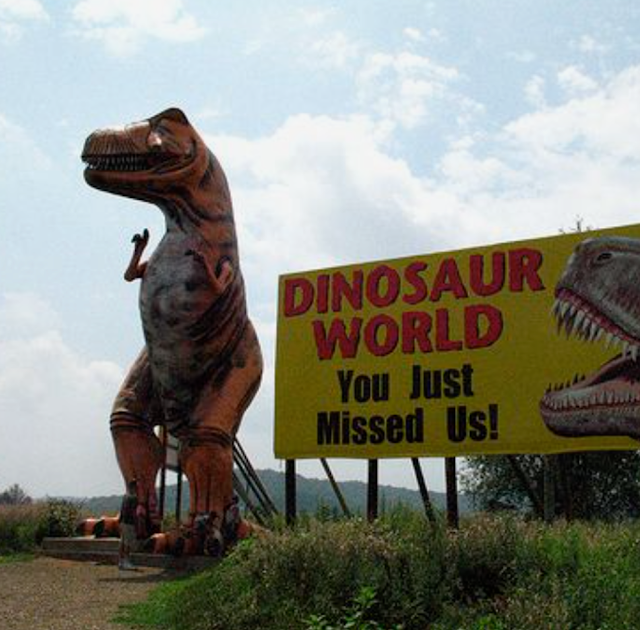
A gigantic polypropylene Tyrannosaurus rex in Bowling Green, Kentucky, on March 20, 2015 (Bebe Barefoot / Stringer / Getty)


⎯⎯⎯⎯⎯⎯⎯⎯⎯

2022

⎯⎯⎯⎯⎯⎯⎯⎯⎯


Ever since it was first published in 2019, readers—including this one—have thrilled to “Total T-rex,” Sean Lovelace’s masterpiece of literary nonfiction, which describes his family’s quest to witness a gigantic polypropylene Tyrannosaurus rex in rural Kentucky. It first appeared in Lovelace’s landmark collection, Teaching a Stick to Fart, and was recently republished in The Abundance, a new anthology of his work. The Atlantic is pleased to offer the essay in full, here, until the end of the pandemic. —Ross Andersen


⎯⎯⎯⎯⎯⎯⎯⎯⎯


It had been like dying, that eating in the Bowling Green, Kentucky Pizza Hut. It had been like the death of someone, maybe the cockroaches that littered the floor like cockroaches, maybe the cigarette butts, maybe the tremulous saliva-like sheen of grease on the table my two kids enjoyed as it made for excellent lubrication for the sliding of salt and pepper shakers off onto the cracked tile floor. Someone was whimpering, perhaps the waitress. Her mouth looked like a hole you fall into while sleeping. No, it was my wife. She was looking at her iPhone and whimpering over a video of a bunch of hummingbirds at a birdbath. It was a pretty moving video. After an hour the pizza arrived, cold and simultaneously burnt and then the bill showed up like a whispered curse on a greasy plastic bill-holder tray that someone (or thing) had chewed upon, and I drank 7 diet Cokes (I was trying to stop drinking and the professional golfer, John Daly, has said if you consume diet Cokes all day long you can stop drinking…) and it had been like dying. Dinosaur World we had traveled here to see sat and belched in our minds like a smoldering meteorite crater nine miles away down highway 65. 

This article is adapted from Lovelace’s recent book.


I lay in bed. My wife, Gary, was reading an article on her phone beside me. I lay in bed and looked at the painting on the hotel room wall. It was a print of a lifelike and eudemonic painting of a smiling clown’s head, made out of bocce balls and items from a kitchen drawer. I lay in bed and contemplated how I used to be really good at bocce, even playing semi-pro for several years on the Minestrone Circuit out of Northern Boston (bocce is an Italian game). It was a simple honest living. A bocce ball held in hand has a comforting heft. It is like holding a Zippo lighter or a river stone or a mashed bag of cannabis gummies you might have hidden from your family in an internal compartment (you cut with a pocketknife) in your shaving kit next to possibly some Dexedrine—it just feels right. Two years have passed since the gigantic polypropylene Tyrannosaurus rex of which I write. During those years I have forgotten, I assume, a great many things I wanted to remember—but I have not forgotten that clown painting or its lunatic setting in the highway motel or the way crushed and snorted Dexedrine will cake up in your sinuses like desiccated drywall. The clown's head was a bald bocce ball, but I already mentioned that. His hair was bunches of tangled phone chargers. Inset in his white clown makeup, and in his bocce ball skull, were his small and laughing human eyes. The clown’s glance was like the glance of Rembrandt or Hannah Montana: lively, knowing, deep, and loving. His eyebrows were rubber bands. Each of his ears was a miniature stapler. His thin, joyful lips were credit card receipts. The clown print was framed by either cheap aluminum or the abyss. 


⎯⎯⎯⎯⎯⎯⎯⎯⎯

“Each of his ears was a miniature stapler.”

⎯⎯⎯⎯⎯⎯⎯⎯⎯


To put ourselves in the path of the gigantic polypropylene Tyrannosaurus rex, that day we had navigated five hours inland from the Muncie, Indiana coast, where we lived. Like Roethke, “I take my driving slow.” When we tried to cross the Lewis and Clark Bridge over the Ohio River, a pedestrian had blocked the pass with his turd brown rusted pickup truck.

Traffic backed up. A skinny man with no shirt and huge ears was trying to duct tape some kind of plastic (garbage or grocery?) bag over his license plate. We waited as cars halted into a jam and idled emphysemic, the whole time the man busily awork on his task. He seemed intense; a man who stalks his calling like a Blue Heron or a Zen monk. Once the man reentered his truck and rattled across and traffic loosened, I understood. The bridge had robotic cameras perched all over its beams like Orwellian crows. This was one of the new toll bridges, with zero human contact, just a bill ($4.22 per axle) arriving in your mail and not even a thanks for passing by. Did I consider the man demented to stop in the middle of a highway, hold up hundreds of cars, and hide his license plate? At first, yes. Later, as I ruminated and my lungs hushed in awe, no. He was a hero. We drove over the Ohio River and descended several feet into central Louisville and its mythical racetrack, Churchill Downs, where I once happily lost $114 and my pants. (I was on a three-day bender during a writing conference). As we shed altitude, the city disappeared; our ears popped; the trees appeared, and I rolled down my window. Above the trees were spirals of birds flying backwards and honking in a strange metallic trilling. Have you ever heard migrating Sandhill Cranes? They sound like Martians and are weird as fuck. I listened to the birds innocently, like a fool, like a raptured diver in the rapture of the deep who plays on the bottom while his air runs out, rapturedly. 


⎯⎯⎯⎯⎯⎯⎯⎯⎯

“They sound like Martians and are weird as fuck.”

⎯⎯⎯⎯⎯⎯⎯⎯⎯


The motel lobby was like every motel lobby off a Kentucky highway that has ever existed. The skinny manager had long hair and enormous breasts, just like Clara from the Bolaño short stories. I had an urge to live with her. She said our room didn’t have a TV but there was one in a box—she gestured to an enormous, crumpled cardboard box that said SONY—right over there if we wanted to carry it upstairs ourselves. The box was darkly stained, as if oil had leaked down one side. I have lower back pain and a popcorn knee. At the dim far end of the room, their backs toward us, sat six bald old men in their shirtsleeves, around a loud television showing America’s Got Talent. There was a neatly dressed kid on the screen, either eating or riding (I couldn’t tell which) a bicycle, but somehow suspended in the air above Simon Cowell and the other two judges. One of the judges appeared to be asleep. “Do it again!” cried Simon on television, “Do it again!”
Stranger at unknown motel, unknown location, on July 4 2008 (Julio Jones / Stringer / Getty)


Now the alarm was set for 6. Like Roethke said, “Sleep or roses?” Dinosaur World didn’t open until 10, but Gary would want to do something complicated to her hair, the kids would desire breakfast (I never eat anything but diet Coke and Dexedrine until lunch) and I wanted time to complete the New York Times crossword puzzle and then 50 pushups and flex in the mirror with my shirt off. I lay awake remembering an article I had read on my phone while using the bathroom, in National Geographic. The article was about a South American tribe of cannibals.


⎯⎯⎯⎯⎯⎯⎯⎯⎯

“’Do it again!’”

⎯⎯⎯⎯⎯⎯⎯⎯⎯


The article read in part: “The cannibals dance around the explorers. The cannibals light the fire. The cannibals have their faces painted in three colors. The cannibals prefer the heart and brain, disdaining the tender flesh of the thighs and the leftover intestines. The cannibals consume those parts of the body they believe will instill in them the virtues they admire in their victims. The cannibals partake of their ritual banquet without pleasure or mercy. The cannibals don the explorers’ clothes. The cannibals, once in London, deliver scholarly lectures on cannibals.”

Early the next morning we checked out. We would drive out of town, find Dinosaur World, locate the gigantic polypropylene Tyrannosaurus rex, and then drive back over the river and home to Muncie. How familiar things are here; how adept we are; how sumptuously and professionally we check out! I had forgotten the clown’s smiling head and the motel lobby as if they had never existed. Gary put the car in gear and off we went on another of our many adventures! (Just in the last year, we’d taken the kids to a corn maze in Illinois and later to Corpus Christie, Texas, to lay a rose at the grave of Latin American crossover phenomenon, Selena.)

It was dawn when we found highway 65 and drove into the unfamiliar countryside. By the growing light we could see a band of clouds in the sky. One of the clouds looked like a silver gravy bowl and a beechwood warming stand from the era of Louis XV; the other one looked like Facebook. 


* * *


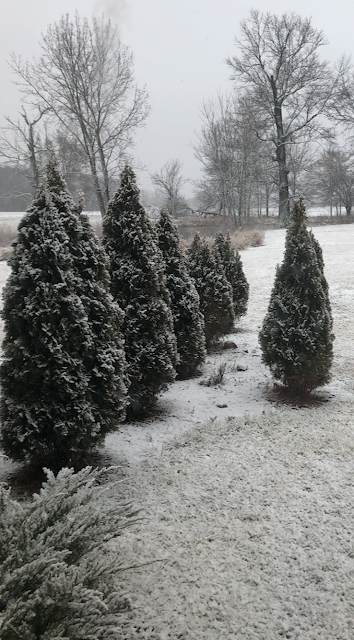
The parking lot was 501 feet long. Stunty arborvitaes lined its border, an evergreen tree very similar to the ones we planted back home to block the persistent western winds. One sultry day last August Gary had mentioned we should cut down two of the arborvitaes for a better view of an old barn in the distance and I replied, “Every one of those trees most likely contains a bird nest in its hidden core. How many nests in this world will we obliterate to see the barns? How many, Gary?” Gary gave me a look she often gives me: quizzical distaste. “I have no idea what you are talking about,” she said and took a long draw on her bottled water. “God save our life!” I spat back. Later that evening I beat her in trivia (I haven’t lost any form of trivia in eighteen years) and then we made awkward love and slept. 
East of us rose the gift shop and three ticket kiosks painted a garish blue and yellow. (I found out later these are the state colors of Kentucky.) We tightened our scarves and looked around. Then we paid ($15.75 adults, $12.75 kids) an expansive woman named Debra Leroy to get our tickets. Leroy had a sweater with a purple stegosaurus on it in glitter and crazy pink and gray hair that made me envious and reminded me of an accident I’d witnessed once as a child wherein a hot air balloon snagged on some overhead wires while descending and tumbled into a water treatment facility. Leroy said her people live over in the hollars near Clinton County and her mom was hit by an Amazon delivery truck and her dad had colon problems and her brother joined a cult and her sister just lost her job in the coalmines and all three of her kids were serving in the Coast Guard clear over in Virginia and where did we come from anyway? Indiana! Lord. Leroy said have fun. Leroy said avoid the Porta John by the velociraptors. Leroy said the best spot for shade was under the pregnant triceratops. Some people kiss under its butt! Leroy caught my eye and winked. Leroy said take a picture. I thought, I would like to learn, or remember, how to live.


⎯⎯⎯⎯⎯⎯⎯⎯⎯

“Some people kiss under its butt!”

⎯⎯⎯⎯⎯⎯⎯⎯⎯


Now the sun was up. Tendrils. More people were parking in the lot and clamoring nearby. All of us rugged individualists were wearing khaki cargo shorts and New Balances. It looked as though we had all gathered in a Jurassic world to pray for the planet on its last day. It looked as though we had all crawled out of spaceships and were preparing to assault the gift shop. It looked as though we were about to sacrifice virgins, make rain, eat cake, bang a gong, sautĂ© kale, pound sand, throw dice, swim a length, cut a rug, return the ring. There was no place out of the wind. 


Arborvitaes in rural Indiana, on January 7 2019 (Don Dove / Stringer / Getty)


My kids did what they always do in a gift shop: ignored the stuffed brontosaurs toys, fossilized shark teeth, fake dirt, Dinosaur World lint removers, etcetera, etcetera, and bought some candy. Gary got a tie-dye (she loves anything tie-dye) DINO WORLD T-shirt. I purchased four 20 oz bottles of diet Coke and slipped two each in the front pockets of my shorts. 

I went to the bathroom with my shaving kit I had stuffed into my fanny pack. Then I bought another diet Coke and we stepped out back of the gift shop, onto the picnic grounds, where several fellow explorers milled about smoking cigarettes and eating popsicles in the shape of a Dilophosaurus. Wind. Deep blue body of sky. Clouds. Gossamer. And a hawk screamed overhead, and I flinched and pointed at the ground and shouted, “Weasel! Weasel! Weasel! Weasel! Weasel! Weasel! Weasel! Weasel! Weasel! Weasel! Weasel! Weasel! Weasel! Weasel!” People froze. People stared. It was not a weasel; it was a brown Miller Lite beer bottle at the base of a garbage can. “Sorry,” I mumbled. And then, behind a small security roping, I saw the egg. The egg. So. 


⎯⎯⎯⎯⎯⎯⎯⎯⎯

“So.”

⎯⎯⎯⎯⎯⎯⎯⎯⎯


I had seen a chicken egg in 1984. A chicken egg is very interesting. It bears almost no relation to a dinosaur egg. Seeing a chicken egg bears the same relation to seeing a dinosaur egg as kissing a man does to marrying him, or as flying in an airplane does to falling out of an airplane. Although the one experience precedes the other, it in no way prepares you for it. A sign read OVIRAPTORID EGGS DO NOT TOUCH. My kids immediately climbed over the roping and vandalized the eggs. Holy shit! 

“Get them! Gary!!!!!!!!!” 
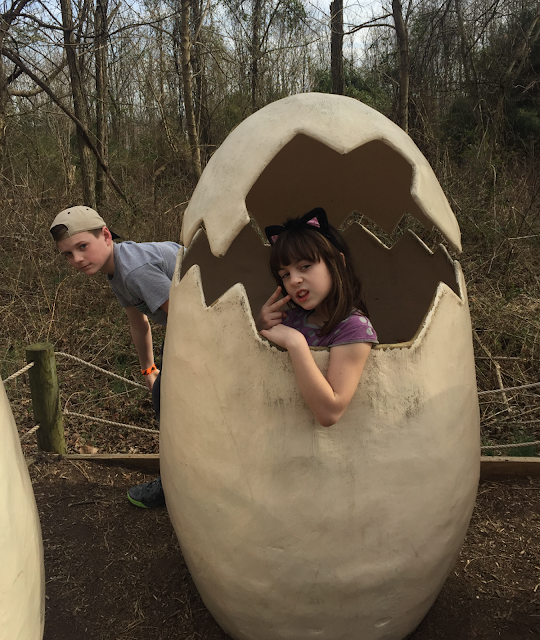

Photo credit, Gary 


From all the picnic grounds came screams. A piece of blue beside the Dippin’ Dots was detaching. Security guard!? My heart kicked up like two artic terns tumbling in a mating ritual. Tremors. My mouth went Moroccan sand. My brain a loosened circle of evening sky, suddenly lighted from the back. A body rushed! It was an abrupt blue body out of nowhere; it was a barreling SWAT team; it was a squad of fallen angels! It was lava dragons! It was almost over my children, the eggs! That is why there were screams. No. I smelled charred meat on the wind. Primeval fire. At once this smoke of acidic (dill?) relish slid over the air like a lid. The hatch in the brain slammed. Abruptly it was now the scent of bread, not relish, on the air and on the land and in the sky. A tiny ring of laughter. Parenting is hard. The holding of my hands where my children belonged. There was no sound. The eyes watered, the arteries drained, the lungs galloped. There was no world but cave. My hands were clay. My mind was going out; my eyes were receding the way manatees recede to the rim of seas. We were the world’s bad parents rotating and orbiting around and around, embedded in the prehistoric crust, while the Earth rolled down. Thoughts were light-years distant, forgetful of almost everything. We had, it seems, loved our children and loved our lives, but could no longer remember the way of them. We got the generations wrong. I missed my own century. I missed nachos and electricity and Netflix and driving the kids to school. In the back of my head was a Frisbee of light. It was a thin ring, an old, thin silver wedding band, or maybe a pacifier or a vape pen. I smelled mustard. There were stars. It was all over. 


______________

“I missed nachos…”

______________


“Are you okay?” a voice said. I was on my back, with Debra Leroy standing over me, blocking the sun like an archipelago. Her perfume smelled of rotting fruit. 

“Um, yeh,” I said, rising up to my elbows. Spin, spin slowing. My mouth felt like an athletic sock. “I’m fine.” I stood up and brushed myself off and grinned stupidly.

“Alrighty then,” Leroy said, and handed me a hot dog. “This one is on the house. People always forget to eat before they come out here, excited and all. You’re not the first I seen faint right out.”

“Thanks,” I mumbled. Leroy just shrugged and waddled off to the gift shop. The hotdog was moist and toasty. 

Gary walked up and said, “Well, they pulled the T-rex. Guy over there told me kids and drunk tourists kept climbing it and falling off. Some kid broke his back. He said they had a big crane in here and yanked it out two years ago. Also said I had a nice ass.”

“Pulled it?” I said through a mouthful. It was a very good hotdog. 

Gary said, “The lawyers. They pulled it. Fucking lawyers…” She shook her head. ‘This is why we can’t have nice things.”


* * *


It is now that the temptation is strongest to flee these regions. We have seen enough; let’s go. Why stain our hands with condiments any more than we have to? But two years have passed; the price of gas and toilet paper and diet Coke has risen. Seeing my own blood swallowed by that dinosaur egg was like seeing a mushroom cloud. The heart sneezed. The individual heart is as small as one goose in a flock of migrating geese—if you happen to notice a flock of migrating geese. The event obliterated itself. Yet I return to the same picnic tables and pick through the smeared ketchup again.

We teach our children one thing only, as we were taught: to eat. I do not know how we returned to the Pizza Hut. Like Roethke, “I fog the spatula.” Gradually I seemed more or less alive, and already forgetful. It was the day of a dinosaur egg in central Kentucky, and an educational adventure for everyone. It was now almost evening. The sky was dusky; there was an odor of breadsticks out of the north. We ate our fill and then more than our fill, as is our way. I was on my third slice of deep dish and eleventh diet Coke. The kids chewed on candy. Gary had spaghetti. We paid. Oh, we paid. We found our car; we paused to watch a kid repeatedly slamming a shopping cart into the brick wall of Pizza Hut, bam, bam, bam; the kid was giggling and was either very dumb or a contented genius. We pulled away, joined the highway traffic, and drove for home. 


______________


This post is excerpted from Lovelace’s book The Abundance: Narrative Essays Old and New. Copyright © 2021 by Sean Lovelace. Published by arrangement with Echo, an imprint of HappyGilmore Publishers.


*


Sean Lovelace lives in Indiana, where he chairs the English Department at Ball State University but is best known for his pioneering work on the theoretical intersections of the natural world and nachos.