Showing posts with label genocide. Show all posts

Monday, January 8, 2024

The Essay in a Time of Genocide: Two Palestinian Writers and a Continuing Call

Maram Humaid's five-month-old baby
Maram Humaid’s five-month-old baby in Southern Gaza [Maram Humaid/Al Jazeera]


For the past five weeks, Essay Daily has regularly featured pieces on the essay in a time of genocide. 

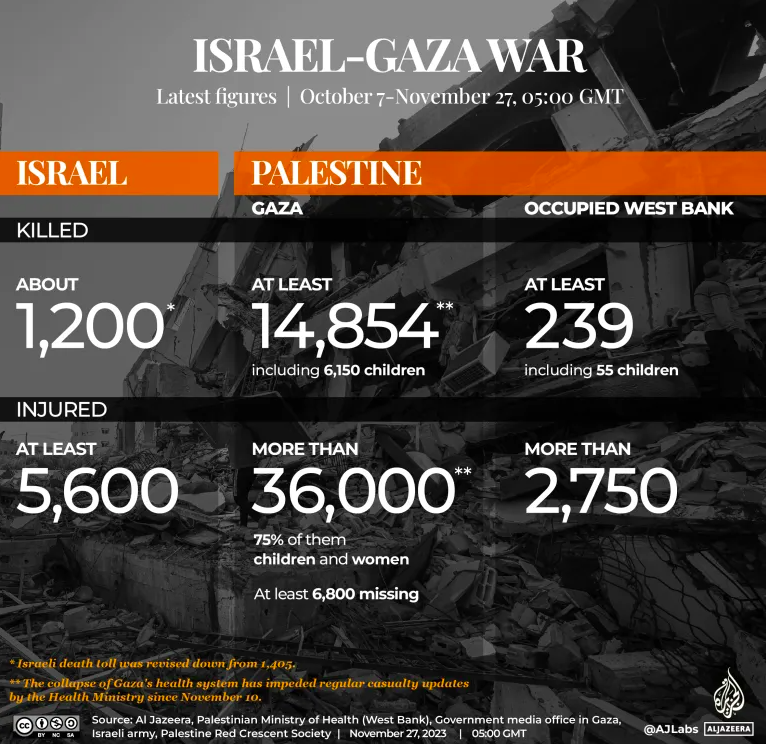
When we extended the invitation to contribute to this feature on November 27th, approximately 1,200 Israelis and 14,854 Palestinians had been killed in the current conflict in Gaza. As of today, January 8th, at least 8,000 more Palestinians have been killed, including 249 in the last 24 hours. 

Right now, according to the United Nation’s World Food Programme, half of Gaza's 2.2 million people are suffering from extreme or severe hunger, and the World Health Organization reports that Gaza is “experiencing soaring rates of infectious disease.” People are suffering from upper respiratory infections, meningitis, skin rashes, scabies, lice, and chickenpox. Over 100,000 cases of diarrhea have been reported since mid-October. This horrific situation has been made worse by Gaza’s current lack of sanitation, clean water, and the collapse of its healthcare system. Approximately 1.9 million people in Gaza have been forced to flee their homes.

Essay Daily has currently published all of the work that's been submitted by our contributors. We are grateful for their essays and for how they’ve illuminated what it means to write as global citizens. Like we do with our other features, we will keep open the call for this feature as we continue to live and write in a time genocide. If you’re an essayist interested in contributing, contact Eric LeMay (eric@ericlemay.org).

As this part of our feature ends, we would like to direct you to two essays by Palestinian writers. The first, “Don’t Look Away,” is by the London-based lawyer and fiction writer Selma Dabbag and was published on the London Review of Books' blog on December 13th. Dabbag begins her essay:

I wonder whether there is a right way to respond to grief, to loss, to a risk of genocide of one’s people. Whether one should go out or stay in, whether it is unseemly to visit cinemas and theatres, to eat out in restaurants, or to laugh. I know a young woman in London whose home was bombed in Gaza City on 10 October. Her family are (or were, the last time I spoke to her) in a tent in a school in Khan Younis. They have no walls, she says. No roof. Some days they eat nothing but a small tin of pineapple, or mushrooms. It is getting cold. Like thousands of others, they had no chance to pack anything from their home before it was bombed. On one occasion there was fighting outside the school, men fearful for the safety of their wives, their daughters, trying to get them inside the gates. The bombing is non-stop. ‘Some days I find everything very funny,’ she told me. Some evenings she spends in tears, but everything is unstable. ‘I feel I am going mad,’ she said. ‘I can’t stop laughing.’

The second essay is by Maram Humaid, a Palestinian journalist and storyteller who lives in Gaza. It’s entitled “Israel flattened my home, killed my family. I still lit a candle for 2024" and was published on January 1st by Al Jazeera. Humaid's essay ends:

Three weeks ago, my aunt, her family, and grandchildren were killed when their six-story home was bombed. Forty-five people were killed and their bodies remained trapped under the rubble for days.

My father and I mourned while offering condolences to my only surviving cousin, who was displaced with her husband to Deir el-Balah.

She told us that no one was able to get them out because of the presence of tanks and snipers around the place. Neighbours told them that they heard some of them alive screaming and pleading for help from under the rubble, but they could not help them. Then these voices eventually faded away after a few days.

This is how lives end in Gaza. This is how people are killed. They get bombed in homes, left to bleed to death under rubble, without rescue. Pain eats away at the hearts of their loved ones who watch their deaths helplessly.

The wider world’s inability to stop this highlights how little our lives are valued. Our death and killing, our spilled blood, have become permissible.

While the world was illuminated to celebrate the New Year last night, I lit a candle for my five-month-old child, amidst the darkness of continuous bombings around.

Our only wish is survival, an end to the war. Farewell to a sorrowful and painful year. Long live Gaza.


Monday, January 1, 2024

Zachary Ostraff on Glass Eyes


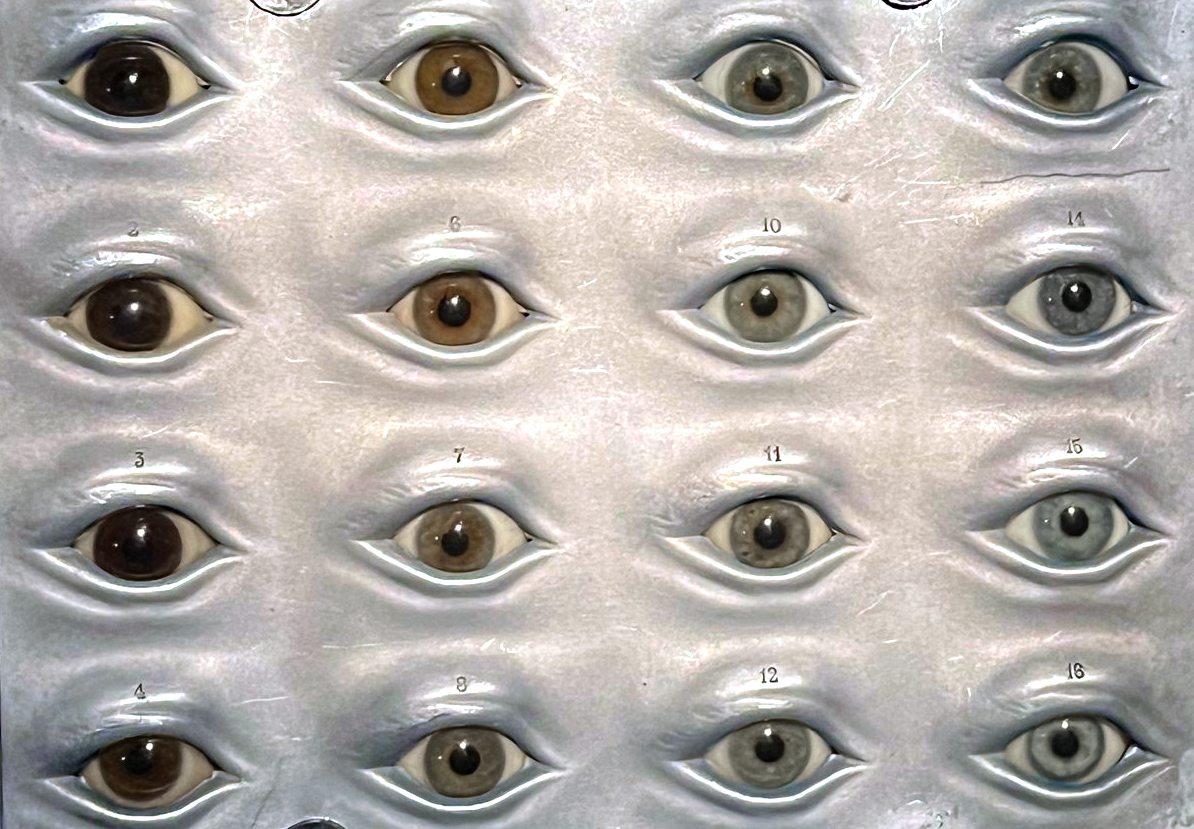
In London, England, I find myself looking at a display case of 16 glass eyes. These eyes show a variation of color. The darkest eye is dark brown, almost black. The lightest is sky blue. These eyes were used as part of a study of eye color, vision, and intelligence in immigrant Jewish children that looked at their eugenic “worth.” This case is a part of a larger exhibit at the Wellcome Collection about the inherent racism and antisemitism embedded in the practice of eugenics, an overlapping practice to phrenology and the creation of many life and death masks. 

The problem with statistics is that the numbers can dehumanize the individuals. The problem with the news is that it saturates our minds with distanced trauma while avoiding the harshness of reality. While I write this essay people in Gaza are dying. People aren’t just dying in Gaza; people are being massacred. And people are not just people but individuals. With names. Families. Goals. Problems. Likes. Dislikes. How do we humanize the dead? 

In a field, alkaline dusted tombstones are the only markers of Clarion, Utah: a Jewish settlement established in 1911. It “folded” four years later. Rabbi Krauskopf thought the local Mormon settlement of Gunnison, Utah ,would be their allies in returning to a lifestyle of farming. The Mormons, after all, were also historically a persecuted people. But no hope would come. The communities remained separated by their faith, by their differences. Records show that the Jews of Clarion didn’t know how to farm such an inhospitable land. The Mormons never really spent the time to help.

My eye color is between eyes six and seven: hazel brown with flecks of other colors. My son’s eyes would be a sixteen, as blue as a pale summer sky. 

With a light knock, the doctor walked into the examination room. With only slight hesitation she told my wife, Elise, that my daughter was obese. My daughter was there in the room too. Talked over, but not unaware. Later she would ask what “obese” meant. This all happened despite the earlier conversation Elise had with the doctor about our family history, despite the fact Elise had asked the doctor to be considerate of our daughter’s body image and her self-confidence; we didn’t feel like we needed to make our daughter feel othered because of her size. Particularly because both our families have a history of huskiness at a young age. The doctor went on to explain that exercise and dieting can help with weight. She didn’t listen when we told her that our daughter was very “active,” that she played tennis and basketball, that our daughter liked to hike and be outside more than anything else. The doctor didn’t listen when we told her that our daughter ate a healthy well-rounded diet. Instead, she handed our daughter a list of things she should eat and things she should avoid; for the doctor, our daughter was just an outlier in the statistics of normality. 

The Noel Phrenology collection at The University College of London has history that isn’t so dissimilar to other death mask collections. It was donated to the college by Noel’s descendants. It ended up in the eugenics lab for a while. It was decided that the masks weren’t necessary, so they were then donated to the art school at the college. For years the masks were used as props in still lifes. They were handled and turned and touched and drawn. You can see the years of grime from all the handling on each mask—a coat of hands grasping. Then when the art school tired of the masks, they were thrown away. Someone discovered them in some discard bins, recognized them as not trash, pulled them out and put them in the Object Based Learning Lab at UCL. 

It is in the Object Based Learning Lab that I first see the collection. I traveled across the ocean to see these masks, to think about the processes of phrenology. It is in the lab that the director points out that there is an exhibit about eugenics only a short distance away that contains some of the masks from the Noel collection. It is in this same exhibit that I see the glass eyes.  

The dark side of phrenology is the way the practice lent itself to bias confirmation; classism and racism are rampant in the evaluation of the head. In the Noel collection, Noel separated each mask into one of two categories: the intellectuals (usually life masks made of people already acknowledged for their brilliance) and the criminals (usually death masks made after the subject had been decapitated for their crimes). The curator of the Object Based learning lab tells me there were only two masks that didn’t fit snuggly in  one of the two categories: a woman considered an intellectual—Noel didn’t know where to place her because she was “smart for a woman” but he didn’t consider her on the same level as his other intellectuals; the other mask was a life mask of a known criminal who had spent time in jail, but then, upon release was reformed. He became a monk and served others for the remainder of his life. Neither of these individuals fit with his other conclusions about shapes and bumps and predictions of predilection. 

I am drawn to Clarion because of my ancestry. I am related to many people that immigrated across the great plains, often at great sacrifice, for their freedom of religion. And my grandfather is Jewish; his lineage stemmed from Russian Jewish immigrants that arrived in Baltimore near the turn of the 19th century. Because of my grandfather and my faith in the Church of Jesus Christ of Latter-Day Saints, I have always felt connected to Judaism. So, in many ways, I view Clarion as what could’ve been a mecca, a blending of my ancestry. Yet, for whatever reason—whether it was that the Mormon’s wouldn’t accept or befriend the Jews, or if the Jews kept themselves apart because their ideologies—the settlement failed. 

It can be easy to forget the anger that accompanies discrimination, the anger at being othered, and the anger that leads to the othering.  It is easy to forget the history that leads to the action. When you are othered, it can be easy to feel like violence is your only defense, especially when your people have faced holocaust after holocaust; I can only trace my Jewish lineage so far before the records disappear from existence, wiped out by discrimination and violent measure. It is also easy to be blinded by anger. Blinded so much that you can’t see that your actions are just repeating the atrocities enacted earlier upon yourself. 

The abused can become the abuser. 

In September of 1857, a wagon train from Missouri traveled through Utah. It is said that some of those Missourians were part of the violent mobs that drove the Mormons from Missouri. Anger spilled over into violence. Mormon settlers from Cedar City masqueraded as Native Americans and massacred the men and women from Missouri. 

How do we break the cycle? How do we acknowledge the past without repeating it in the present. How do the abused heal? 

Thousands of miles away from Gaza I find myself conflicted. There is a history behind the violence. Both sides are guilty. But too many of the victims are innocent. Too many of the people being affected by the anger are just trying to live their lives. My distance is part of the problem. My lineage is Jewish, but I am not a Zionist. My people have been erased, but that does not mean we should erase others. But how do we protect ourselves, our beliefs when we are feeling attacked? 

All these miles away, I have the luxury of thinking that too often language is used to create emotional distance. Conflict is just a softened way of saying violence and anger are rampant. Even the word violence is a softened way of saying that someone is intentionally causing hurt, injury, and/or death to others. We are so practiced at using language to blur the blows that even now, as I turn toward the problem, I am part of the problem. 

Looking at a photograph of the glass eyes, it is easy to see only the color of the glass. The glass is just glass. But what does it mean when we attribute the color of an eye or the shape of a head to inherent qualities. What does it mean when we judge others by numbers and statistics instead of seeing them as a living person? 

“Let my people go!”

Moses says this. In The Ten Commandments, in the Bible, in The Prince of Egypt. Let my people go. Now, thousands of miles away from Israel, from Gaza, people are saying something similar to the Israelites about the Palestinians. But the issue isn’t about letting anyone go, or finding a home, really; it is about finding a way to come together, to listen and acknowledge the atrocities of the past, and finding peace for the future. But how do we do that with so much anger? How do we do that when all we see is the other; the colors of the glass eyes reflect only what we want to see and not what needs to be seen. 


*


Zachary Ostraff received his MFA in creative writing from Eastern Washington University (2016). He has work in Assay: A Journal of Nonfiction Studies, High Desert Journal, Longridge Review, Hippocampus Magazine and more. He is currently a Ph.D. candidate at Texas Tech University. This essay is part of manuscript Zachary is developing that uses life and death masks to explore memory and connection. You can follow him on X (Twitter) @ostraffz or view his joint website with his artist partner, Elise, at ostraffworks.com.

This essay is part of the feature "The Essay in a Time of Genocide"

Monday, December 18, 2023

Dave Griffith on Thinking About Looking or The Essay as Ally

Screen shot from Instagram: Warning for Sensitive Content
 

In the summer of 2017 I met Shaun King at the Chautauqua Institution–yes, that Chautauqua, where Salman Rusdhie was attacked and subsequently lost sight in his right eye. 

I was onboarding that summer. I had just been hired to the executive team of the Institution and, though my start date was later in the fall, they wanted me to see what the lovely and venerable grounds were like in-season.


King, an activist and organizer, was unknown to me. All I knew was that his visit was controversial. The audience at Chautauqua, while known for being deeply curious and full of well-educated folk committed to life-long education, are also known for being majority white and politically center-right. All I was hearing about King was that he was a supporter of the Black Lives Matter movement, an affiliation that led most of the Chautauquans I spoke with to cock an eyebrow.


King’s lecture was in the newly rebuilt 4,400 seat amphitheater, or simply, “Amp,” as it is known on the grounds, and it was standing room only. I stood at the back of the Amp and listened, but mainly I was watching the crowd. I was curious to see how they would react to the news that this young man–still not quite forty-years-old–was there to share with them; that racism is systemic and structural; that it is endemic, baked in, so to speak, to most American institutions, especially law enforcement. 


While the crowd was gracious, clearly what King was saying was a direct challenge to the way most audience members, myself included, experienced everyday life. One audience member, an older gentleman wearing a baseball cap emblazoned with the name of the military vessel he presumably served aboard during World War II, turned to me and said, “Love it or leave it.” 


King got his start blogging and writing as a justice reporter for the New York Daily News, but these days he’s most known for raising funds for families victimized by police violence, and for the long, impassioned explanatory captions he writes in the space below his numerous Instagram posts, many of which are reposts of videos sent to him in order to help boost the visibility and awareness of events that would otherwise be lost in the daily glut of fitness and lifestyle influencers. If you follow reports of police brutality, then chances are good that you have seen some of his posts. His words illustrate and illuminate: “Let me tell you what you’re seeing,” he often begins, providing context for the often jumpy or grainy cell phone footage taken by bystanders.


Since the October terrorist attacks on Israel by Hamas militants, King’s Instagram feed has become focused almost exclusively on the IDF’s retaliatory counterattack, which has led to the death of thousands of civilians. Collaborating with journalists inside of Gaza, King has been reposting dozens of videos per day, many of them depicting the lifeless bodies of children. 


Many of the posts are flagged by Instagram as “Sensitive Content,” indicated by a white eye icon with a warning slash through it, as well as a brief message: “This video may contain graphic or violent content” and beneath it a small box containing the words “See why.” Clicking on the box reveals a boilerplate statement explaining that though the post “doesn’t go against our Community Standards, [it] may contain images that some people might find upsetting.” And then: “We cover graphic content so people can choose whether to see it.” 


The unintentional poetry of this statement–choosing whether or not to see–is profound.


King has many detractors for a variety of reasons–see Wikipedia–and I’m not here to defend him against those criticisms, but one thing that I think needs to be said is that what he is doing here and now goes beyond mere “outrage journalism.” He is forcing us to confront the choice itself. Do we opt for blissful ignorance and avoidance of what is being done in the name of justice and peace out of fear of being allied to, or complicit in, the cause, or do we engage in the difficult work of looking and thinking for ourselves.


King’s Instagram posts are, in a way, reminiscent of the work of essayists and thinkers like James Baldwin, Thomas Merton, Wendell Berry, and Susan Sontag, writers who look(ed) at the world around them and, as Henry Giroux writes, told stories about what they saw in a way that has “the potential to unsettle common sense, challenge the commonplace, and move communities to invest in their own sense of civic and collective agency.” In this way, essays and essaying “make knowledge meaningful, in order to make it critical and transformative and provide a different sense of how the world is narrated.”  


I am thinking here of many essays at once, but top of mind is Thomas Merton’s “Letter to an Innocent Bystander,” which I wrote about 11 years ago this month for this very forum on the occasion of the school shooting in Newtown, CT.


As odd as it feels, I will quote myself: 


Reading Merton's essay now in the full, glaring light of the the school massacre in Newtown, Connecticut--27 dead, 20 of them children between the ages of five and ten--I am reminded how an essay, a preoccupation relentlessly chased, an attempt to articulate--to assail--the unspeakable, written decades ago with no thought of Newtown, Connecticut or gun control laws, can implicate us and charge us--and here I mean "everyone"--with a mission: "Our duty," Merton writes, "is to refuse to believe that their way is inevitable." 


I know that I (and we) must be careful how we choose our words and our analogies. And so let me say that I do not mean to equate the murdering of American school children with assault-style rifles with the IDF’s current bombardment (much of it with munitions whose flight cannot be controlled) of innocent Palestinians. Nor would I call the unrelenting spate of school shootings the genocide of American school-age children. 


This is not what the essay, as I am currently imagining it, intends. Merton might say it best. Writing in the prologue to his collection of essays Raids on the Unspeakable he directly addresses his essays:


You are not so much concerned with ethical principles and traditional answers, for many men have decided no longer to ask themselves those questions. Your main interest is not in formal answers or accurate definitions, but in difficult insights at a moment of human crisis.  


In other words, the essay, in the face of a crisis like the murder of revelers at a party in the name of freedom or the indiscriminate bombing–”total war,” as it called–of a civilian population, moves away from the safe pedantry of articulating ethical principles, and detours into the history of warfare to underscore the fact that we have been here before, and, don’t you know, that we have treaties and conventions abolishing such conduct, to focus on what we can say of ourselves at this precise moment in time. And, in so doing, enter the timeless and the prophetic.


I am thinking now of Wendell Berry who begins his essay collection What Are People For? with “Damage,” a poem about the building of a pond on his property to water his livestock.


The trouble was the familiar one: too much power, too little knowledge. The fault was mine.


I am thinking of the closing paragraph of Susan Sontag’s book-length essay Regarding the Pain of Others. Writing about a photo depicting dead soldiers from the Russian/Afghan war, she takes on the perspective of the dead:


What would they have to say to us? “We”--this “we” is everyone who has never experienced anything like what they went through–don’t understand. We don’t get it. We truly can’t imagine what it was like. We can’t imagine how dreadful, how terrifying war is; and how normal it becomes. Can’t understand, can’t imagine. That’s what every soldier, and every journalist and aid worker and independent observer who has put in time under fire, and had the luck to elude the death that struck down others nearby, stubbornly feels. And they are right.


What we can say of ourselves–we, us–at this moment? I look to a post on Shaun King’s Instagram for assistance. The post is dated 12/5. It has received 317,890 likes, if that matters. It bears the “Sensitive Content” warning, so the screen is blurry in that 2 am scrambled cable channel pornography way. The caption reads “Forgive me for what you will see and what I have to say.”


The caption continues:


 What you are witnessing is the Massacre of Deir Al-Balah in Gaza–RIGHT NOW.


This is being filmed by our dear brother @motaz_azaiza [a photographer living in Gaza whose own Instagram feed has 17.1 million followers] - this is HIS NEIGHBORHOOD. He soon realizes that he has lost many family members, friends, and neighbors.


The entire videos are some of the worst I’ve ever seen. It looks like 6 ENTIRE BLOCKS of LARGE APARTMENT BUILDINGS were just completely destroyed. Kids, elders, women, men. Everybody - either blown to literal bits or so badly mangled that survival is unlikely.


I saw torsos without heads of limbs.

Hands with no arms.

Heads with no bodies.

Skin with no bone.

It’s been a lie since 1948.  


When I saw this post on the 5th of December, I chose to click on the “See Reel” link at the bottom of the blurred window. I did not bother with clicking the “See Why” button. I knew that what I was likely to see would be graphic. I told myself that I needed to see it. I had been avoiding such accounts. I had been taking other people’s word for it–thousands of innocent dead; whole neighborhoods bombed to rubble–so now I needed to see it with my own eyes.


What I see is this:


Cell phone footage from Motaz Azaiza. His camera is facing the street–not at him. He is running so the camera lurches up and down, up and down, with his footfalls. I am reminded of standing over my youngest brothers’ shoulder, watching him play the first-person shooter game DOOM. It is the 90s. He is maybe 10. All I see are the player’s hands as he runs through the maze of rooms. If I listen closely, I can hear the panting of this digital person as he runs. This is not Gaza, but some subterranean hellscape, but the movement and the sounds are eerily the same. The bobbing, lurching action simulates desperate, life or death running. I am concerned about my brother because I have heard the warnings about these first-person shooter games; worries that they can desensitize you, make you into a violent person.


Azaiza’s camera does not pause until he encounters bodies, and even then he runs past the first body he sees, fixing his camera instead on the large apartment building–or what had been an apartment building–shrouded in dust, a dark plume of smoke rising above it. Then, he doubles back a few yards to capture the body in the street–a man, covered in dust, above his head is a halo of blood, spreading itself on the asphalt of the street.


The camera turns and he is running again towards the wrecked building. People are running into the rubble and returning with small, limp, dust-covered bodies in their arms. All the bodies that he passes are covered in this dust. We must not come from the same dust, I think to myself. It is the only answer to how such destruction and death could be tolerated, could be countenanced.


I keep coming back to the formal apology of King’s caption: “Forgive me for what you will see and what I have to say.”


I am thinking now of John Hersey’s Hiroshima. I am thinking of the Reverend Kiyoshi Tanimoto, a Methodist minister who survived the initial blast on August 6, 1945. I am thinking of him running through the streets in the aftermath and saying to the wounded who walk burned, bloodied, dazed, and covered in dust past him: “Forgive me for having no burden like yours.” 


I am thinking of what we are told is a quintessentially Japanese attitude, the guilt of having survived while so many others perished. 


I am thinking now of James Baldwin who begins his essay “The Discovery of What it Means to Be an American” with a Henry James quote:


“It is a complex fate to be an American.”


I am thinking of my students from this past semester. We had just begun reading Sontag’s Regarding the Pain of Others when Hamas militants attacked and massacred young people their age at an outdoor rave. 


I am thinking of the looks on their faces when what we were reading became practical, if that is even the word for it. I am thinking of Sontag, quoting Simone Weil’s “The Iliad, of the Poem of Force” (another book-length essay) how “violence turns anybody subjected to it into a thing.” I remember looking out at my classroom, this ring of students in their desks and allowing for just a moment to think of them as things. I am thinking of the horror, the shudder that went through me at the thought; that I had even allowed myself to have it in the first place.


After Shaun King’s appearance on the amphitheater stage, he was to lead a workshop for a much smaller group of people who had paid extra, I believe, for this more intimate experience. I asked if I could sit in on the workshop. This, too, was standing room only. 


Held in a high ceilinged ballroom on the third floor of Alumni Hall, a beautiful old manse with a wrap around porch, I stood at the back of the room and, again, as in the amphitheater, listened and watched the audience. The focus of King’s remarks to this small group of maybe fifty people–mostly white–was allyship: How can we be allies to the oppressed? 


His message, and I quote (as best as my memory serves): To be an ally don’t show up expecting to provide the answer. Being an ally means asking what you can do. It means bringing food, setting up chairs. It means standing back and listening, waiting, watching, and being ready to help. But don’t expect that anything you have to say will help solve the problem. 


From the looks on the faces of those present, this was a hard, deflating message to hear–it was definitely not what I expected to hear–as it burst the growing bubble of hubris; that fantasy that we alone can make a difference. 


I am thinking about looking. I am thinking about thinking about looking, and about how looking causes us to think. 


But, I am thinking: Is looking required, or is requiring photographic proof of atrocity a concession to the cynics among us? No, I am thinking, I suppose not–the freedom to choose to look or not must be protected. 


But I will say this: an essay is a different sort of looking, a different sort of proof, a different kind of choice. It is an allying. 


The essay asks, If this is true, then what? 


*


DAVE GRIFFITH is the author of A Good War is Hard to Find: The Art of Violence in America (Soft Skull Press). His essays have appeared in print and online at the Paris Review, New England Review, Belt Magazine, Image, and Another Chicago Magazine, among others. 


This essay is part of the feature "The Essay in a Time of Genocide"


Monday, December 4, 2023

Eric LeMay on Unbearable Thoughts and the Bombing of Children

Embed from Getty Images

Palestinians evacuate the area following an Israeli airstrike
on the Sousi mosque in Gaza City on October 9, 2023


“Writing my children’s names on their bodies is the solution, so that the world will know them.” 

- Mohammed Abu Odeh


On October 22, over two weeks into the bombardment of Gaza, I learned that parents are writing the names of their children on their children’s arms and legs. The parents hope their names will identify them if their bodies or parts of their bodies are found at bomb sites.
      Before I learned this, I’d read the reports of children being dismembered by Israeli missiles and found in the wreckage. I’d also read the reports of the thousands of children who’d had to flee their homes, who’d been orphaned, who’d been killed. At least 6,600 dead as of today, December 4, fifty-nine days into the fighting.
      Yet when I read about these parents inscribing their children’s names on their children’s limbs—names they gave them at their births, names they say every day of their lives—I broke.
      I am a parent and a writer. I can’t imagine writing any words more devastating than my child’s name on my child flesh, meant to be read when he is dead, when pieces of him are found.

“When my children ask me why I’m doing this,” says Mohammed Abu Odeh. “I tell them that it is for their safety and protection.”
      Abu Odeh is from the Al-Shati refugee camp in Northern Gaza. He has two children. He is explaining to reporters from Al Jazeera that no child should have to live hearing bombs explode above them, needing to worry about whether they’ll be buried under rubble.
      “Can anyone in the world bear the thought of what our children are going through?”

As the days continue and the bombings continue and the deaths continue, I see ever more clearly that the answer to Abu Odeh’s question is yes.
      There are many people in the world, many in my own country, who are not only bearing the horrors that Palestinian children are going through, but who are also supporting this attack on the civilians of Gaza.
      I see ever more clearly how they—how we—have hardened our hearts even to the mass killing of children. We who are parents. We who cannot bear the thought of such horrors happening to our own children.
      When I learn about these parents writing their children’s names on their children’s limbs, I try to share this news with my spouse. It’s morning, before school, and our own child is in the next room, playing with his electric toothbrush.
      As I tell her, she begins to cry and says, “Stop it.”
      I stop and, later, I think to myself that this is exactly what has to happen: it has to stop.
      It hasn’t stopped. 

“At that moment, I thought that if the house was hit by a severe bombing, my children would die, and no one would be able to identify them.”
      The moment Sara al-Khalidi is describing happened in her living room in Gaza City, where she huddled with her four children during an Israeli bombardment that lasted the entire night. She goes on to describe fleeing south to Khan Younis, where she hoped she and her family would be safer.
      Once there, al-Khalidi saw her relatives writing the names of their children on their bodies and, later, saw a doctor at al-Shifa Hospital doing the same to the children there. Until then, al-Khalidi had resisted doing this with her own daughters. The thought of it, she said, made her cry. She worried it would bring bad luck.   
      “The world should know about these children who were murdered by Israel,” al-Khalid says, “because they are not numbers, but names, stories and dreams killed by the Israeli occupation in Gaza.”

Yes. They are not numbers. They are children, as full of stories and dreams, as fully named, as our own children. As my own child.
      It’s knowing this, it’s knowing and loving my own child, that makes the thought of what these children are going through unbearable.
      My child’s name is Roland Sean LeMay.
      I write these words here, as a parent and a witness to the parents in Gaza, to the love they bear for their children in the midst of what’s unbearable. 


Note: One of my aims in this essay is to amplify the voices of Palestinian parents. I’m grateful to Linah Alsaafin and Ruwaida Amer, journalists at Al Jeezera, for their reporting on the people of Gaza and for this report from which I’ve drawn the accounts about and quotations from Mohammed Abu Odeh and Sara al-Khalidi.


*


Eric LeMay is an essayist and a parent. He lives in Athens, Ohio. One of his most recent essays, "Hole," appears in RiverTeeth.

This essay is part of the feature "The Essay in a Time of Genocide"


Monday, November 27, 2023

The Essay in a Time of Genocide: An Invitation

Statistics on individuals killed and injured in Palestine and Israel
(Source Al Jazeera)

Around the globe, in real time, we are witnessing atrocities happening to the people of Gaza. Through our phones, our tablets, our televisions, we’re seeing the images that Palestinians are posting on social media. We’re hearing about their experiences directly from them. Never before have we, as a collective, witnessed such violence happening to a people as it is happening. 

And this violence has extended our collective awareness to other atrocities. Genocides in the Democratic Republic of the Congo, Sudan, Myanmar, and China, as well as the genocides of the indigenous people in what colonial settlers named the Americas and their connections to the history and ongoing legacies of chattel slavery.  

In such a moment, what is the purpose of the essay? What is the role of the essayist?   

Essay Daily invites essayists to respond to these questions for a feature that, given the exigencies of this moment, will begin as soon as possible.  

In a time of genocide, what insights might the essay afford us about language, about violence, about empire, empathy, and justice? What alternatives does the essay offer to the current op-eds and talking heads? What beneficial change, if any, can an essay make in a humanitarian crisis or a human heart? 

Contributors might look to essayists from the past, such as Hannah Arendt, Edward Said, Mahmoud Darwish, Audre Lorde, and Gloria Anzaldúa. They might also look to practitioners in the present, such as Gayatri Spivak, Jamaica Kincaid, Angela Davis, Trinh T. Minh-ha, and Noor Hindi, whose “Against Erasure” and “American Beings” offer powerful examples of what the essay can accomplish. 

This is an open invitation, a call to witness, a collective attempt to support—in whatever ways essays and essayists can—our fellow human beings. 

If you’re interested in contributing, contact Eric LeMay (eric@ericlemay.org).